Einstein bose condensate can make ultra powerful lasers. bigsmile
The general understanding of nature involves three, sometimes four states of matter. We all are well aware of solids, liquids and gases, plus – if we think about stars – plasmas. The state in which a specific “matter” is found depends on the relation between interaction energy and temperature. In 1924, a revolutionary article was published by Bose and Einstein theoretically describing that particles should undergo a phase transition at low temperatures even if there is no or negligible interaction between them. This phase transition would not rely on an interaction between the particles but occur only due to quantum statistical effects relying on the indistinguishable nature of particles with integer spin (called bosons). This was a striking prediction and it took 71 years until this phase transition could clearly be observed in dilute atomic gases by three research groups in 1995. Only 6 years later, the Nobel Prize in physics was awarded to E. A. Cornell, W. Ketterle and C. E. Wieman “for the achievement of Bose-Einstein condensation in dilute gases of alkali atoms, and for early fundamental studies of the properties of the condensates”. The headline was simpler: “New state of matter revealed: Bose-Einstein condensate”. This was just a beginning of a still exploding research field. Not only are Bose-Einstein condensate the coldest things in universe – temperatures below one nK (1 billionth of a K above absolute zero) have been observed, they also show unique properties, e.g. behave as one giant matter wave. Weakly interacting particles with half integer spin (Fermions) do not undergo a phase transition to a Bose-Einstein condensate (BEC). Still one can cool them so far that quantum statistical effects dominate. The system is called degenerate Fermi gas (DFG) and again strange behavior occurs. Both types of degenerate quantum gases, BEC and DFG, are investigated in optical lattices to study solid state physics. New methods for precise tuning of the atomic interaction were used to study effects of High-Tc super conductivity, to create molecular BECs or to investigate dipolar BECs.
Formation of Bose-Einstein condensates
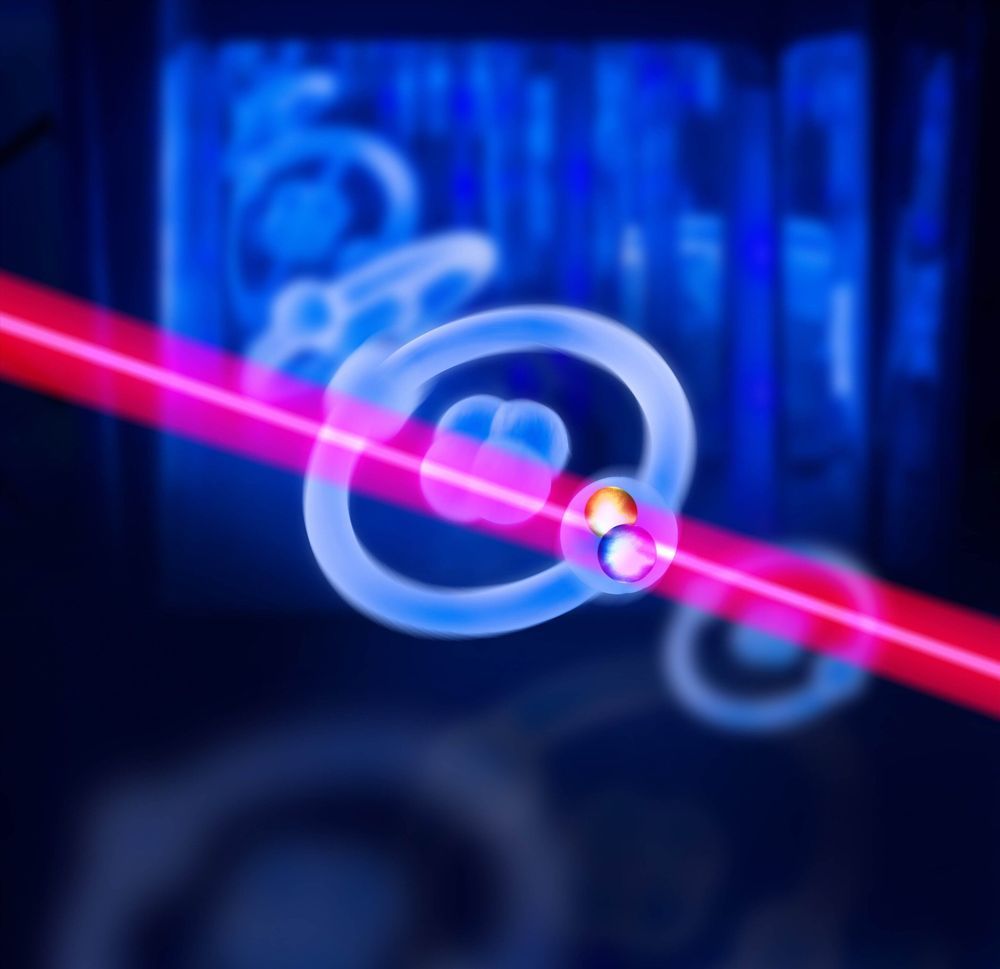
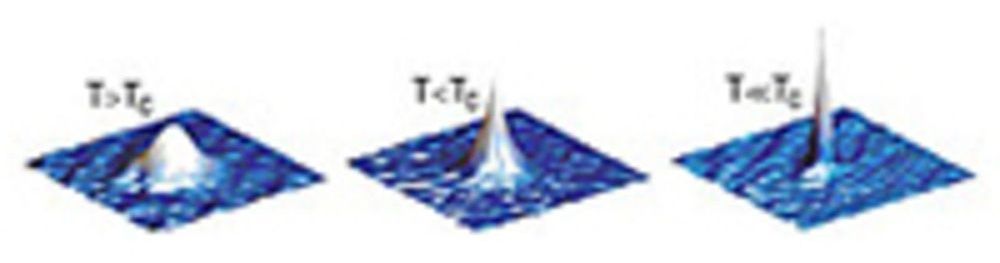
Bose-Einstein condensates (BECs) are formed if the phase space density of the atom gas becomes greater than an integer number of order one. Above this point more and more atoms occupy the lowest energy state available leading to macroscopically occupied lowest energy quantum state. A more intuitive picture is based on the wave nature of the atoms. Atoms are not point like particles. They show wave-like behavior especially at low temperature. At the transition from a thermal gas to a Bose-Einstein condensate, the size of the atomic wave packet becomes comparable to the mean distance between atoms so all atoms start to feel their common identity. In order to increase the phase space density of a laser cooled atom cloud – that is making it colder and/or more dense — one transfers the atoms into a magnetic or optical dipole trap. Further cooling is achieved by evaporative cooling taking away high energy atoms and letting the remaining ones rethermalize, quite similar to the cooling of a hot cup of coffee or tea. Typically, Bose-Einstein condensation then occurs at temperatures on the order of 0.1 µK and is observed by a characteristic change in the shape of an atom cloud that was released from the trap, illuminated with a resonant laser beam and its shadow then observed with a CCD camera.