If it fulfills its promise, quantum machine learning could transform AI.
The Canadian Space Agency (CSA) has awarded $1.85M contract to the University of Waterloo for the Quantum Encryption and Science Satellite (QEYSSat) mission.
The QEYSSat mission was one of two projects cited in the 2017 budget when it was unveiled in March of this year. In April, the government sent Innovation Science and Economic Development (ISED) Minister Navdeep Bains to the CSA’s headquarters to formally announce the funding for the QEYSSat mission along with funding for a radar instrument that will be developed for a future orbiter mission to Mars and to announce the Canadian CubeSat Project. The $80.9M of funding would be over five years.
A short history of the QEYSSat mission.
Engineers have shown that a widely used method of detecting single photons can also count the presence of at least four photons at a time. The researchers say this discovery will unlock new capabilities in physics labs working in quantum information science around the world, while providing easier paths to developing quantum-based technologies.
The study was a collaboration between Duke University, the Ohio State University and industry partner Quantum Opus, and appeared online on December 14 in the journal Optica.
“Experts in the field were trying to do this more than a decade ago, but their back-of-the-envelope calculations concluded it would be impossible,” said Daniel Gauthier, a professor of physics at Ohio State who was formerly the chair of physics at Duke. “They went on to do different things and never revisited it. They had it locked in their mind that it wasn’t possible and that it wasn’t worth spending time on.”
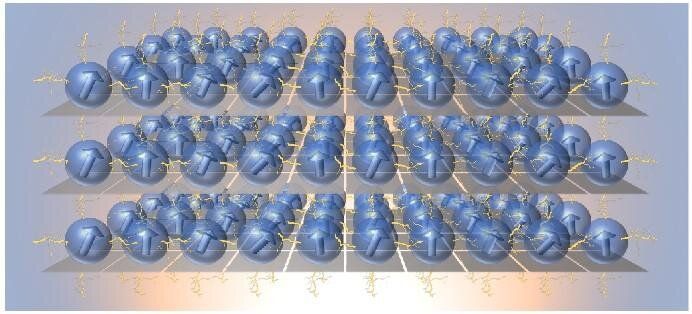
A cylindrical rod is rotationally symmetric — after any arbitrary rotation around its axis it always looks the same. If an increasingly large force is applied to it in the longitudinal direction, however, it will eventually buckle and lose its rotational symmetry. Such processes, known as “spontaneous symmetry breaking”, also occur in subtle ways in the microscopic quantum world, where they are responsible for a number of fundamental phenomena such as magnetism and superconductivity. A team of researchers led by ETH professor Tilman Esslinger and Senior Scientist Tobias Donner at the Institute for Quantum Electronics has now studied the consequences of spontaneous symmetry breaking in detail using a quantum simulator. The results of their research have recently been published in the scientific journal Science.
Phase transitions caused by symmetry breaking
In their new work, Esslinger and his collaborators took a particular interest in phase transitions — physical processes, that is, in which the properties of a material change drastically, such as the transition of a material from solid to liquid or the spontaneous magnetization of a solid. In a particular type of phase transition that is caused by spontaneous symmetry breaking, so-called Higgs and Goldstone modes appear. Those modes describe how the particles in a material react collectively to a perturbation from the outside. “Such collective excitations have only been detected indirectly so far,” explains Julian Léonard, who obtained his doctorate in Esslinger’s laboratory now works as a post-doc at Harvard University, “but now we have succeeded in directly observing the character of those modes, which is dictated by symmetry.”
Practical quantum computing has been big news this year, with significant advances being made on theoretical and technical frontiers.
But one big stumbling block has remained – melding the delicate quantum landscape with the more familiar digital one. This new microprocessor design just might be the solution we need.
Researchers from the University of New South Wales (UNSW) have come up with a new kind of architecture that uses standard semiconductors common to modern processors to perform quantum calculations.
So you want to learn how to program a quantum computer. Now, there’s a toolkit for that.
Microsoft is releasing a free preview version of its Quantum Development Kit, which includes the Q# programming language, a quantum computing simulator and other resources for people who want to start writing applications for a quantum computer. The Q# programming language was built from the ground up specifically for quantum computing.
The Quantum Development Kit, which Microsoft first announced at its Ignite conference in September, is designed for developers who are eager to learn how to program on quantum computers whether or not they are experts in the field of quantum physics.
In 2016, the Nobel Prize in Physics went to three British scientists for their work on superconductors and superfluids, which included the explanation of a rather odd phase of matter.
Now, for the first time, their discovery has a practical application – shrinking an electrical component to a size that will help quantum computers reach a scale that just might make them useful.
In a collaboration with Stanford University in the US, a team of scientists from the University of Sydney and Microsoft have used the newly found phase of matter — topological insulator — in shrinking an electrical component called a circulator 1,000 times smaller.
Yes.
Physicists in the QUTIS Quantum Biomimetics and Quantum Artificial Life research group at the Department of Physical Chemistry, University of the Basque Country in Spain have harnessed the unprecedented power of the IBM Q Cloud Quantum Computer —recently made available for public use ( IBM makes 20 qubit quantum computing machine available as a cloud service) —to reproduce the hallmark features of Darwinian life and evolution in microscopic quantum systems, proving they can efficiently encode quantum features and biological behaviors that are usually associated with living systems and natural selection.