Toggle light / dark theme

Synopsis: Making Hard Problems for Quantum Computers

Researchers have developed a computer algorithm that doesn’t solve problems but instead creates them for the purpose of evaluating quantum computers.

The desire for quantum computers stems from their potential to solve certain hard problems faster than classical computers. But those bragging rights haven’t actually been earned yet, as no experiment has shown this presumed speedup. Researchers from the University of Southern California, Los Angeles, and the Complutense University of Madrid, Spain, have devised an algorithm that generates extra hard problems that could offer quantum computers the chance to prove their worth.

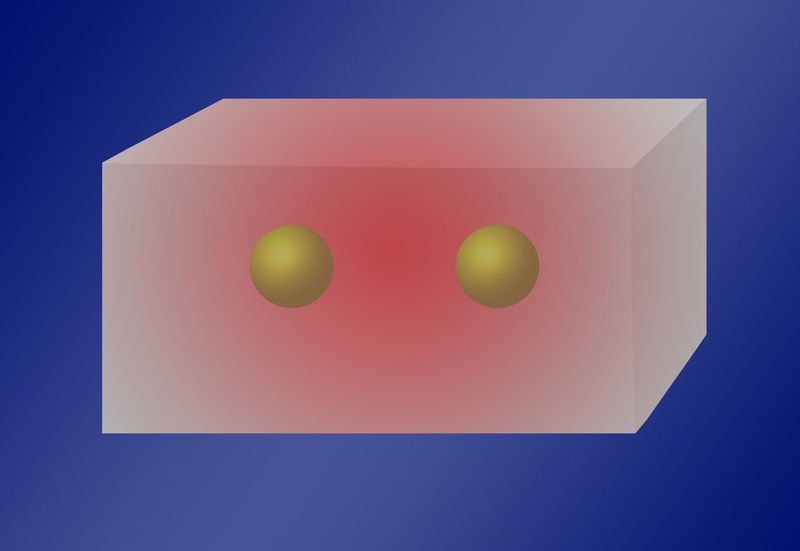
The problems that the team focused on belong to the general class of optimization problems. The main example is the Ising model, which describes the interaction of a large number of spins within a lattice. The goal is to find the ground state, which is the orientation of spins that minimizes the interaction energy. The problem is computationally hard because there are many local minima (pseudo-ground-states) that can fool a search algorithm.

The Noise at the Bottom of the Universe

Is search of the sound of silence.


To a physicist, perfect quiet is the ultimate noise. Silence your cellphone, still your thoughts, and muffle every kind of vibration, and you would still be left with quantum noise. It represents an indeterminacy deep within nature, bursts of static and inexplicable motions that cannot be gotten rid of, or made sense of. It seems devoid of meaning.

Considering how pervasive this noise is, you might presume that physicists would have a good explanation for it. But it remains one of the great unsolved problems in science. Quantum theory is silent not just on where the noise comes from, but on how exactly it enters the world. The theory’s defining equation, the Schrödinger equation, is completely deterministic. There is no noise in it at all. To explain why we observe quantum particles to be noisy, we need some additional principle.

For physicists in the Niels Bohr tradition, the act of observation itself is decisive. The Schrödinger equation defines a menu of possibilities for what a particle could do, but only when measured does the particle actually do anything, choosing at random from the menu. Identical particles will make different choices, causing the outcomes of fundamental processes to vary in an uncontrollable way. On Bohr’s view, quantum noise cannot be explained further. It is what physicist John Wheeler called “an elementary act of creation,” with no antecedents. Genesis was not a singular event in the distant past, but an ongoing process that we bring about. We create the world by observing it.

Researchers Develop A Universal Quantum Gate

The universal quantum gate to enable long distance communications with QC without degradation.


Scientists have now developed a universal quantum gate, which could become the key component in a quantum computer.

Light particles completely ignore each other. In order that these particles can nevertheless switch each other when processing quantum information, researchers at the Max Planck Institute of Quantum Optics in Garching have now developed a universal quantum gate. Quantum gates are essential elements of a quantum computer. Switching them with photons, i.e. light particles, would have practical advantages over operating them with other carriers of quantum information.

The light-saber fights of the Jedi and Sith in the Star Wars saga may well suggest something different, but light beams do not notice each other. No matter how high their intensity, they cut through each other without hindrance. When individual light particles meet, as is necessary for some applications of quantum information technology, nothing at all happens. Photons can therefore not switch each other just like that, as would have to be the case if one wanted to use them to operate a quantum gate, the elementary computing unit of a quantum computer.

Diamond coupled to carbon nanotube could be used for quantum information processing

Why synthetic diamonds are critical to the QC story.


(Phys.org)—By carefully placing a tiny piece of diamond within a few nanometers of a carbon nanotube, and then sending an electric current through the nanotube, researchers have designed a device that could one day form the building blocks of quantum information processing systems. In their recent study, they have shown that the electrified nanotube’s mechanical vibrations couple to the magnetic (or spin) properties of defects in the diamond. This coupling allows for the quantum states of the nanotube and diamond to be transferred to each other as well as to a second diamond positioned several micrometers away.

The researchers, Peng-Bo Li et al., have published a paper on the new hybrid quantum device in a recent issue of Physical Review Letters.

Diamonds and carbon nanotubes, which are both carbon allotropes, each have their own unique properties that make building such a device possible. Diamond contains defects called nitrogen-vacancy centers that emit highly coherent bright red light. The defects’ optical properties can be well-controlled so that they occupy one of two distinct states, which enables the defects to act as qubits. Carbon nanotubes, for their part, are well-known for their highly advantageous mechanical and electrical properties.

/* */