Toggle light / dark theme

From bits to p-bits: One step closer to probabilistic computing

Tohoku University scientists in Japan have developed a mathematical description of what happens within tiny magnets as they fluctuate between states when an electric current and magnetic field are applied. Their findings, published in the journal Nature Communications, could act as the foundation for engineering more advanced computers that can quantify uncertainty while interpreting complex data.

Classical computers have gotten us this far, but there are some problems that they cannot address efficiently. Scientists have been working on addressing this by engineering computers that can utilize the laws of quantum physics to recognize patterns in . But these so-called quantum computers are still in their early stages of development and are extremely sensitive to their surroundings, requiring extremely low temperatures to function.

Now, scientists are looking at something different: a concept called probabilistic computing. This type of computer, which could function at , would be able to infer potential answers from complex input. A simplistic example of this type of problem would be to infer information about a person by looking at their purchasing behavior. Instead of the computer providing a single, discrete result, it picks out patterns and delivers a good guess of what the result might be.

How the Five National Quantum Information Science Research Centers harness the quantum revolution

The NQISRCs integrate state-of-the-art DOE facilities, preeminent talent at national laboratories and U.S. universities, and the enterprising ingenuity of U.S. technology companies.

As a result, the centers are pushing the frontier of what’s possible in quantum computers, sensors, devices, materials and much more.

Physicists entangle more than a dozen photons efficiently

Physicists at the Max Planck Institute of Quantum Optics have managed to entangle more than a dozen photons efficiently and in a defined way. They are thus creating a basis for a new type of quantum computer. Their study is published in Nature.

The phenomena of the quantum world, which often seem bizarre from the perspective of the common everyday world, have long since found their way into technology. For example, entanglement: a quantum-physical connection between particles that links them in a strange way over arbitrarily long distances. It can be used, for example, in a quantum computer—a computing machine that, unlike a conventional computer, can perform numerous mathematical operations simultaneously. However, in order to use a quantum computer profitably, a large number of entangled particles must work together. They are the for calculations, so-called qubits.

“Photons, the particles of light, are particularly well suited for this because they are robust by nature and easy to manipulate,” says Philip Thomas, a doctoral student at the Max Planck Institute of Quantum Optics (MPQ) in Garching near Munich. Together with colleagues from the Quantum Dynamics Division led by Prof. Gerhard Rempe, he has now succeeded in taking an important step towards making usable for technological applications such as quantum computing: For the first time, the team generated up to 14 entangled photons in a defined way and with high efficiency.

Baidu Releases Superconducting Quantum Computer and World’s First All-Platform Integration Solution, Making Quantum Computing Within Reach

“Everyone can quantum.”

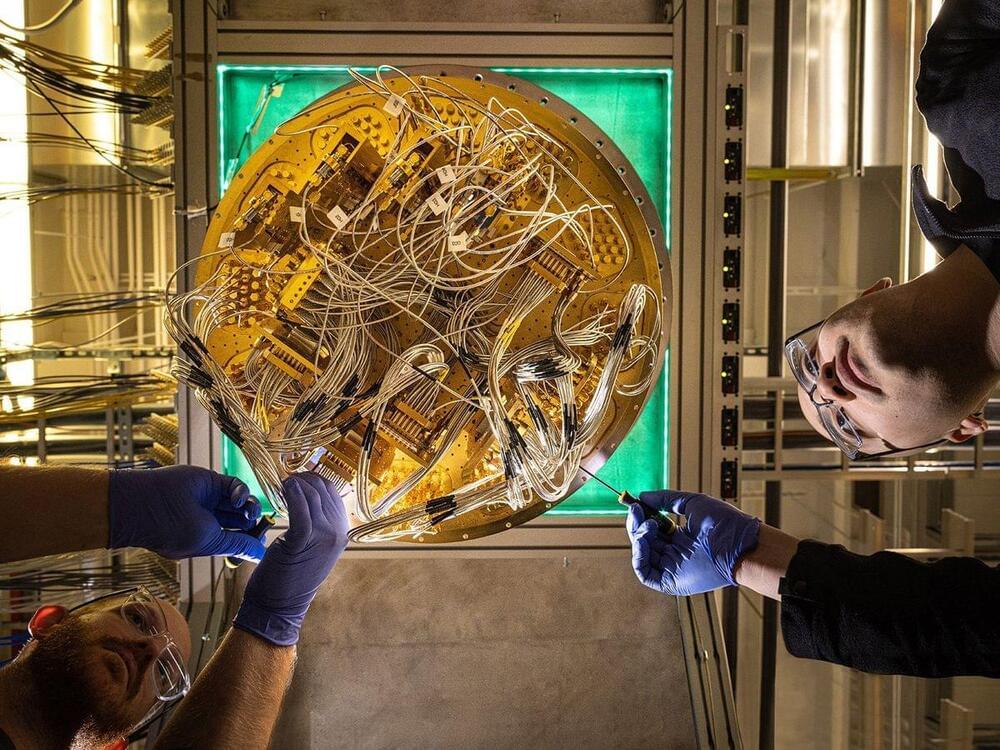
Chinese multinational technology company Baidu just released its first quantum computer on Thursday. The first superconducting quantum computer, “Qian Shi” can integrate hardware, software, and many applications. Baidu also introduced the world’s first all-platform quantum hardware-software integration solution — Liang Xi — that provides access to various quantum chips via mobile app, PC, and cloud.

Qian Shi is expected to solve data that a standard computer cannot calculate and problems that cannot be solved. This development is also thought to be a breakthrough in artificial intelligence, computational biology, material simulation, and financial technology.

Qian Shi offers a stable and substantial quantum computing service to the public with high-fidelity 10 quantum bits (qubits) of power. Apart from Qian Shi, Baidu has recently developed the design of a 36-qubit superconducting quantum chip.

Researchers demonstrate error correction in a silicon qubit system

Researchers from RIKEN in Japan have achieved a major step toward large-scale quantum computing by demonstrating error correction in a three-qubit silicon-based quantum computing system. This work, published in Nature, could pave the way toward the achievement of practical quantum computers.

Quantum computers are a hot area of research today, as they promise to make it possible to solve certain important problems that are intractable using conventional computers. They use a completely different architecture, using superimposition states found in rather than the simple 1 or 0 binary bits used in conventional computers. However, because they are designed in a completely different way, they are very sensitive to environmental noise and other issues, such as decoherence, and require error correction to allow them to do precise calculations.

One important challenge today is choosing what systems can best act as “qubits”—the basic units used to make quantum calculations. Different candidate systems have their own strengths and weaknesses. Some of the popular systems today include superconducting circuits and ions, which have the advantage that some form of error correction has been demonstrated, allowing them to be put into actual use albeit on a small scale. Silicon-based quantum technology, which has only begun to be developed over the past decade, is known to have an advantage in that it utilizes a semiconductor nanostructure similar to what is commonly used to integrate billions of transistors in a small chip, and therefore could take advantage of current production technology.

Turning Quantum States into Music at Australia’s First Ever Qiskit Hackathon

By Robert Davis and Desiree Vogt-Lee

Quantum computing is notoriously counterintuitive; it challenges us to grapple with concepts that can be difficult to imagine. We often rely on our sense of sight to make those concepts a little easier to grasp, by representing quantum information with visualization models like the Q-sphere or the circuit diagram, and even creative visual arts projects like the recent Quantum Circuit Disks series. But what happens when we represent quantum using not only imagery, but also sound?

One team of Australian researchers is showing the world exactly what that looks like with a project that turns quantum circuits into music videos. That project, which the creators have named “qMuVi” (“quantum Music Video”), earned the titles of both 1st place winner and Community Choice winner at the recent Qiskit Hackathon Melbourne, a hybrid in-person and virtual event held in early July that marked the first ever Qiskit Hackathon in Australia. The event brought together 35 participants over four days to learn about quantum computing and Qiskit, and to use their new knowledge to hack together a diverse array of novel quantum computing projects. The event as a whole was a tremendous success. But before we talk about that, let’s take a closer look at that winning quantum music videos project.

Diamond Quantum Sensor Measures Currents in the Heart at Millimeter Resolution

Many heart problems, including tachycardia and fibrillation, mainly originate from imperfections in the way electric currents propagate through the heart. Unfortunately, it is difficult for doctors to study these imperfections. This is because measuring these currents involves highly invasive procedures and exposure to X-ray radiation.

Luckily, there are other options. For example, magnetocardiography (MCG) is a promising alternative approach to measuring heart currents indirectly. The technique involves sensing minute changes in the magnetic field near the heart caused by cardiac currents. This can be done in a completely contactless manner. To this end, various types of quantum sensors suitable for this purpose have been developed. However, their spatial resolution is limited to centimeter scales, which is not good enough to detect cardiac currents that propagate at millimeter scales. Furthermore, each of these sensors has a fair share of its practical limitations, such as size and operating temperature.

In a new study published today (August 23, 2022) in Communications Physics, a team of scientists developed a novel setup to perform MCG at higher resolutions. Their approach is based on a diamond quantum sensor comprising nitrogen vacancies, which act as special magnetic “centers” that are sensitive to the weak magnetic fields produced by heart currents. The researchers were led by Associate Professor Takayuki Iwasaki of Tokyo Institute of Technology (Tokyo Tech), Japan.

/* */