Toggle light / dark theme

Quantum Temporal Mechanics: Consciousness and Time

In the study of temporal mechanics, we have to venture beyond the confines of traditional objective science to incorporate the profound role of consciousness in shaping our understanding of time. The evidence and theories discussed throughout my upcoming paper (to be released as a Kindle eBook) suggest that the flow of time is not simply a physical phenomenon dictated by the laws of thermodynamics or the spacetime continuum, but rather a deeply psychological one, intertwined with consciousness itself. Time, as we experience it, emerges from our awareness of ongoing change—a continuous psychological construct that weaves our perceptions into a coherent narrative of past, present, and future.

The implications of this perspective are far-reaching. If the flow of time is indeed a function of consciousness, then time cannot be fully understood without accounting for the observer—the conscious entity whose perception of change gives rise to the experience of time. This challenges the classical notion of time as a separate, objective entity and places consciousness as a central player in the multidimensional matrix of reality.

Scientists Turn a Quantum Computer Into a Time Crystal That Never Stops

Researchers have managed to coax a quantum computer to pulse with a rhythm unlike any before—a rhythm that defies conventional physics. For the first time, scientists have transformed a quantum processor into a robust time crystal, a bizarre state of matter that ticks endlessly without external energy.

This achievement, the work of physicists from China and the United States, could mark a turning point for quantum computing. By stabilizing the delicate systems that underpin this cutting-edge technology, the experiment hints at a path toward practical quantum computers capable of solving problems far beyond the reach of traditional machines.

Unlike conventional phases, such as solids or liquids, time crystals exist in a state of perpetual motion. Let me explain.

Quantum Breakthrough: Atoms held in quantum superposition for more than 23 minutes

Quantum mechanics, a realm of the incredibly small, is often characterized by its paradoxical nature. One such paradox is the concept of superposition, where a quantum particle can exist in multiple states simultaneously. These delicate states, however, are notoriously fragile, often collapsing into a single, definite state within mere fractions of a second. Yet, a recent breakthrough has pushed the boundaries of quantum stability, achieving a record-breaking 23-minute lifespan for a specific type of superposition known as a cat state.

The term “cat state” is a whimsical reference to Schrödinger’s famous thought experiment, where a cat is placed in a box with a device that could randomly kill it. Until the box is opened, the cat is both alive and dead, a superposition of two states. In quantum mechanics, cat states manifest when a quantum object, such as an atom or a photon, exists in multiple states simultaneously, defying classical intuition.

While researchers have previously created cat states in laboratories, these states have been fleeting, quickly succumbing to the disruptive influence of their environment. However, a team led by Zheng-Tian Lu at the University of Science and Technology of China has managed to extend the lifespan of a cat state dramatically. They achieved this feat by manipulating a cloud of 10,000 ytterbium atoms, cooled to near absolute zero and trapped by laser light. By carefully controlling the atoms’ quantum states, the researchers were able to induce a superposition where each atom existed in two distinct spin states simultaneously.

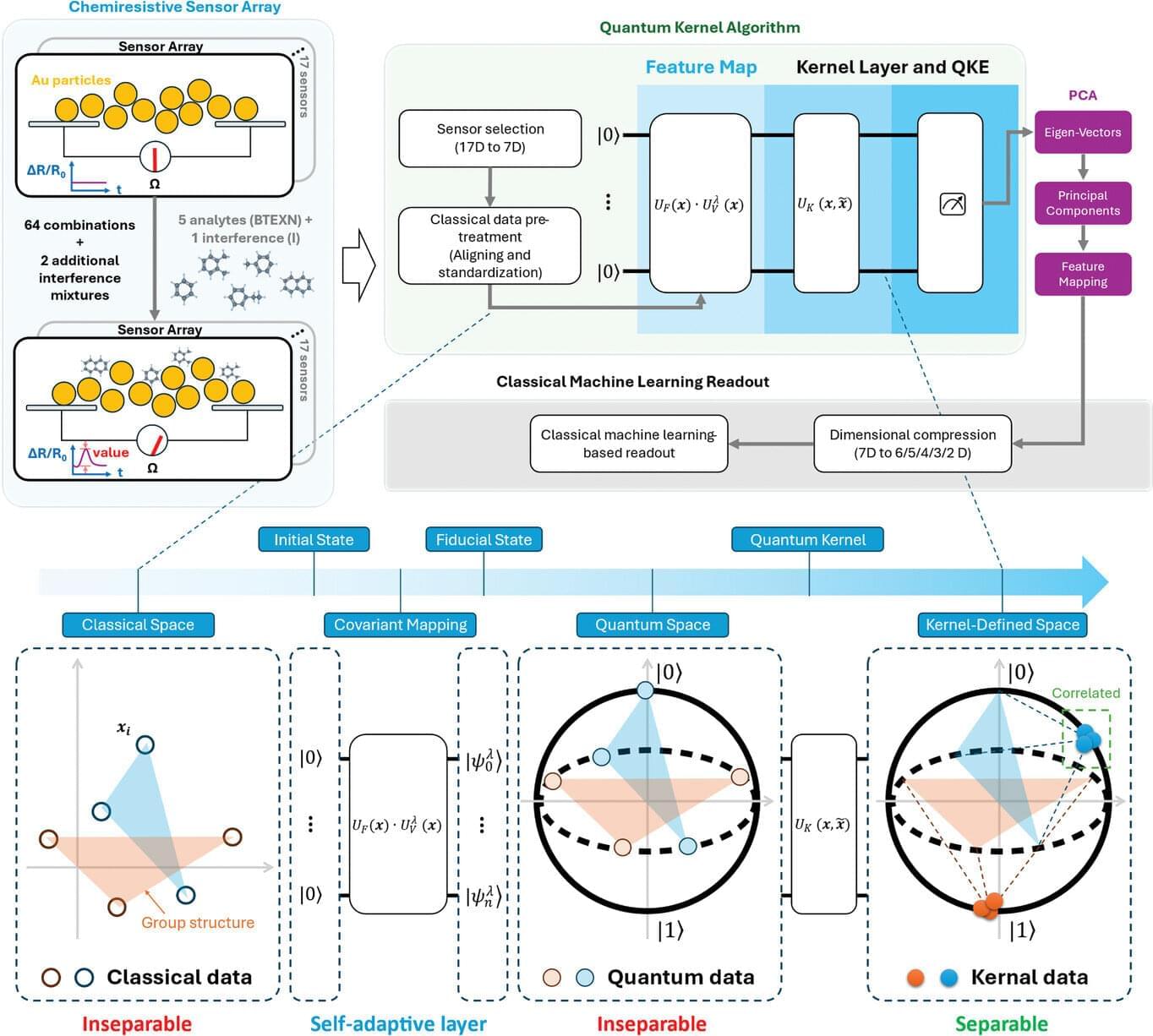
Scientists Crack Quantum Computing Complexity With Revolutionary Hybrid Design

Quantum computers operate using quantum gates, but the complexity and large number of these gates can diminish their efficiency. A new “hybrid” approach reduces this complexity by utilizing natural system interactions, making quantum algorithms easier to execute.

This innovation helps manage the inherent “noise” issues of current quantum systems, enhancing their practical use. The approach has been effectively demonstrated with Grover’s algorithm, enabling efficient searches of large datasets without extensive error correction.

Challenges of Quantum Computing.

Atoms moved from one place to another via quantum tunneling in a first

In order to achieve the tunneling of atoms, the researchers used three optical tweezers and arranged them in a series. Then they introduced ultracold fermionic atoms (atoms that are cooled down to absolute zero temperatures) in this arrangement.

Using the three tweezers as traps, the researchers were able to control the tunneling rate of atoms by changing the distance between the traps. This approach allowed the researchers to successfully transfer atoms between the two outer tweezers.

“We observe a smooth and high-efficiency transfer of atoms between the two outer traps, with a very low population remaining in the central trap,” the researchers note in their study.

Atoms transferred between optical tweezers via quantum tunneling in a first

Researchers at the University of Twente, Netherlands, have made an advancement in bioprinting technology that could transform how we create vascularized tissues. Their innovative bioink, recently featured in Advanced Healthcare Materials, introduces a way to precisely guide the growth and organization of tiny blood vessels within 3D-bioprinted tissues. The tiny blood vessels mimic the intricate networks found in the human body.

3D-printed organs have the potential to revolutionize medicine by providing solutions for organ failure, and tissue damage and developing new therapies. But a major challenge is ensuring these printed tissues receive enough nutrients and oxygen, which is critical for their survival and function. Without blood vessels, these tissues can’t efficiently obtain nutrients or remove waste, limiting their effectiveness. Therefore, the ability to 3D-bioprint blood vessels is a crucial advancement.

Tissue engineers could already position blood vessels during the bioprinting process, but these vessels often remodel unpredictably when cultured in the lab or implanted in the body, reducing the effectiveness of the engineered tissue. The programmable bioink developed by the University of Twente team addresses this issue by providing dynamic control over vessel growth and remodeling over time. This opens new possibilities for creating engineered tissues with long-term functionality and adaptability.

A pathway toward new quantum devices: Electrically defined quantum dots in zinc oxide

Researchers have successfully created electrically defined quantum dots in zinc oxide (ZnO) heterostructures, marking a significant milestone in the development of quantum technologies.

Details of their breakthrough were published in the journal Nature Communications on November 7, 2024.

Quantum dots, tiny semiconductor structures that can trap electrons in nanometer-scale spaces, have long been studied for their potential to serve as qubits in quantum computing. These dots are crucial for quantum computing because they allow scientists to control the behavior of electrons, similar to how a conductor might control a current of water flowing through pipes.

Making quantum physics easier to digest in schools: Experts encourage focus on two-state systems

A team of physics educators from Italy, Hungary, Slovenia and Germany is focusing on a new approach to teaching quantum physics in schools. Traditional classroom teaching has tended to focus on presenting the history of the origins of quantum physics, which often poses problems for learners.

Using the quantum measurement process as an example, the researchers have now published their first empirical findings on learning —based on two-state systems—in Physical Review Physics Education Research.

The researchers, including physics education specialist Professor Philipp Bitzenbauer from Leipzig University, concentrate on what are known as qubits. These are two-state systems, the simplest and at the same time most important quantum systems that can be used to describe many situations. Controlling and manipulating these qubits plays a central role in modern quantum technologies.

/* */