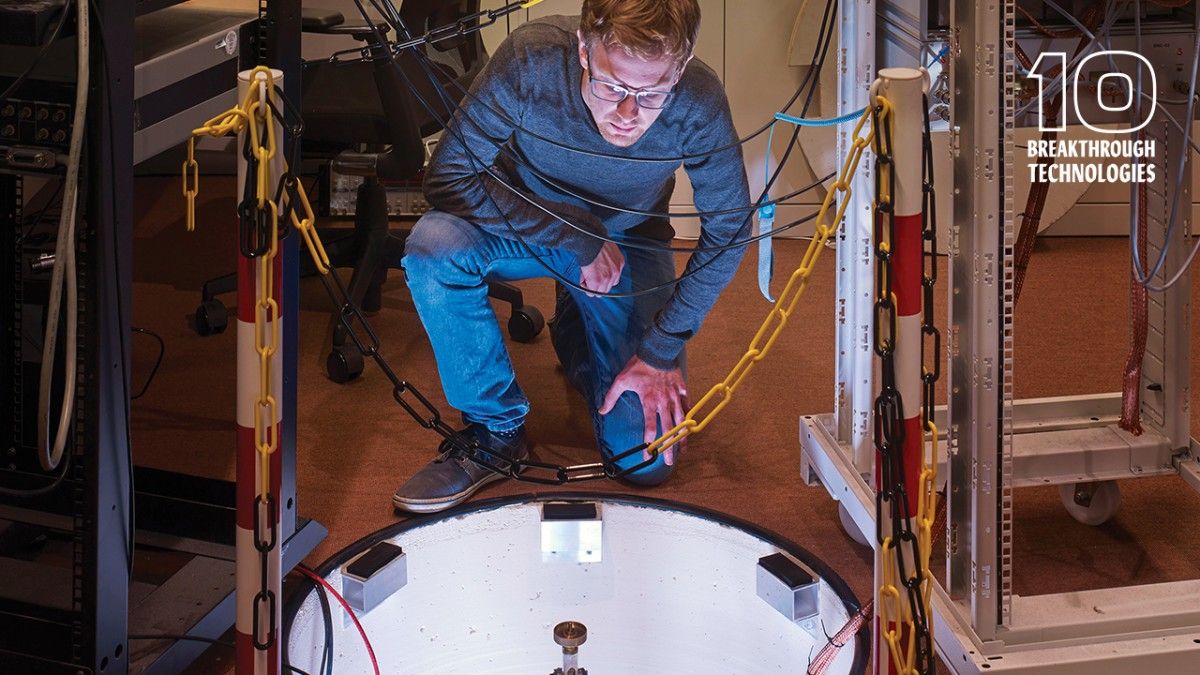
Advances at Google, Intel, and several research groups indicate that computers with previously unimaginable power are finally within reach.
Availability: 4–5 years.

I believe that this is a stretch for me. However, wouldn’t be nice if we could. Imagine Steve Jobs could still run Apple, we could hear Einstein and Bhor debate, etc. Again cool concept but at this stage hard to believe it will be real until we learn more about Quantum Biosystem in the mix; and even then unlikely. Nonetheless, good luck with it MIT.
Imagine debating the interpretation of a Shakespearean sonnet and being able to clarify its meaning with the bard himself. Or sitting in history class and being able to ask George Washington questions about the Constitution, no soul-conjuring witchcraft required.
In the next decade, advancing AI technology will allow us to learn from the dead first-hand. New chatbot programs are being developed to keep our knowledge active after our physical being passes away.
Early research in this topic already allows us to simulate dialogues with the dead. For example, Russian startup Luka has created a simulacrum of the notoriously private musician Prince. This AI-powered chatbot draws from song lyrics and rare interview snippets to let users instant message with a vision of the late singer, who died in 2016.
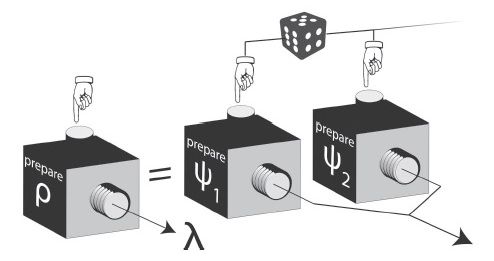
(Phys.org)—Physicists are getting a little bit closer to answering one of the oldest and most basic questions of quantum theory: does the quantum state represent reality or just our knowledge of reality?
George C. Knee, a theoretical physicist at the University of Oxford and the University of Warwick, has created an algorithm for designing optimal experiments that could provide the strongest evidence yet that the quantum state is an ontic state (a state of reality) and not an epistemic state (a state of knowledge). Knee has published a paper on the new strategy in a recent issue of the New Journal of Physics.
While physicists have debated about the nature of the quantum state since the early days of quantum theory (with, most famously, Bohr being in favor of the ontic interpretation and Einstein arguing for the epistemic one), most modern evidence has supported the view that the quantum state does indeed represent reality.

A team of researchers led by physics professor Immanuel Bloch has experimentally realized an exotic quantum system which is robust to mixing by periodic forces (Nature Physics, “Periodically driving a many-body localized quantum system”).
When James Bond asks the barkeeper for a Martini (“shaken, not stirred”), he takes it for granted that the ingredients of the drink are miscible. If he were to place the order in a bar in the quantum realm, however, Agent 007 might be in for a surprise!

Published: 2012/11/01 | ISBN: 311027325X | PDF | 349 pages | 12.06 MB
The subject of this book is theory of quantum system presented from information science perspective. The central role is played by the concept of quantum channel and its entropic and information characteristics. Quantum information theory gives a key to understanding elusive phenomena of quantum world and provides a background for development of experimental techniques that enable measuring and manipulation of individual quantum systems. This is important for the new efficient applications such as quantum computing, communication and cryptography. Research in the field of quantum informatics, including quantum information theory, is in progress in leading scientific centers throughout the world. This book gives an accessible, albeit mathematically rigorous and self-contained introduction to quantum information theory, starting from primary structures and leading to fundamental results and to exiting open problems.
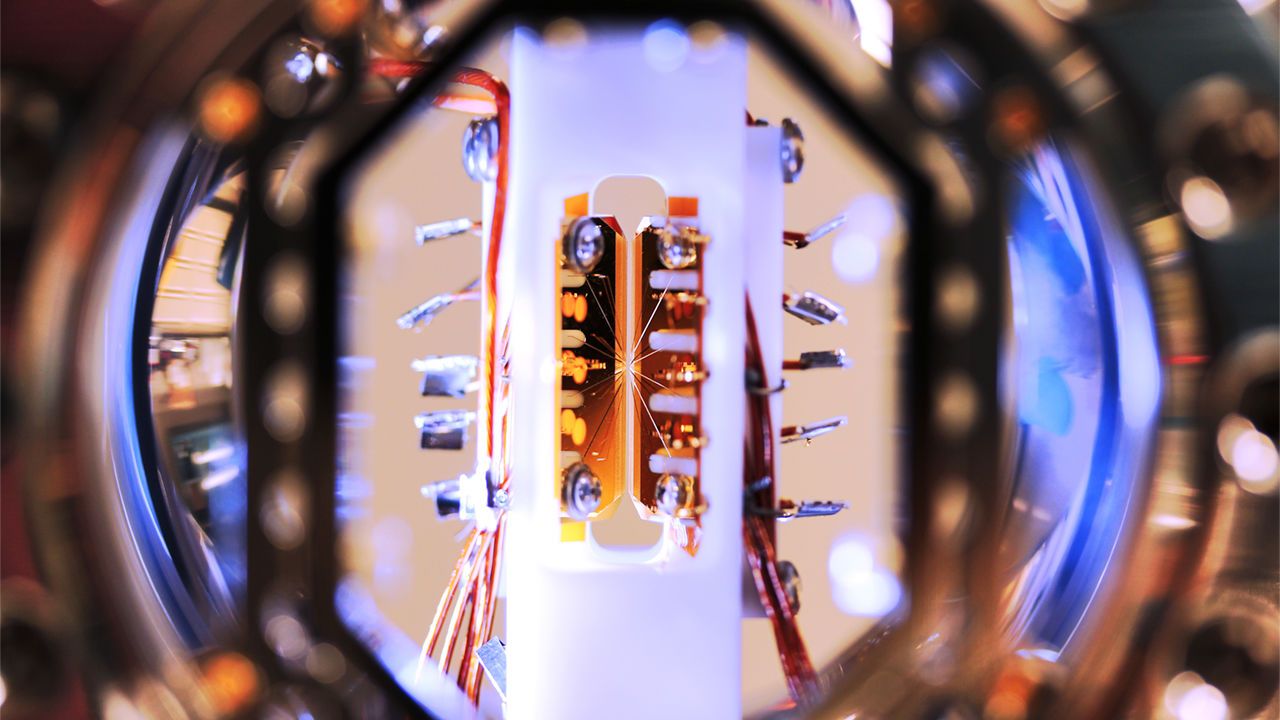

More on the QC Blueprint which enables others to use as a reference when building a QC.
According to Prof Winfried Hensinger of the University of Sussex in the United Kingdom, he and his team have the first practical design for a quantum computer. Like millions of others, I have struggled to come to an understanding of quantum mechanics and how a quantum computer might work.
It would use qubits rather than standard on/off or 1 and 0 bits used in traditional computers. A qubit can have a state of anywhere between zero and one, including all the “states” in between. Theoretically, a quantum computer can perform a very large number of calculations simultaneously using the ideas of super positioning and quantum entanglement. The theory is that all the necessary calculations are carried out at virtually the same time, e.g. working out all the factors of a very large number. This kind of problem can take a regular computer quite a while.
Prof Hensinger claims he has produced a “how to build it” template, published in Science Advances journal, with a scalable construction plan which you can read here: www.advances.sciencemag.org/content/3/2/e1601540.full. It involves ions, long wave radiation, overlapping fields, vacuum chambers and other pieces of exacting technology. To be honest, I have never quite understood how you program in the questions and read the answers from quantum computers.
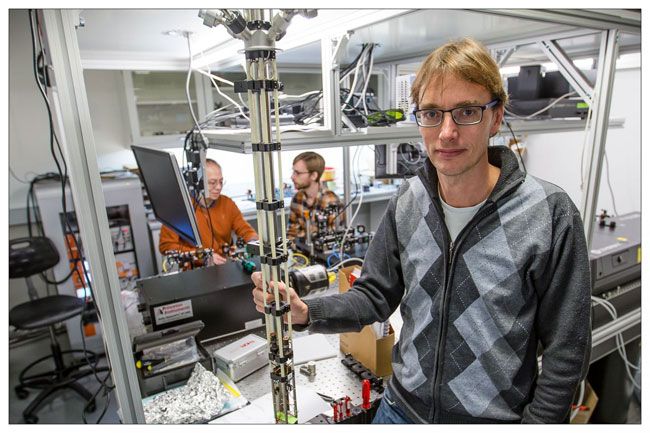
Sharing in case folks would like to listen in.
Microsoft’s Station Q was founded in 2006. The focus of the team has always been topological quantum computing. By taking a full systems architecture approach, we have reached the point where we now able to start engineering a scalable quantum computer. The goal is to be able to solve major problems in areas of interest (e.g., Chemistry, Materials and Machine Learning). This talk will focus on the types of applications that we will be trying to solve as well as the unique approach to quantum computation that we’ve developed. For reference, see:
Current Approach: https://arxiv.org/abs/1610.05289 Chemistry Application: https://arxiv.org/abs/1605.03590 Other papers: https://arxiv.org/find/all/1/all:+wecker_d/0/1/0/all/0/1