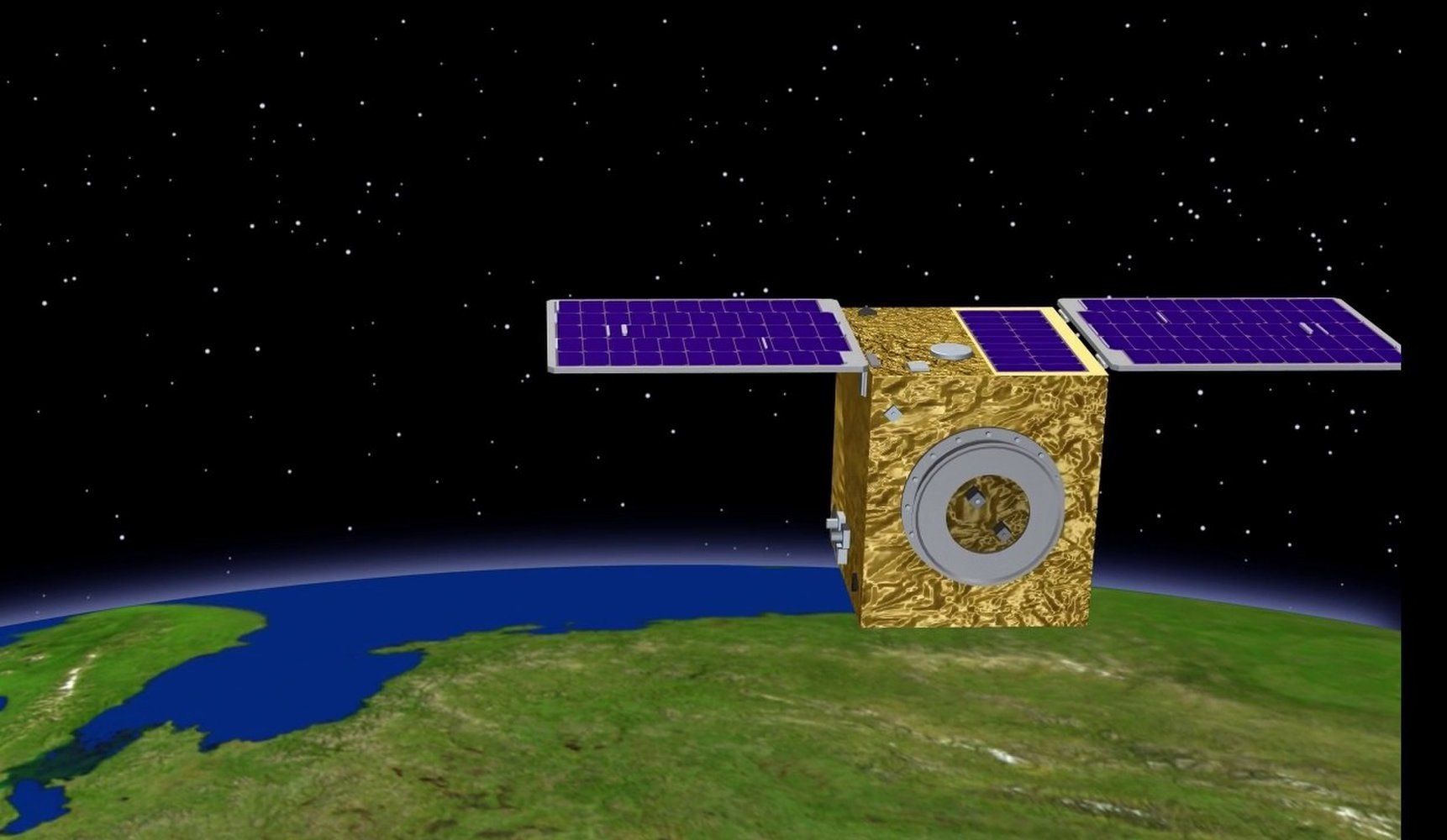
The SOCRATES microsatellite securely transmitted data to a receiver on Earth using a process called Quantum Key Distribution, marking the first time the technique has used between the ground and space.
The current leader in quantum computing just announced the successful creation of a 51-qubit quantum computer at a recent conference in Moscow.
Achieving liquid light at room temperature will boost research into quantum hydrodynamics.
In the study, researchers from the Universities of York, Munich, and Cardiff explored the phenomenon known as backflow in particles that are not ‘free.’
Free quantum particles exist without any external forces, but the researchers note that this setting is idealized.
Through the new analysis, the researchers estimated the strength of backflow and found that it applies to all quantum particles, not just free ones.

You are very lucky that you ended up about the size that you are today, somewhere between one and ten feet tall and weighing somewhere between one and one thousand pounds. This is a very good size. Not to body shame, but if you were, say, a quadrillion times shorter and weighed a nonillion times less (that’s one followed by 30 zeros), that would be very inconvenient for you. Everything would be very inconvenient for you.
One thing you take for granted as a human-sized thing, for example, is that when you push things, they move forward. But a team of researchers realized that this is not necessarily the case if you zoom into the quantum world, where particles might decide to go backwards, no matter what kind of outside force you put on them.
Researchers from China successfully teleported a photon from Earth to a satellite 500 km away. The work is an essential step towards establishing a global-scale quantum internet.
Not long ago, in the early 1990s, scientists only speculated that teleportation using quantum physics could be possible. Since then, the process has become a standard operation in quantum optics labs around the world. In fact, just last year, two separate teams conducted the world’s first quantum teleportation outside of a laboratory.
Interesting…
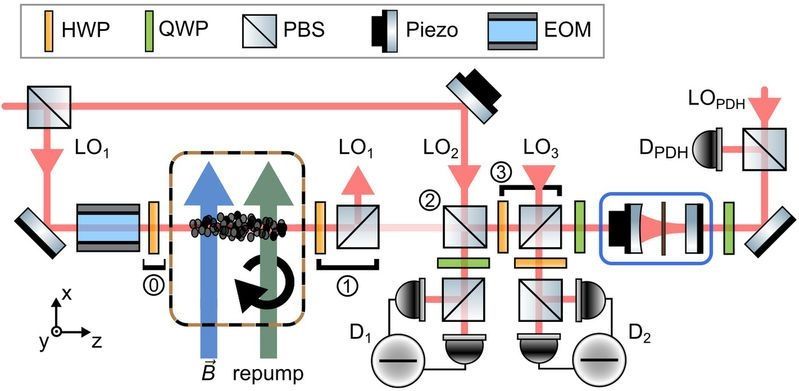
Quantum mechanics dictates that a continuous measurement of the position of an object imposes a random quantum back-action (QBA) perturbation on its momentum. This randomness translates with time into position uncertainty, thus leading to the well known uncertainty on the measurement of motion1, 2. As a consequence of this randomness, and in accordance with the Heisenberg uncertainty principle, the QBA3, 4 puts a limitation—the so-called standard quantum limit—on the precision of sensing of position, velocity and acceleration. Here we show that QBA on a macroscopic mechanical oscillator can be evaded if the measurement of motion is conducted in the reference frame of an atomic spin oscillator6, 7. The collective quantum measurement on this hybrid system of two distant and disparate oscillators is performed with light. The mechanical oscillator is a vibrational ‘drum’ mode of a millimetre-sized dielectric membrane, and the spin oscillator is an atomic ensemble in a magnetic field9, 10. The spin oriented along the field corresponds to an energetically inverted spin population and realizes a negative-effective-mass oscillator, while the opposite orientation corresponds to an oscillator with positive effective mass. The QBA is suppressed by −1.8 decibels in the negative-mass setting and enhanced by 2.4 decibels in the positive-mass case. This hybrid quantum system paves the way to entanglement generation and distant quantum communication between mechanical and spin systems and to sensing of force, motion and gravity beyond the standard quantum limit.
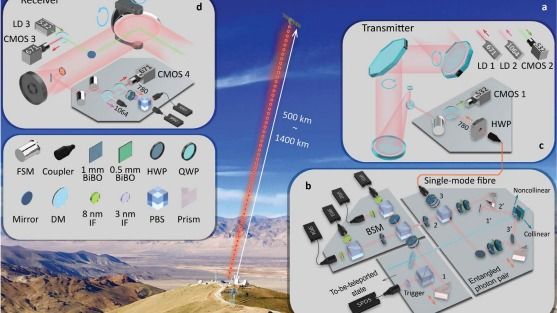

Humanity is advancing rapidly towards a place where the news sounds an awful lot like science fiction. In fact, yesterday, Chinese scientists reported that they “teleported” a photon over hundreds of miles using a “quantum satellite.” But this isn’t Star Trek. It’s the real world.
Which happens to mean it’s a lot less exciting than Star Trek-style teleportation, unfortunately. But it’s still really cool, I promise!
The benefits of rejuvenation biotechnologies would extend to the whole human society. #aging
Rejuvenation isn’t good just for individuals and the people close to them. It is good for society as a whole, for a number of reasons. These reasons—which I will now proceed to discuss—should be enough make rejuvenation research a top priority for humanity in its entirety.
Ever heard anyone lamenting that the great minds of history are no longer with us? That we could certainly do with all the Einsteins, Montalcinis, Fermis, Curies, etc, living longer? And have you ever felt saddened when a great mind of our time died? You probably did, or at the very least know someone who did.
Just imagine how much faster would science and progress march if our greatest physicists, doctors, engineers, philantrophists, etc, could live an indefinitely long life. Remember that we’re not talking about a longer life spent in decrepitude and sickness: We’re talking about a 200-year-old Einstein with the experience of two centuries but the physical and mental agility of a 25-year-old. If he was still alive, maybe he could’ve figured out how to unify general relativity with quantum mechanics—something that has been eluding all efforts for decades. Every time a great person (or any person, for that matter) dies, their particular experience is lost forever. Never mind that there are other experts, or that similar knowledge is found in books; it’s not even remotely the same. Rejuvenation would allow us to benefit from the knowledge and wisdom of the best among us for centuries on end.