Big data budgets now rival CRM software.
Right now it’s easiest to think about an artificial intelligence algorithm as a specific tool, like a hammer. A hammer is really good at hitting things, but when you need a saw to cut something in half, it’s back to the toolbox. Need a face recognized? Train an facial recognition algorithm, but don’t ask it to recognize cows.
Alphabet’s AI research arm, DeepMind, is trying to change that idea with a new algorithm that can learn more than one skill. Having algorithms that can learn multiple skills could make it far easier to add new languages to translators, remove bias from image recognition systems, or even have algorithms use existing knowledge to solve new complex problems. The research published in Proceedings of the National Academy of Sciences this week is preliminary, as it only tests the algorithm on playing different Atari games, but this research shows multi-purpose algorithms are actually possible.
The problem DeepMind’s research tackles is called “catastrophic forgetting,” the company writes. If you train an algorithm to recognize faces and then try to train it again to recognize cows, it will forget faces to make room for all the cow-knowledge. Modern artificial neural networks use millions of mathematic equations to calculate patterns in data, which could be the pixels that make a face or the series of words that make a sentence. These equations are connected in various ways, and are so dependent on some equations that they’ll begin to fail when even slightly tweaked for a different task. DeepMind’s new algorithm identifies and protects the equations most important for carrying out the original task, while letting the less-important ones be overwritten.
Scientists say it’s possible to build a new type of self-replicating computer that replaces silicon chips with processors made from DNA molecules, and it would be faster than any other form of computer ever proposed — even quantum computers.
Called a nondeterministic universal Turing machine (NUTM), it’s predicted that the technology could execute all possible algorithms at once by taking advantage of DNA’s ability to replicate almost perfect copies of itself over billions of years.
The basic idea is that our current electronic computers are based on a finite number of silicon chips, and we’re fast approaching the limit for how many we can actually fit in our machines.
My new article for Psychology Today on my federal audit and the coming day of eliminating taxes because of technology.
With all that in mind—and the $7500 they say I owe them—they know I wouldn’t hire an accountant at $150 an hour to deal with the thousand-plus receipts, payments, and supposed car log entries I made last year—since the amount I’d spend on an accountant in the San Francisco Bay Area might easily end up more than $7500. They also surely know I won’t do it myself, since it’s definitely not worth my own time.
They have me in a pickle—even though it’s more than obvious my busy self probably has far more in write-offs than I even bothered to report in the first place. In fact—given how perturbed I feel at the IRS and its 82,000 full time employees this moment, if it was just economical, I’d re-file to get more of my earnings back. But in the twisted game they created in their 74,000+ page tax code, it’s not worth it.
Their way of operating has made me suspect one of their main algorithms on whether to audit people resembles mafia morality:
The goal of transcending flesh is an old fetish. Yogis meditated and fasted for eons in order to rise above our ‘meat casing,’ performing painful ablutions and inventing kriyas, intense breathing exercises that are physiologically indistinct from intentional hyperventilation. The goal of many religions, from some forms of Tibetan Buddhism to numerous strains of Christianity and Islam, is all about letting the spirit soar free.
While language changes, pretensions remain. Today we talk about ‘uploading consciousness’ to an as of yet discovered virtual cloud. Artificial intelligence is only moments away, so the story goes, with experts weighing in on the ethical consequences of creating machines void of emotional response systems. In this view consciousness, itself a loaded and mismanaged term, is nothing more than an algorithm waiting to be deciphered. Upon cracking the code, immortality awaits.
Of course others are more grounded. The goal of extending life to 150 years includes the body by default, though the mind is still championed above all else. Yet we seem to age in opposing directions by design. At forty-one little has changed in how I think about myself, yet my body is decaying: a post-knee surgery creek here, a perpetual tight shoulder there. It certainly feels like a slowly approaching transition, even if that, like much of life, is an illusion.
One thing is clear: the way in which we organize the economy and society will change fundamentally. We are experiencing the largest transformation since the end of the Second World War; after the automation of production and the creation of self-driving cars the automation of society is next. With this, society is at a crossroads, which promises great opportunities, but also considerable risks. If we take the wrong decisions it could threaten our greatest historical achievements.
We are in the middle of a technological upheaval that will transform the way society is organized. We must make the right decisions now.
(Tech Xplore)—Can you picture indoor security robots strolling around your workplace tomorrow? You might balk at the idea of militaristic rolling machines making people feel uncomfortable as they hunt for thieves and blunderers. Well Cobalt Robotics has come up with a different kind of indoor security robot.
The robots made news this week when IEEE Spectrum posted a video on Wednesday to show what they look like and what they do.
These are mobile robots designed to work alongside human guards. “Cobalt’s robots gather data using sensors like cameras and lidar, and process the information using machine-learning algorithms to detect and flag anomalies,” said IEEE Spectrum.
Coca-Cola is ditching flesh and blood creatives in favour of software algorithms in an experiment to see whether AI bots have what it takes to beat their human masters.
Mariano Bosaz, Coca-Cola’s global senior digital director, is spearheading the move as part of wider efforts to push the bounds of technology to see what they are capable of.
In an interview with Adweek at Mobile World Congress in Barcelona Bosaz said: “Content creation is something that we have been doing for a very long time—we brief creative agencies and then they come up with stories that they audio visualize and then we have 30 seconds or maybe longer. In content, what I want to start experimenting with is automated narratives.”
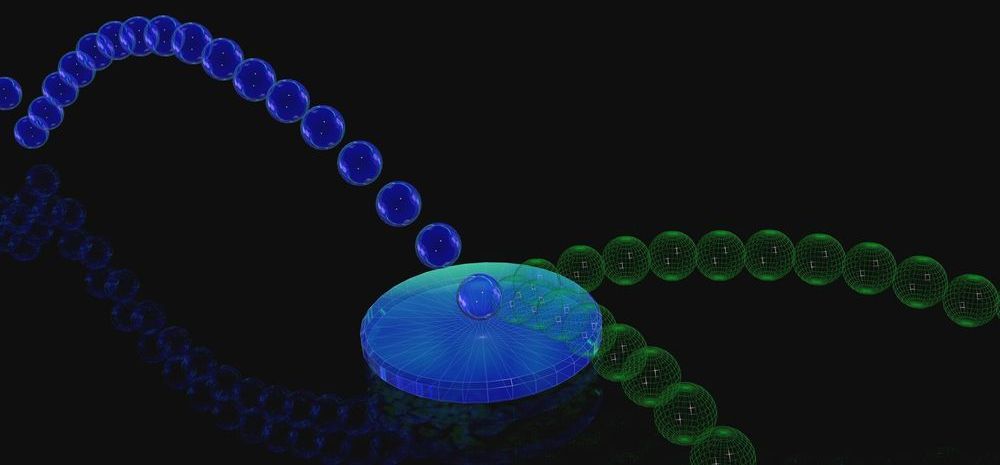
How do molecules rotate in a solvent? Answering this question is complicated, since molecular rotation is perturbed by a very large number of surrounding atoms. For a long time, large-scale computer simulations have been the main approach to model molecule-solvent interactions. However, they are extremely time consuming and sometimes infeasible. Now, Mikhail Lemeshko from the Institute of Science and Technology Austria (IST Austria) has proven that angulons—a certain type of quasiparticle he proposed two years ago—do, in fact, form when a molecule is immersed in superfluid helium. This offers a quick and simple description for rotation of molecules in solvents.
In physics, the concept of quasiparticles is used as a technique to simplify the description of many-particle systems. Namely, instead of modeling strong interactions between trillions of individual particles, one identifies building blocks of the system that are only weakly interacting with one another. These building blocks are called quasiparticles and might consist of groups of particles. For example, to describe air bubbles rising up in water from first principles, one would need to solve an enormous set of equations describing the position and momentum of each water molecule. On the other hand, the bubbles themselves can be treated as individual particles—or quasiparticles—which drastically simplifies the description of the system. As another example, consider a running horse engulfed in a cloud of dust. One can think of it as a quasiparticle consisting of the horse itself and the dust cloud moving along with it.