Reading is a fascinating process that engages many regions of our brain. We all know it’s an essential skill, but did you know that reading is like weightlifting for our minds? The more we read, the stronger our neural connections become, and the better we get at it. But what happens in our brains when we read? Scientists have been trying to answer this question for years, and a new study has finally shed some light on the matter.
A groundbreaking study led by neuroscientist Oscar Woolnough from the University of Texas Health Science Center at Houston shed new light on how our brains process language. According to the research, two distinct brain networks get activated while reading.
Findings point to brain areas that integrate planning, purpose, physiology, behavior, and movement.
Calm body, calm mind, say the practitioners of mindfulness. A new study by researchers at Washington University School of Medicine in St. Louis indicates that the idea that the body and mind are inextricably intertwined is more than just an abstraction. The study shows that parts of the brain area that control movement are plugged into networks involved in thinking and planning, and in control of involuntary bodily functions such as blood pressure and heartbeat. The findings represent a literal linkage of body and mind in the very structure of the brain.
The research, published on April 19 in the journal Nature, could help explain some baffling phenomena, such as why anxiety makes some people want to pace back and forth; why stimulating the vagus nerve, which regulates internal organ functions such as digestion and heart rate, may alleviate depression; and why people who exercise regularly report a more positive outlook on life.
In this episode, my guest is Matthew MacDougall, MD, the head neurosurgeon at Neuralink. Dr. MacDougall trained at the University of California, San Diego and Stanford University School of Medicine and is a world expert in brain stimulation, repair and augmentation. He explains Neuralink’s mission and projects to develop and use neural implant technologies and robotics to 1) restore normal movement to paralyzed patients and those with neurodegeneration-based movement disorders (e.g., Parkinson’s, Huntington’s Disease) and to repair malfunctions of deep brain circuitry (e.g., those involved in addiction). He also discusses Neuralink’s efforts to create novel brain-machine interfaces (BMI) that enhance human learning, cognition and communication as a means to accelerate human progress. Dr. MacDougall also explains other uses of bio-integrated machines in daily life; for instance, he implanted himself with a radio chip into his hand that allows him to open specific doors, collect and store data and communicate with machines and other objects in unique ways. Listeners will learn about brain health and function through the lens of neurosurgery, neurotechnology, clinical medicine and Neuralink’s bold and unique mission. Anyone interested in how the brain works and can be made to work better ought to derive value from this discussion.
Magnetic resonance imaging (MRI) is how we visualize soft, watery tissue that is hard to image with X-rays. But while an MRI provides good enough resolution to spot a brain tumor, it needs to be a lot sharper to visualize microscopic details within the brain that reveal its organization.
In a decades-long technical tour de force led by Duke’s Center for In Vivo Microscopy with colleagues at the University of Tennessee Health Science Center, University of Pennsylvania, University of Pittsburgh and Indiana University, researchers took up the gauntlet and improved the resolution of MRI leading to the sharpest images ever captured of a mouse brain.
Coinciding with the 50th anniversary of the first MRI, the researchers generated scans of a mouse brain that are dramatically crisper than a typical clinical MRI for humans, the scientific equivalent of going from a pixelated 8-bit graphic to the hyper-realistic detail of a Chuck Close painting.
How can we increase natural killer cell activity naturally? Exercise can do it, unless, apparently, you’re eating a high-fat diet. Those randomized to undergo an exercise training program on a high-fat diet actually suffered a decline in natural killer cell activity, suggesting training on a high-fat diet is detrimental to the immune system. Eating lots of contaminated fatty fish may also adversely affect natural killer cell levels. But put people on a low-fat diet, and you can dramatically increase natural killer cell activity within a matter of months by about 50 percent, suggesting that dietary fat might increase the formation of cancer by depressing the tumor surveillance capacity of the immune system.
The bottom line in terms of fasting is that, at present, long-term fasting in cancer treatment is supported only by some case reports; so, more research is desperately needed. Sadly, there is currently no clinical research evaluating the effects of water-only fasting and a whole food, plant-based diet on follicular lymphoma in humans. Long-term fasting is certainly not without risk. In this case, a guy opted to try a 60-day fast instead of chemotherapy for non-Hodgkin lymphoma, ending up hospitalized in a coma and respiratory failure because of Wernicke encephalopathy, a life-threatening neurological emergency caused by thiamine deficiency. But starting on a healthier diet seems like a win-win no-brainer. Just putting people on a plant-based, whole foods, sugar-oil-salt-free diet, with or without fasting, is sometimes sufficient to induce an intense healing response.
Please consider volunteering to help out on the site.
This study investigated the effect of administering Lactobacillus probiotics (LBPs) on vaginal dysbiosis in asymptomatic women. The results showed that oral intake of LBPs improved vaginal health in women with high Nugent scores.
Think about grasshopper fries, a protein bar made of crickets or silkworm cocoons. As unconventional as it may sound, Singapore is trying to make insect food mainstream. The Singapore Food Agency (SFA) has given approval to 16 species of insects, such as crickets, silkworms and grasshoppers for human consumption.
The latest news, reported by the Singapore newspaper The Straits Times notes that the approval of the insects for consumption will be subject to food safety requirements. This will include treatment processes to kill pathogens and proper packaging and storage facilities.
The United Nations Food and Agriculture Organisation (FAO) has been promoting insects for human consumption recently. Insects are known for their high protein content and Singapore’s latest interest in adding insects to the national food menu is seen as a way for the country to safeguard its national food security. As per The Strait Times newspaper, the SFA had also conducted a scientific review to analyse the benefits of directly eating specific insects or making them into items such as snacks for human consumption. The Singapore government also held a public consultation exercise on the regulation of insects and insect products before the SFA approval.
Besides insects, SFA said it will also permit the cocoons of silkworms for human consumption in Singapore. They are also consumed in China and Malaysia, among other places. Silkworms produce cocoons with silk threads that are composed of two main proteins, known as sericin and fibroin. While silk has traditionally been used to produce textiles, countries like Japan have allowed companies to turn these silk threads into food and edible coatings in recent years. With the new announcement, the Singapore food industry is trying to capitalise on the opportunity to launch snacks and protein bars made of insects. Several home-grown firms also produce cricket powder for use in flour and cookies and are currently selling it to customers in the US and the UK. But the scale of consumer demand and the lack of public awareness is seen as challenges down the road. With a growing population, the world needs more available, affordable and sustainable alternatives for a balanced diet. However, a lot more needs to be done to normalise insect consumption around the world.
In this animation, the differences between bacteria and viruses are explained. How does a bacterium or virus enter the body? And what are typical complaints of a viral or bacterial infection? Finally, the different treatments for bacterial and viral infections are mentioned.
Health TV makes complex medical information easy to understand. With 2D and 3D animations checked by medical doctors, we give information on certain diseases: what is it, wat are the causes and how is it treated? Subscribe to our Youtube channel and learn more about your health!
Healthchannel attempts to make complex medical information easy to understand. With 2D and 3D animations checked by medical doctors, we give information on certain diseases: what is it, wat are the causes and how is it treated? Subscribe to our Youtube channel and learn more about your health!
Scientists have created thin, elastic bottlebrush polymer films that can function as artificial muscles at significantly lower voltages than currently available materials, potentially enabling their use in safer medical devices and artificial organs.
Whether wriggling your toes or lifting groceries, muscles in your body smoothly expand and contract. Some polymers can do the same thing — acting like artificial muscles — but only when stimulated by dangerously high voltages. Now, researchers in ACS Applied Materials & Interfaces report a series of thin, elastic films that respond to substantially lower electrical charges. The materials represent a step toward artificial muscles that could someday operate safely in medical devices.
Artificial muscles could become key components of movable soft robotic implants and functional artificial organs. Electroactive elastomers, such as bottlebrush polymers, are attractive materials for this purpose because they start soft but stiffen when stretched. And they can change shape when electrically charged. However, currently available bottlebrush polymer films only move at voltages over 4,000 V, which exceeds the 50 V maximum that the U.S. Occupational Safety & Health Administration states is safe. Reducing the thickness of these films to less than 100 µm could lower the required voltages, but this hasn’t been done successfully yet for bottlebrush polymers. So, Dorina Opris and colleagues wanted to find a simple way to produce thinner films.
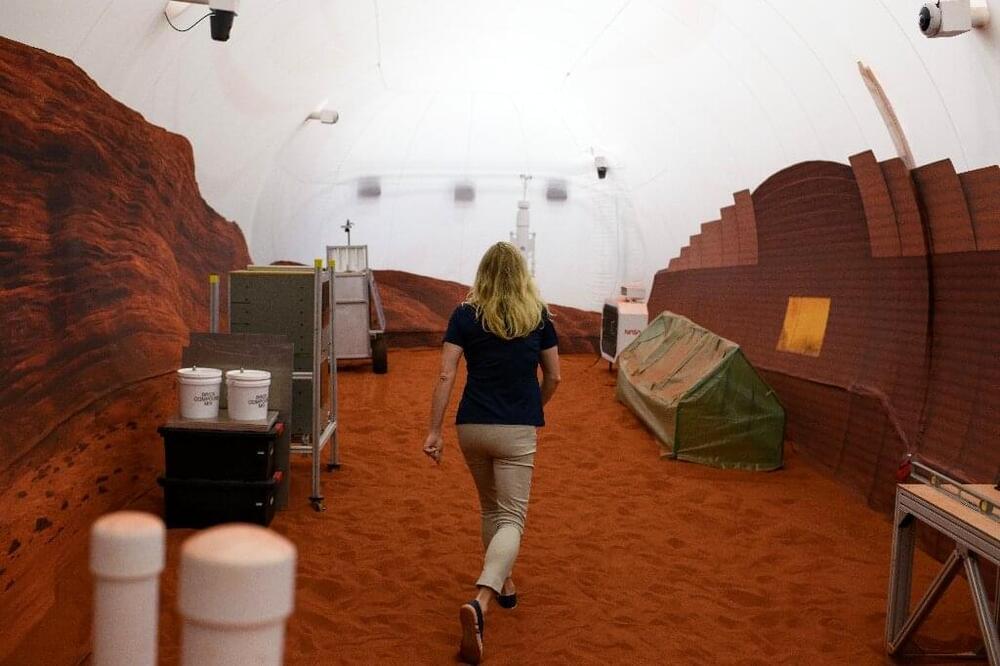
Four small rooms, a gym and a lot of red sand—NASA unveiled on Tuesday its new Mars-simulation habitat, in which volunteers will live for a year at a time to test what life will be like on future missions to Earth’s neighbor.
The facility, created for three planned experiments called the Crew Health and Performance Exploration Analog (CHAPEA), is located at the US space agency’s massive research base in Houston, Texas.
Four volunteers will begin the first trial this summer, during which NASA plans to monitor their physical and mental health to better understand humans’ fortitude for such a long isolation.