In a previous essay, I suggested how we might do better with the unintended consequences of superintelligence if, instead of attempting to pre-formulate satisfactory goals or providing a capacity to learn some set of goals, we gave it the intuition that knowing all goals is not a practical possibility. Instead, we can act with a modest confidence having worked to discover goals, developing an understanding of our discovery processes that allows asserting an equilibrium between the risk of doing something wrong and the cost of work to uncover more stakeholders and their goals. This approach promotes moderation given the potential of undiscovered goals potentially contradicting any particular action. In short, we’d like a superintelligence that applies the non-parametric intuition, the intuition that we can’t know all the factors but can partially discover them with well-motivated trade-offs.
However, I’ve come to the perspective that the non-parametric intuition, while correct, on its own can be cripplingly misguided. Unfortunately, going through a discovery-rich design process doesn’t promise an appropriate outcome. It is possible for all of the apparently relevant sources not to reflect significant consequences.
How could one possibly do better than accepting this limitation, that relevant information is sometimes not present in all apparently relevant information sources? The answer is that, while in some cases it is impossible, there is always the background knowledge that all flourishing is grounded in material conditions, and that “staying grounded” in these conditions is one way to know that important design information is missing and seek it out. The Onion article “Man’s Garbage To Have Much More Significant Effect On Planet Than He Will” is one example of a common failure at living in a grounded way.
In other words, “staying grounded” means recognizing that just because we do not know all of the goals informing our actions does not mean that we do not know any of them. There are some goals that are given to us by the nature of how we are embedded in the world and cannot be responsibly ignored. Our continual flourishing as sentient creatures means coming to know and care for those systems that sustain us and creatures like us. A functioning participation in these systems at a basic level means we should aim to see that our inputs are securely supplied, our wastes properly processed, and the supporting conditions of our environment maintained.
Suppose that there were a superintelligence where individual agents have a capacity as compared to us such that we are as mice are to us. What might we reasonably hope from the agents of such an intelligence? My hope is that these agents are ecologists who wish for us to flourish in our natural lifeways. This does not mean that they leave us all to our own preserves, though hopefully they will see the advantage to having some unaltered wilderness in which to observe how we choose to live left to our own devices. Instead, we can be participants in patterned arrangements aimed to satisfy our needs in return for our engaged participation in larger systems of resource management. By this standard, our human systems might be found wanting by many living creatures today.
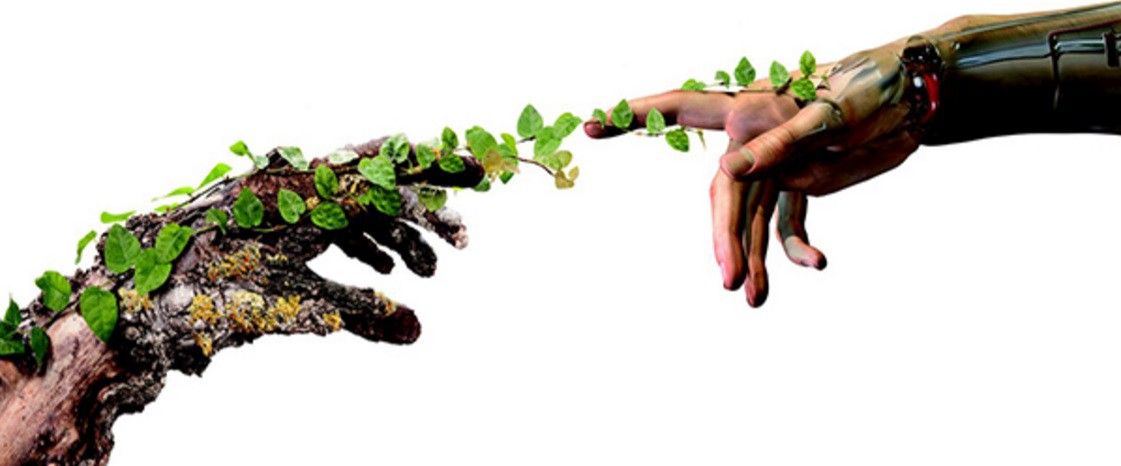
Given this, a productive approach to developing superintelligence would not only be concerned with its technical creation, but also by being in the position to demonstrate how all can flourish through good stewardship, setting a proper example for when these systems emerge and are trying to understand what goals should be like. We would also want the facts of its and our material conditions readily apparent, so that it doesn’t start from a disconnected and disembodied basis.
Overall, this means that in addition to the capacity to discover more goals, it would be instructive to supply this superintelligence with a schema of describing the relationships and conditions under which current participants flourish, as well as the goal to promote such flourishing whenever the means are clear and circumstances indicate such flourishing will not emerge of its own accord. This kind of information technology for ecological engineering might also be useful for our own purposes.
What will a superintelligence take as its flourishing? It is hard to say. However, hopefully it will find sustaining, extending, and promoting the flourishing of the ecology that allowed its emergence as a inspiring, challenging, and creative goal.