Toggle light / dark theme

Proof-of-Work Alternatives: Massive electric consumption by cryptocurrency mining

Some blogs and news outlets eschew long titles. Publishers want readers to scan a list of topics that fit on one-line each. But, a better title for this article would be:

“Massive electric consumption by cryptocurrency mining:
An unfortunate environmental nightmare will soon pass!
… Proof-of-Work alternatives are on the horizon”

A considerable amount of electricity is used in the process of mining Bitcoin and other cryptocurrencies. Miners are effectively distributed bookkeepers, and this use of resources is part of a system called “proof-of-work”. It keeps the books fair, honest, and without an ability for the miners to collude (In other words, they cannot ‘cook the books’).

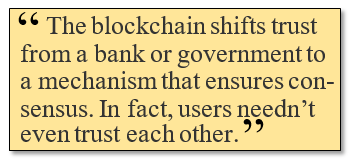
What makes the process unique and exciting is that this “distributed consensus” does not require a trusted authority, like a bank. In fact, the whole point of the blockchain revolution is that users trust a mechanism rather than a bank, government or even each other.

But, for any network that hopes to become part of the financial fabric, it must be ubiquitous and in constant motion. Proof-of-work just doesn’t make the grade, because it doesn’t scale. The need for miners to prove that they did something complex sucks up too much power. If Bitcoin or any proof-of-work currency were to be adopted for even a small fraction of commercial and personal transactions, it would overwhelm the world’s energy services.
One reader suggests the problem will be solved by the recent boom in shale fracking and renewable, non-polluting energy. He points out that crypto mining may even drive a market for distributed, clean electric production.

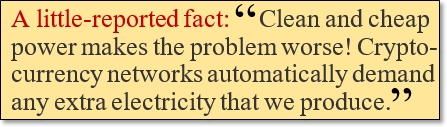
Unfortunately, clean and cheap power makes the problem worse. Even if electric capacity were to rise dramatically and experience a great cost reduction, cryptocurrency networks would automatically demand all the extra electricity. It is a no-win game, because mining incentives escalate with an increase in supply or drop in cost.
Will large-scale, blockchain-based networks fail, because of enormous electric demand? Fortunately, the future is not so bad, after all. Although networks, like Bitcoin, currently use proof-of-work to ensure honesty and fairness, it is only one of many possible measurement and enforcement mechanisms. Eventually, developers and miners will swap in another proof mechanism to keep the network humming—and without creating an environmental catastrophe.

Will Change in Proof Come in Time?

The political process for changing the fairness mechanism (“forking the code”) is complex and fraught with infighting, but the problem will eventually be addressed, and it will be solved before electricity becomes a critical issue. Despite a messy voting process, the miners have too much at stake to ignore this problem much longer.

Various proof alternatives are already being used in altcoins. Since Bitcoin is perfectly free to steal these techniques (none can be protected by patent or trade secrecy), we can think of these other coins as beta-tests for Bitcoin. How so? As the first and biggest elephant in the room, Bitcoin will likely reign supreme, as long as it doesn’t wait too long before grabbing the best technology and tucking it into its quiver.

Proof-of-Work Alternatives

  • One method, already used by some altcoins, is called “proof-of-stake”. It’s a bit like getting voting rights based on how much land you own. This method does not demand lots of electricity—but some analysts feel that is not as fair, because it cedes network control to the wealthiest members.
  • Another method, called BFT Replication was developed by Marko Vukolić, at the IBM Blockchain Group in Zurich Switzerland. It might be exactly what we need.
  • Yet another method was proposed by C.V. Alkan, an amateur analyst with a passion to solve this problem. He calls it Distributed Objective Consensus.

These aren’t the only alternatives to proof-of-work. Ultimately, one or more of these fairness enforcement mechanisms will make its way into Bitcoin and other currencies and blockchain services. In my opinion, the electrical crisis is a genuine threat, but it is one that with a solution that will be implemented soon—perhaps even this year.

Related:


Philip Raymond co-chairs CRYPSA, publishes A Wild Duck and hosts the New York Bitcoin Event. He is keynote speaker at the Cryptocurrency Expo in India this month. Click Here to inquire about a presentation or consulting engagement.
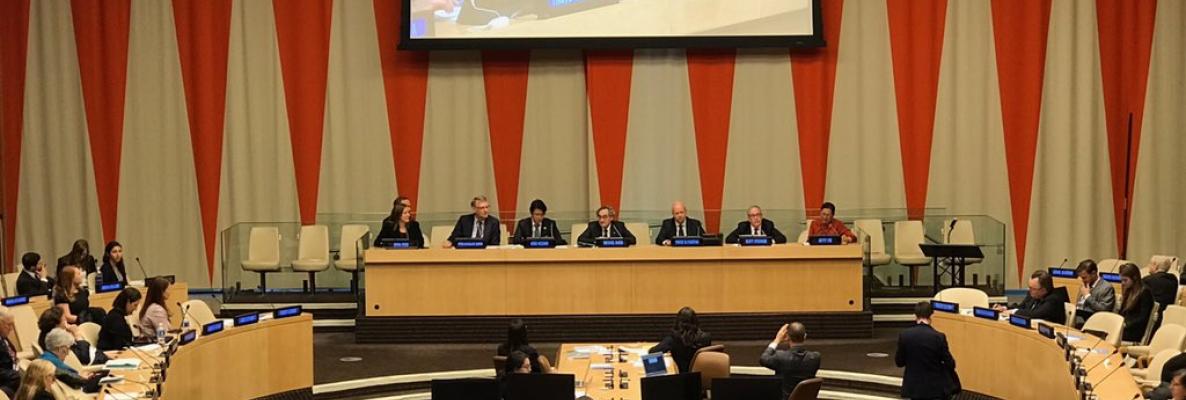

Christiana Figueres Europe Regional Round Table—United Nations Environment Programme Finance Initiative (UNEP FI)

“Former Executive Secretary to UNFCCC, Christiana Figueres has laid down a challenge to UNEP FI’s banking members, and the wider finance industry to increase their allocations to low carbon investments to avoid a 2 degrees scenario. Watch her recording which she made for participants at UNEP FI’s Europe Regional Roundtable on Sustainable Finance which took place in October 2017.”

Read more

Al Gore — Fiduciary Duty in the 21st century—Principles for Responsible Investment (PRI)

“Former Vice President and Chairman of Generation Investment Management, Al Gore, introduces PRI, UNEP FI and The Generation Foundation’s Fiduciary duty in the 21st century programme. The project finds that, far from being a barrier, there are positive duties to integrate environmental, social and governance factors in investment processes.”

Read more

Fifty years since the first United Nations Conference on the Exploration and Peaceful Uses of Outer Space (1968 — 2018): UNISPACE+50 — United Nations Office for Outer Space Affairs (UNOOSA)

“UNISPACE+50 will celebrate the fiftieth anniversary of the first United Nations Conference on the Exploration and Peaceful Uses of Outer Space. It will also be an opportunity for the international community to gather and consider the future course of global space cooperation for the benefit of humankind.

From 20 to 21 June 2018 the international community will gather in Vienna for UNISPACE+50, a special segment of the 61 st session of the Committee on the Peaceful Uses of Outer Space (COPUOS).”

Read more

Transforming Education through Imagination — even for Tech Execs

Why do Silicon Valley technology executives send their children to an almost tech-free school? Several authors have explored this question, including New York University professor Adam Alter. In his book “Irresistible: The Rise of Addictive Technology and the Business of Keeping Us Hooked” Alter explores the case of a San Francisco Steiner-Waldorf school where 75% of students are the children of Silicon Valley tech execs. How ironic.

In this piece I propose some additional reasons why imaginative education is becoming an approach of choice for parents wanting their children to become innovative, ecologically aware and even, as Whitehead suggests, to develop genius.

The three factors of genius are the habit of action, the vivid imagination, and the discipline of judgment. Alfred North Whitehead, 1916.

When we offer children a lifeless, stale education, we not only destroy their vitality, but we dumb them down. Through industrial era excesses we have altered the biosphere to the extent that our planetary homeland may in the foreseeable future become inhospitable for human habitation. Climate crisis is recognised as a global geo-political issue. How can young people be expected to contend with such catastrophic futures? How can we turn around dead, stale thinking, awaken ecological thinking and bring education back to life?

Evolution of consciousness research tells us that 19th century mechanistic thinking is giving way to more life enhancing thinking. In the early 20th century Whitehead’s process philosophy, Einstein’s relativity and quantum physics turned Newton’s building block universe on its head. Is education keeping up?

A few well-known educational pioneers made significant contributions to overhauling the factory model of education and breathing life into it. The ideas of Maria Montessori in Italy, Rudolf Steiner in Germany, John Dewey in the USA and Sri Aurobindo in India are still alive today globally. But they have remained relatively marginalised. How can the best of these ideas be spread?

Several contemporary educational approaches can help to shift static concepts to living thinking. One of the most important is Kieran Egan’s imaginative education. I first met Kieran at the “Imagination and Education Conference” (2009) in Australia, after completing my PhD on evolution of consciousness and its importance for education. I became particularly interested in his five developmental stages of imaginative education: somatic, mythic, romantic, philosophic and ironic. It synergised wonderfully with Jean Gebser’s structures of consciousness: archaic, magical, mythic, mental and integral.

Australian advocate of imagination in education, Bernie Neville, compared Egan’s stages with both Gebser’s structures of consciousness and psychologist Robert Kegan’s orders of consciousness. I discuss this in detail in Postformal Education, in Chapter 9: “Pedagogical Life: A Sustaining Force.”

Other contemporary educators who believe imagination plays a crucial role in transforming education include Jack Miller from Toronto, Ron Miller from the United States and Thomas Nielsen from Australia.

Life and its metaphors are also emphasised in ecological, environmental and sustainability education. David Jardine talks about developing “ecological imagination” in young people. Similarly, ecopedagogy grew out of the First Earth Summit in Brazil in 1992 under the influence of Paulo Freire’s critical pedagogy. In addition to its home in Latin America, ecopedagogy is thriving in Bulgaria through the influence of young sociologist, Stefan Grigorov.

Futures studies and foresight education, with their links to sustainability and citizenship education, play a vital role in ecological awareness. They help develop a sense of responsibility for long-term futures of life on our planet, the survival of our companion species and life itself. Futures education with young people may involve workshops in which the young people imagine possible, alternative and desirable futures, before creating the action plans that empower them to create their preferred futures.

We can also encourage life-enhancing values and increase vitality through promoting pedagogical life in simple practical ways. We can ground children in nature through gardening, creative handwork, and following daily and seasonal cycles, rather than mechanical clock time. I share a couple of enlivening examples from the school I founded in the 1980s, when alternative energy was still a relatively new idea. With the help of a low-impact alternative energy expert from the local region, we designed and built a swing set that was like no other. When the children swung on the swings, once their kinetic energy built up to a certain degree, a light bulb installed in the frame of the swing set would light up. To the children, this was pure magic. And yet it was a magic that they had created with their own energy, while they were playing!

In a second project we built a large stone structure with a water wheel at the top and a series of sculpted clay-fired flow form basins through which water flowed down like a waterfall into a pond nestled into a sandpit beside a see-saw. When children rode the see-saw, the kinetic energy of their weight moving the see-saw up and down pumped water up, turning the water wheel and pouring water down through the flow forms. The children were empowered to experience their own kinetic energy transforming into another kind of energy—physics through imaginative play. Even these primary school children learnt important lessons in physics through their bodily kinetic activity, which they would only learn about conceptually in high school, when they studied physics.

Finally, creative school architecture is an increasingly popular way to stimulate children’s creativity and imagination – to help them to think outside the square. Creative school architecture is iconic to Steiner-Waldorf schooling, but more recently has become a benchmark for top international schools in Scandinavia, Japan and elsewhere. See below the colourful kindergarten in Tromso, Norway.

To read more about Jennifer’s idea on Imaginative Education:

The ideas in this blog are expanded and discussed in: Postformal Education: A Philosophy for Complex Futures (Springer, 2016).

An earlier version of this article was published on ImaginEd: Education that Inspires.

/* */