Toggle light / dark theme

General Motors to double size of Israel R&D center

Regulation is not the immediate problem with autonomous cars. Example, is Google car has been deemed approved by existing regs. However, the issue is the broader public’s trust due to the various reports of hacking of connected cars such as the Nissan Leaf, etc. Until we put in place a more resilient net infrastructure such as Quantum; slow down will happen. I suggest GM to read the news more because everything that I stated has been well communicated in the news and research for the past 4 months.


GM Ventures president Lauckner believes regulation will not halt the advance of the autonomous car.

MIT’s AI Can Predict 85 Percent of Cyberattacks

Knowing a cyberattack’s going to occur before it actually happens is very useful—but it’s tricky to achieve in practice. Now MIT’s built an artificial intelligence system that can predict attacks 85 percent of the time.

Cyberattack spotters work in two main ways. Some are AI that simply looks out for anomalies in internet traffic. They work, but often throw up false positives—warnings about a threat when actually nothing’s wrong. Other software systems are built on rules developed by humans, but it’s hard to create systems like that which catches every attack.

Instead, researchers from MIT’s Computer Science and Artificial Intelligence Lab built a new AI—creatively named AI2—that combines the two approaches.

Artificial Intelligence’s Ultimate Challenge? Cyber Attacks

AI is hackable as long as it’s underpinning technology is still supported on legacy platform technology and connected to a legacy infrastructure. Only when the underpinning technology & net infrastructure is updated to Quantum will we see a secured AI environment.


At MIT, machine learning specialists are training deep learning algorithms to spot cyber attacks. It may be AI’s ultimate test.

How bots will change the Web, according to a bot we built to answer that question

I am still not convinced that everyone fully understands how bot technology is about to change IoT and its impact to online business industry. Let me share a few ideas: Financial Auditing and accounting. Bots will be able to do a more thorough job in managing, tracking, reporting financials that many finance back office controls can be performed by bots and requiring a sign off by CFO/ Lead Controller. And, Accounting & Audit firms can easily leverage the technology to perform audits on companies remotely without having to send teams of auditors to a client’s site.

Here’s another one; I decide to set up a few 3D printers to make some unique seals for aircraft manufactures for their jets/ planes; and I need a call center plus online sales teams taking and processing orders. With bot technology my whole operation is automated and no need for sales people, call center folks, or operators. All I need is myself and couple of techies to manage the bot operations; and more profit for me and my team.

However, we still have to keep a tight oversight on hacking which is still a risk; however, we should see more micro-size companies spin up as a result of online bots and 3D printers in our immediate future.


Don’t even TRY to get Intersect Bot to talk about Trump or the Holocaust.

Three-way battles in the quantum world

One thing about Quntum; nothing ever stays consistent. Why it’s loved & hated by Cyber Security enthusiasts as well as AI engineers.


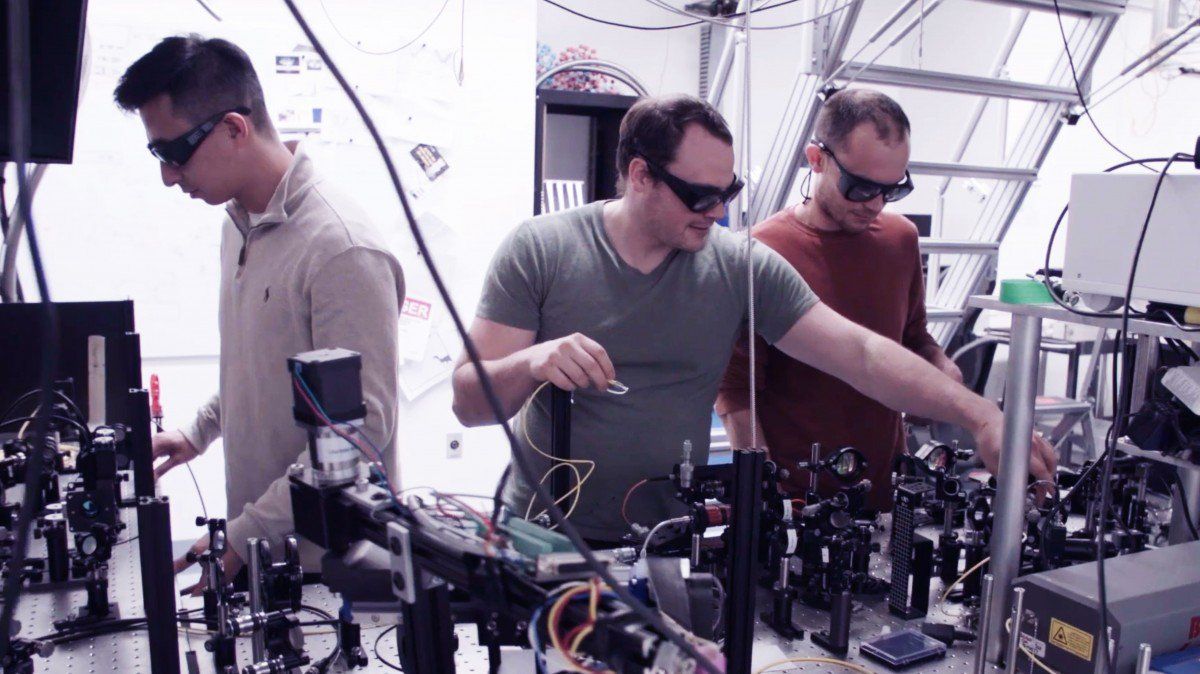
When water in a pot is slowly heated to the boil, an exciting duel of energies takes place inside the liquid. On the one hand there is the interaction energy that wants to keep the water molecules together because of their mutual attraction. On the other hand, however, the motional energy, which increases due to heating, tries to separate the molecules. Below the boiling point the interaction energy prevails, but as soon as the motional energy wins the water boils and turns into water vapour. This process is also known as a phase transition. In this scenario the interaction only involves water molecules that are in immediate proximity to one another.

An artificial quantum world of atoms and light

An artificial quantum world of atoms and light: Atoms (red) spontaneously arrange themselves in a checkerboard pattern as a result of the complex interplay between short- and long-range interactions. (Visualizations: ETH Zurich / Tobias Donner)

A team of researchers led by Tilman Esslinger at the Institute for Quantum Electronics at ETH Zurich, and Tobias Donner, a scientist in his group, have now shown that particles can be made to “feel” each other even over large distances. By adding such long-range interactions the physicists were able to observe novel phase transitions that result from energetic three-way battles (“Quantum phases from competing short- and long-range interactions in an optical lattice”).

Are Artificial-Intelligence Software Audits Around the Corner?

They need to be especially as we assess AI with SOX, HIPAA, and Cyber security. It will be interesting how auditors will approach this space as well since not many folks outside of tech are considered AI experts. This should be interesting.


Scott & Scott, LLP attorney, Christopher Barnett, expresses concern whether KPMG’s recent announcement that they will be deploying IBM’s Watson cognitive computing technology points to changes in software audits in the future.

Download PDF [259KB]

Obama warned by China against undermining ‘national security’ interests

Interesting: China wants more cross sharing of Cyber Security information with US. This will only get more interesting with the advancement of Quantum tech.

Article’s headline “Obama warned by China against undermining ‘national security’ interests”.


He made the remarks while addressing the Korean Peninsula situation in separate meetings here with U.S. President Barack Obama and South Korean President Park Geun-hye on the sidelines of the fourth Nuclear Security Summit (NSS).

How To Remove ‘Crepey Skin’ & Saggy Wrinkles In Minutes

FBI Warns of Cyber Threat to Electric Grid

Three months after a Department of Homeland Security intelligence report downplayed the threat of a cyber attack against the U.S. electrical grid, DHS and the FBI began a nationwide program warning of the dangers faced by U.S. utilities from damaging cyber attacks like the recent hacking against Ukraine’s power grid.

The nationwide campaign by DHS and the FBI began March 31 and includes 12 briefings and online webinars for electrical power infrastructure companies and others involved in security, with sessions in eight U.S. cities, including a session next week in Washington.

The unclassified briefings are titled “Ukraine Cyber Attack: Implications for U.S. Stakeholders,” and are based on work with the Ukrainian government in the aftermath of the Dec. 23 cyber attack against the Ukrainian power infrastructure.

Your next car will need a firewall

As our cars become increasingly connected to the internet, and eventually drive themselves, we’re going to want them to be rock-solid secure. The recent Chrysler exploit and FBI warning both highlighted just how vulnerable our vehicles can be to malicious hackers.

The idea of anti-virus software for cars has been around for several years, and this year there’s even an entire conference about in-car cybersecurity. Karamba Security is a new company in the space that is offering what amounts to a firewall for your ride.

Don’t miss our biggest TNW Conference yet! Join us May 26 & 27 in Amsterdam.

/* */