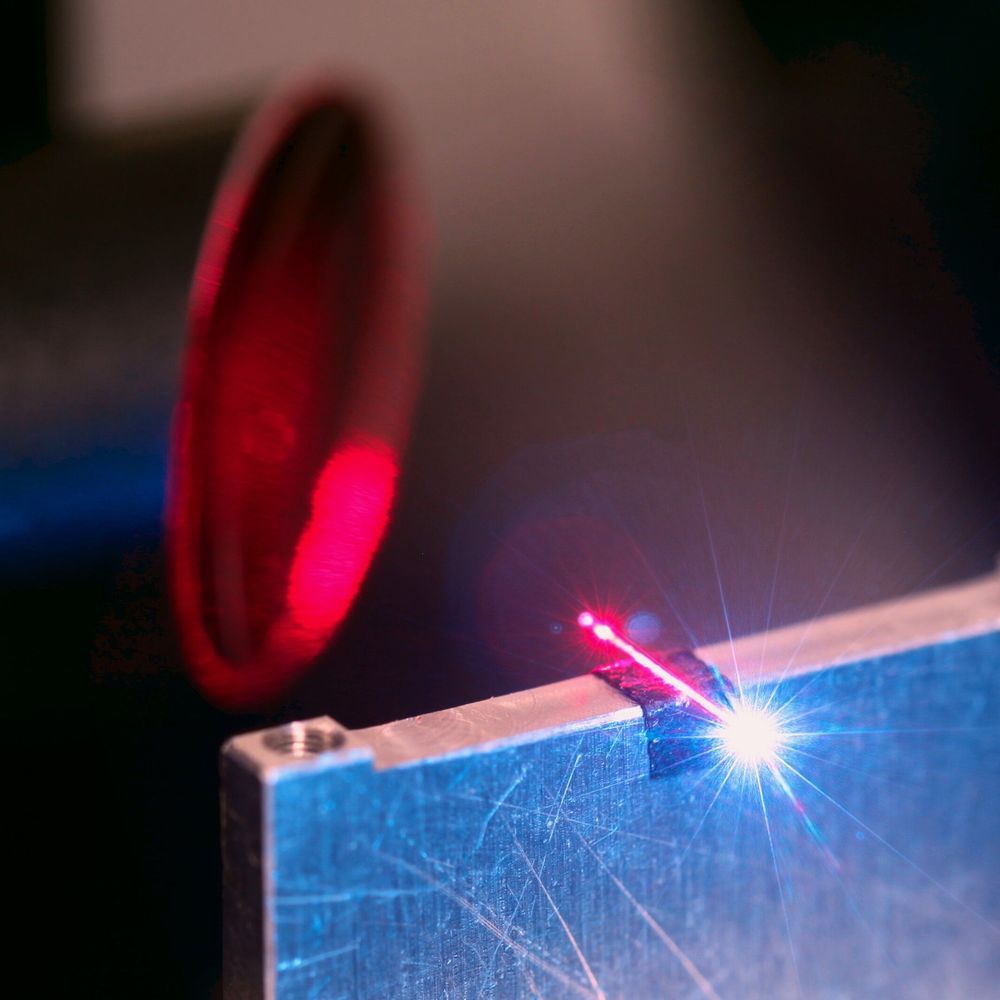
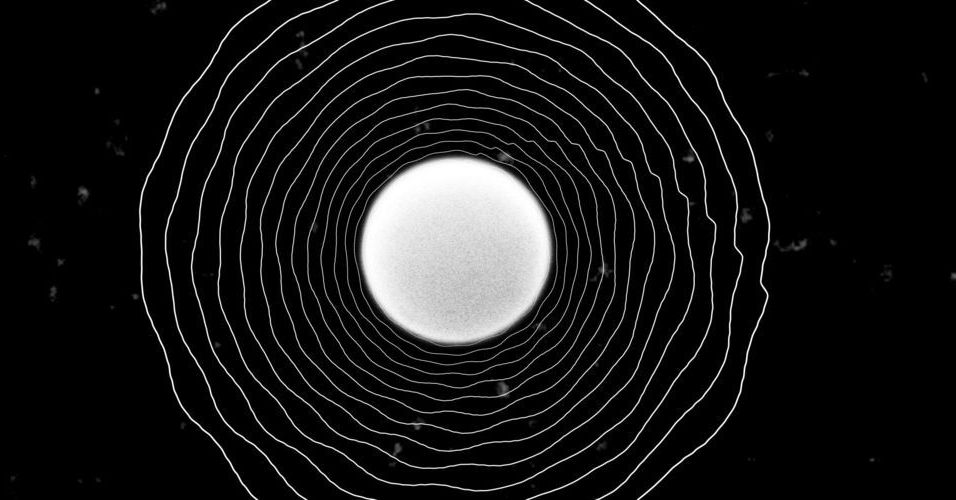
Researchers at Weizmann Institute of Science and Cinvestav recently carried out a study testing the theory of Hawking radiation on laboratory analogues of black holes. In their experiments, they used light pulses in nonlinear fiber optics to establish artificial event horizons.
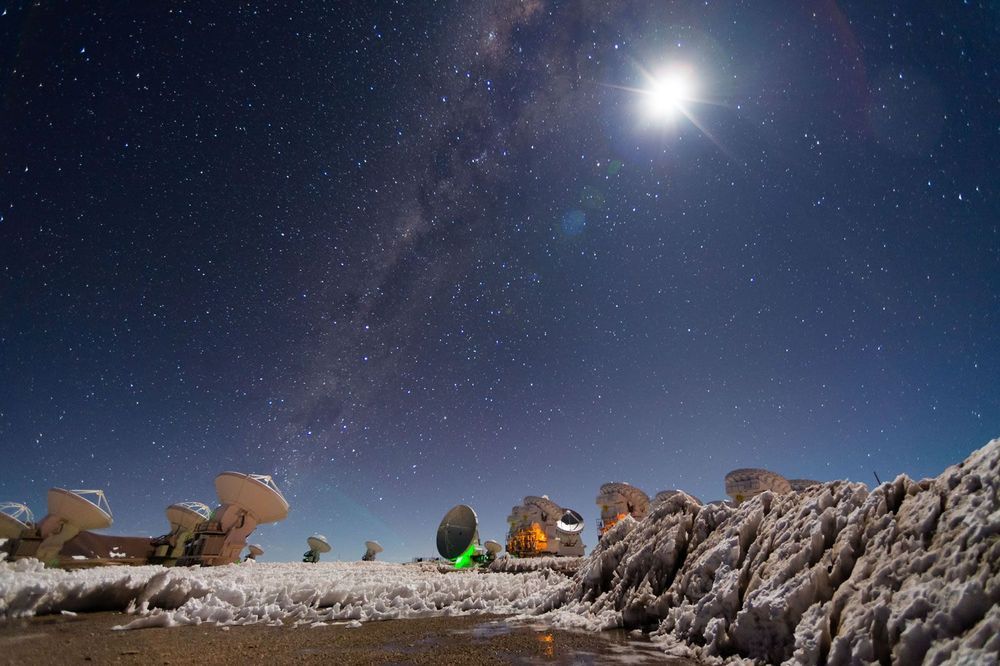
Astronomers have announced that they have gathered new data on the black hole that lies at the center of our galaxy. The new information was gleaned when the scientists added the ALMA telescope into the array of telescopes being used to study the black hole. The discovery has found that the emissions from the supermassive black hole, called Sagittarius A (Sgr A), comes from a smaller region than previously believed.
The best image yet of the supermassive black hole at the centre of the Milky Way shows that if it has a powerful jet like others do, it may be pointing at Earth.
CERN has revealed plans for a gigantic successor of the giant atom smasher LHC, the biggest machine ever built. Particle physicists will never stop to ask for ever larger big bang machines. But where are the limits for the ordinary society concerning costs and existential risks?
CERN boffins are already conducting a mega experiment at the LHC, a 27km circular particle collider, at the cost of several billion Euros to study conditions of matter as it existed fractions of a second after the big bang and to find the smallest particle possible – but the question is how could they ever know? Now, they pretend to be a little bit upset because they could not find any particles beyond the standard model, which means something they would not expect. To achieve that, particle physicists would like to build an even larger “Future Circular Collider” (FCC) near Geneva, where CERN enjoys extraterritorial status, with a ring of 100km – for about 24 billion Euros.
Experts point out that this research could be as limitless as the universe itself. The UK’s former Chief Scientific Advisor, Prof Sir David King told BBC: “We have to draw a line somewhere otherwise we end up with a collider that is so large that it goes around the equator. And if it doesn’t end there perhaps there will be a request for one that goes to the Moon and back.”
Interview with Scott Aaronson — covering whether quantum computers could have subjective experience, whether information is physical and what might be important for consciousness — he touches on classic philosophical conundrums and the observation that while people want to be thorough-going materialists, unlike traditional computers brain-states are not obviously copyable. Aaronson wrote about this his paper ‘The Ghost in the Quantum Turing Machine’ (found here https://arxiv.org/abs/1306.0159). Scott also critiques Tononi’s integrated information theory (IIT).
Scott discusses whether quantum computers could have subjective experience, whether information is physical and what might be important for consciousness — he touches on classic philosophical conundrums and the observation that while people want to be thorough-going materialists, unlike traditional computers brain-states are not obviously copyable. Aaronson wrote about this his paper ‘The Ghost in the Quantum Turing Machine’ (found here https://arxiv.org/abs/1306.0159). Scott also critiques Tononi’s integrated information theory (IIT).
Questions include: - In “Could a Quantum Computer Have Subjective Experience?” you speculate that a process has to ‘fully participate in the arrow of time’ to be conscious, and this points to decoherence. If pressed, how might you try to formalize this?
- In “Is ‘information is physical’ contentful?” you note that if a system crosses the Schwarzschild bound it collapses into a black hole. Do you think this could be used to put an upper bound on the ‘amount’ of consciousness in any given physical system?
- One of your core objections to IIT is that it produces blatantly counter-intuitive results. But to what degree should we expect intuition to be a guide for phenomenological experience in evolutionarily novel contexts? I.e., Eric Schwitzgebel notes “Common sense is incoherent in matters of metaphysics. There’s no way to develop an ambitious, broad-ranging, self- consistent metaphysical system without doing serious violence to common sense somewhere. It’s just impossible. Since common sense is an inconsistent system, you can’t respect it all. Every metaphysician will have to violate it somewhere.”
A new study suggests that subatomic particles called muons streamed through the atmosphere and fatally irradiated megafauna like the monster shark megalodon.
Scientists working with the Event Horizon Telescope project may have have captured an image of a black hole in the Milky Way, which could be ‘the most iconic ever’.
Scientists have suggested that for the first time, they may have finally captured what could end up being the first image of a black hole within the Milky Way. A team of international astronomers have been hard at work analyzing two specific areas of space located in Sagittarius A and M87 through the Event Horizon Telescope project (EHT), and have reported that they have discovered what amounts to “spectacular” data during their research, which in this case, would be the faint image of the silhouette of a black hole.
According to the Daily Mail, this image may very well prove to be “one of the most iconic ever.” The scientists involved with the EHT collaboration are currently analyzing tremendous amounts of data from 2017, and this data is set to be made public later on this year.