Toggle light / dark theme

Electro-optical device provides solution to faster computing memories and processors

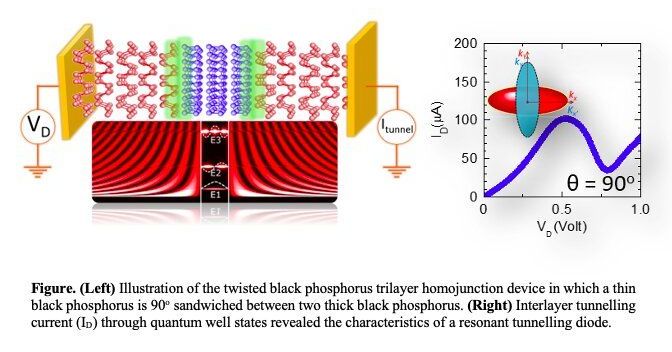
The first ever integrated nanoscale device which can be programmed with either photons or electrons has been developed by scientists in Harish Bhaskaran’s Advanced Nanoscale Engineering research group at the University of Oxford.

In collaboration with researchers at the universities of Münster and Exeter, scientists have created a first-of-a-kind electro– which bridges the fields of optical and electronic computing. This provides an elegant solution to achieving faster and more energy efficient memories and processors.

Computing at the has been an enticing but elusive prospect, but with this development it’s now in tangible proximity. Using light to encode as well as transfer information enables these processes to occur at the ultimate speed limit—that of light. While as of recently, using light for certain processes has been experimentally demonstrated, a compact device to interface with the electronic architecture of traditional computers has been lacking. The incompatibility of electrical and light-based computing fundamentally stems from the different interaction volumes that electrons and photons operate in. Electrical chips need to be small to operate efficiently, whereas need to be large, as the wavelength of light is larger than that of electrons.

AMD CEO Lisa Su on 2020 Outlook: ‘The Best Is Yet to Come’

Su is laser-focused on where she wants to take AMD by 2025 when she will reach her 10th year as CEO. “What I like to always say is that the best is yet to come,” she says, beaming. “Our goal is to really push the envelope.”

Watch the video above for more from my interview with Su.


AMD is on a roll with its high tech chips powering PCs, data centers and gaming consoles, and the stock surging 80 percent in 2019.

Study: Our universe may be part of a giant quantum computer

A pair of physicists from Immanuel Kant Baltic Federal University (IKBFU) in Russia recently proposed an entirely new view of the cosmos. Their research takes the wacky idea that we’re living in a computer simulation and mashes it up with the mind-boggling “many worlds” theory to say that, essentially, our entire universe is part of an immeasurably large quantum system spanning “uncountable” multiverses.

When you think about quantum systems, like IBM and Google’s quantum computers, we usually imagine a device that’s designed to work with subatomic particles – qubits – to perform quantum calculations.

Tiny Devices made of DNA detect Cancer with fewer false alarms

DNA circuits could help ensure that cancer screens and therapies zero in on the right culprits. A new cancer-detecting tool uses tiny circuits made of DNA to identify cancer cells by the molecular signatures on their surface.

Duke University researchers fashioned the simple circuits from interacting strands of synthetic DNA that are tens of thousands of times finer than a human hair.

Unlike the circuits in a computer, these circuits work by attaching to the outside of a cell and analyzing it for proteins found in greater numbers on some cell types than others. If a circuit finds its targets, it labels the cell with a tiny light-up tag.

Rocket Lab readies Electron for the first launch with rocket recovery systems on board

Rocket Lab is getting ready to fly its tenth mission, which the first official launch window during which it could happen set for this week on November 29. Aside from being a milestone 10th mission (dubbed ‘Running Out of Fingers,’ ha), this will be the first time that Rocket Lab includes technology designed to help it eventually recover and reuse elements of its launch vehicle.

After first designing its Electron launch platform as a fully expendable spacecraft, meaning it could only do one way trips to bring cargo to orbit, Rocket Lab announced that it would be moving towards rocket reusability at an event hosted by CEO and founder Peter Beck in August. To make this happen, the company will be developing and testing the tech necessary to recover Electron’s first-stage rocket booster over the course of multiple missions.

Toe be clear, this mission has the primary goal of delivering a number of small satellites on behalf of paying customers, including microsatellites from Alba Orbital and a Tokyo –based company called ALE that is using microsatellites to simulate particles from meteors. But Rocket Lab will also be testing recovery instrumentation loaddd on board the Electron vehicle, including guidance and navigation systems, as well as telemetry and flight computer hardware. This will be used to gather real-time data about the process of re-entry for Electron’s first stage, and Rocket Lab will also attempt to make use of a reaction control system to control the orientation of the booster as it re-enters.

/* */