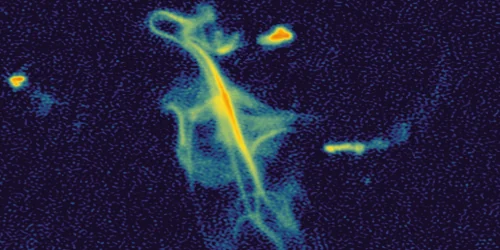
A key property of superconductors called superfluid stiffness can now be measured in a wide range of 2D systems.
When certain atoms are irradiated with laser light, they can produce a very different kind of laser light: laser pulses with extremely high frequencies in the X-ray range. These laser pulses, which helped achieve record-breaking results at TU Wien in the 1990s, were the subject of the 2023 Nobel Prize in Physics.
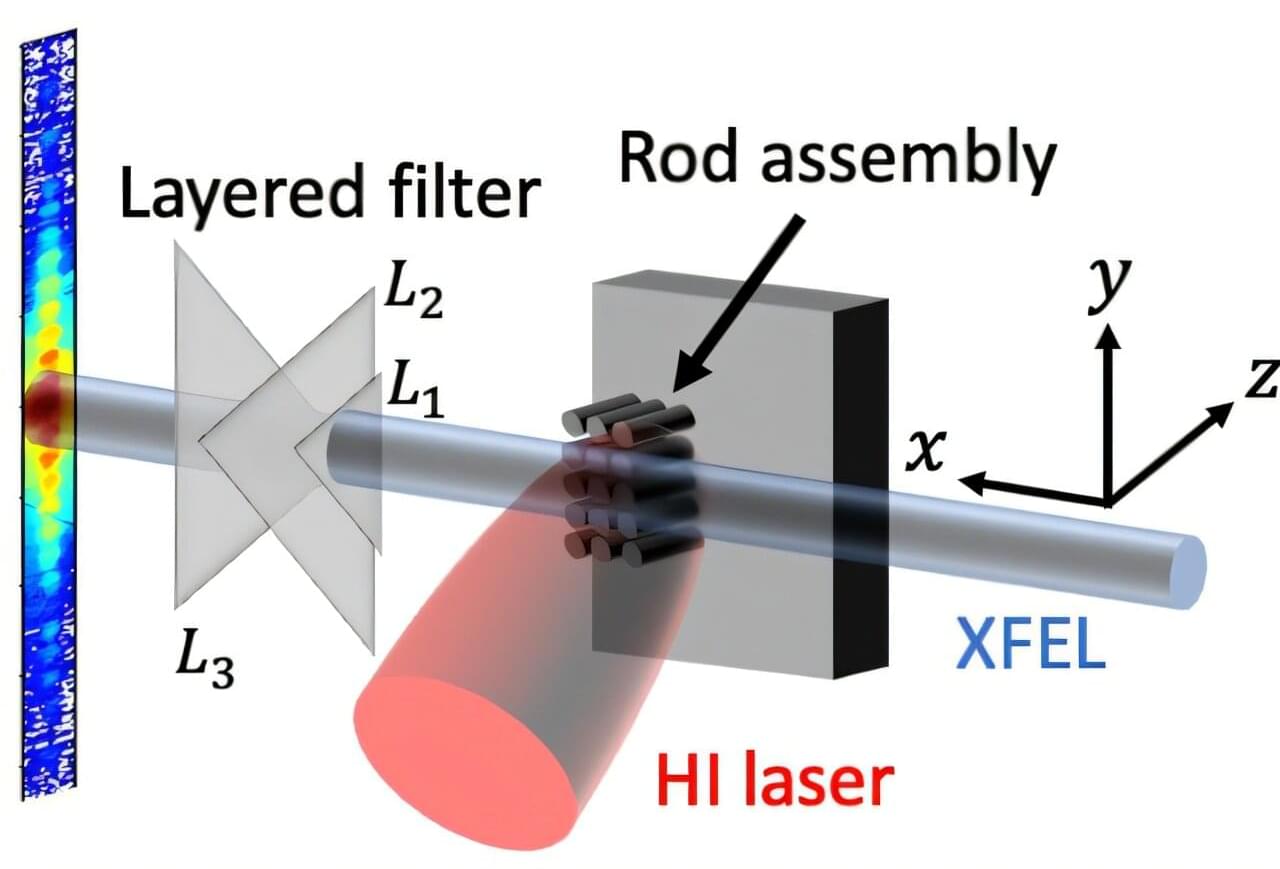
However, the theoretical model of this effect makes a clear prediction: There is an upper limit to the energy, depending on the properties of the laser beam directed at the atoms. Above a certain value, known as the energy cutoff, hardly any X-rays are produced.
Now, however, a new experiment jointly performed by teams at TU Wien and the University of California San Diego has succeeded in overcoming this textbook cutoff rule: Using helium atoms, the researchers reached a much higher energy range than standard theory would allow. The reason lies in the interaction between the two electrons in the helium atom: They can release their energy simultaneously.
A centromere is a specific region on a chromosome that ensures that, when a cell divides, the chromosome separates accurately so each new cell receives the correct amount of genetic material. Despite their essential role, centromeres remain one of the last major blind spots in the human genome.
A recent study published in Nature set out to reveal what had been hidden inside human centromeres, using advanced long-read sequencing and custom-built computational tools to piece together 2,110 complete centromeres. The researchers sampled individuals from 28 population groups across five continents, then compared their centromeres with 5,747 assembled by the Human Pangenome Reference Consortium to trace how these regions differ and evolve.
They discovered 226 major centromere haplotypes—distinct genetic patterns—and 1,870 new genetic variants. By studying a four-generation family, they were able to follow centromeres as they changed from parent to child, tracking genetic changes across generations.
A University of Kansas physicist played a leading role in a CERN study showing that two rival explanations for how gluons behave inside atomic nuclei can now be experimentally distinguished.
The research, carried out within the ALICE experiment at CERN’s Large Hadron Collider and published in Physical Review Letters, reports the first multidimensional measurement of incoherent J/ψ (pronounced “JAY-sigh”) photonuclear production as a function of both interaction energy and momentum transfer. The measurement gives scientists their clearest view yet of how gluons, the particles that bind quarks together, are arranged inside atomic nuclei at high energies.
“Although quarks are often described as the fundamental building blocks of matter, nearly all the mass of the visible universe—from the atoms in our bodies to the matter inside stars—actually comes from the energy carried by gluons and the strong force that binds quarks together,” said nuclear physicist Daniel Tapia Takaki, professor of physics & astronomy at KU and member of the ALICE collaboration. “Understanding how gluons behave inside nuclei is therefore essential to understanding how matter itself acquires its mass and structure.”
Fluorescent protein imaging is an indispensable tool in life science research, enabling visualization of protein movement and localization, gene expression, signaling pathways, protein-protein interactions and more. For simultaneous analysis of multiple proteins (i.e., multiplex imaging), a variety of fluorescent proteins that emit different colors (blue, green, yellow and red) have been developed.
However, the number of colors that can be distinguished simultaneously is limited, making it difficult to observe and distinguish multiple fluorescent proteins that emit similar colors. Now, researchers from WPI-ITbM at Nagoya University have demonstrated that overlapping colored fluorescent proteins can be distinguished within living plant cells using fluorescence lifetime imaging microscopy (FLIM).
This research was published in Plant Physiology on July 30, 2026.
New research introduces a contactless way to see how mirror-image materials respond differently to circularly polarized light, without first building them into a complete electronic device. The researchers developed a novel method based on light-induced charge separation that allows researchers to directly probe how the material’s structure acts like a microscopic filter, influencing how electrons separate and move.
The advance is important because it gives scientists a faster, cleaner way to test promising materials without metal contacts and other parts of a finished device affecting the results. The approach could ultimately help researchers develop new mirror-image materials for technologies that use circularly polarized light, electrical charge and electron spin.
Imagine two nearly identical materials sitting side by side. They are mirror images of each other, much like your left and right hands. Shine an ordinary light on them, and they seem much the same. But shine light that twists in one direction, and one material responds more strongly. Twist the light the other way, and its mirror-image partner takes the lead.
Putting power in people’s hands to pursue their own aspirations is how humanity has made the most progress. Novel ideas and major steps forward rarely originate from established institutions alone. They came from the brothers in a bicycle shop who believed people could fly, the bookbinder’s apprentice with no schooling who figured out how to generate electricity, and the kid in a garage who thought personal computers could be for everyone. We believe this will continue to be true. As everyone gains more powerful tools, each person will become more capable of shaping the future, not less.
Invention, not automation, will be the greatest contribution of superintelligence. Early AI could answer questions and do routine work. Soon it will increasingly help discover new knowledge—from discovering new drugs to cure a family member’s disease to finding new ways to improve your business. While the number of questions you can ask in a day is limited, the number of valuable things superintelligence can invent to help achieve your goals is unlimited.
As intelligence becomes abundant, the most important question will be how we direct it. Some argue that superintelligence itself, or a small set of experts who control it, should decide what is best for humanity. I disagree. The history of democracy and economics has shown that there is no single objective answer to how people define the best life, and therefore the best approach is letting people decide what matters to them.
We’ve made improvements to Copilot Chat on github.com that make it easier to use. These include easier access to your recent conversations in chat, the ability to minimize the chat window and return to an in-progress conversation, and indicators that help you track your Copilot token spend.
We’ve improved the chat overlay experience by adding two new features.
The first is the ability to minimize the screen during a conversation. This allows you to browse GitHub while waiting for a Copilot response.