Microsoft is adding Kimi K3 to its Azure cloud services, while its engineers continue to evaluate the model for a deployment within Copilot.
Certain molecules can be placed into states that are less sensitive to external noise, offering researchers a quiet system for probing fundamental physics.
Molecules are like tiny sandboxes for exploring fundamental physics. Within the molecular environment, bound electrons and nucleons can be exposed to exceptionally strong fields, inducing effects that can’t easily be observed elsewhere. By measuring transitions within these molecules, researchers can look for small deviations from theory, which could be signs of new physics beyond the standard model of particle physics. However, molecules are very sensitive to external fields, causing “noise” that can hide the small internally induced deviations. Yuiki Takahashi and colleagues at Caltech have come up with a potential solution, which counterintuitively uses external fields to make molecules immune to external fields [1]. By exposing small triatomic molecules to carefully tuned electromagnetic fields, the researchers have placed the molecules into special states where their sensitivity to noise is reduced by a factor of several hundred.
Over the past decade, perovskite LEDs have become increasingly vibrant and affordable to produce. With careful tweaks to their chemical composition, these crystal-based light emitters can be tuned across the visible spectrum—matching and sometimes even beating rival LED materials for producing red and green light. However, blue light has remained a holdout, keeping full-color perovskite displays out of reach.
Through new research published in Nature, a team led by Xuyong Yang at Shanghai University has found a way past this barrier, building perovskite LEDs that emit a vivid, saturated blue while also lasting longer than earlier attempts.
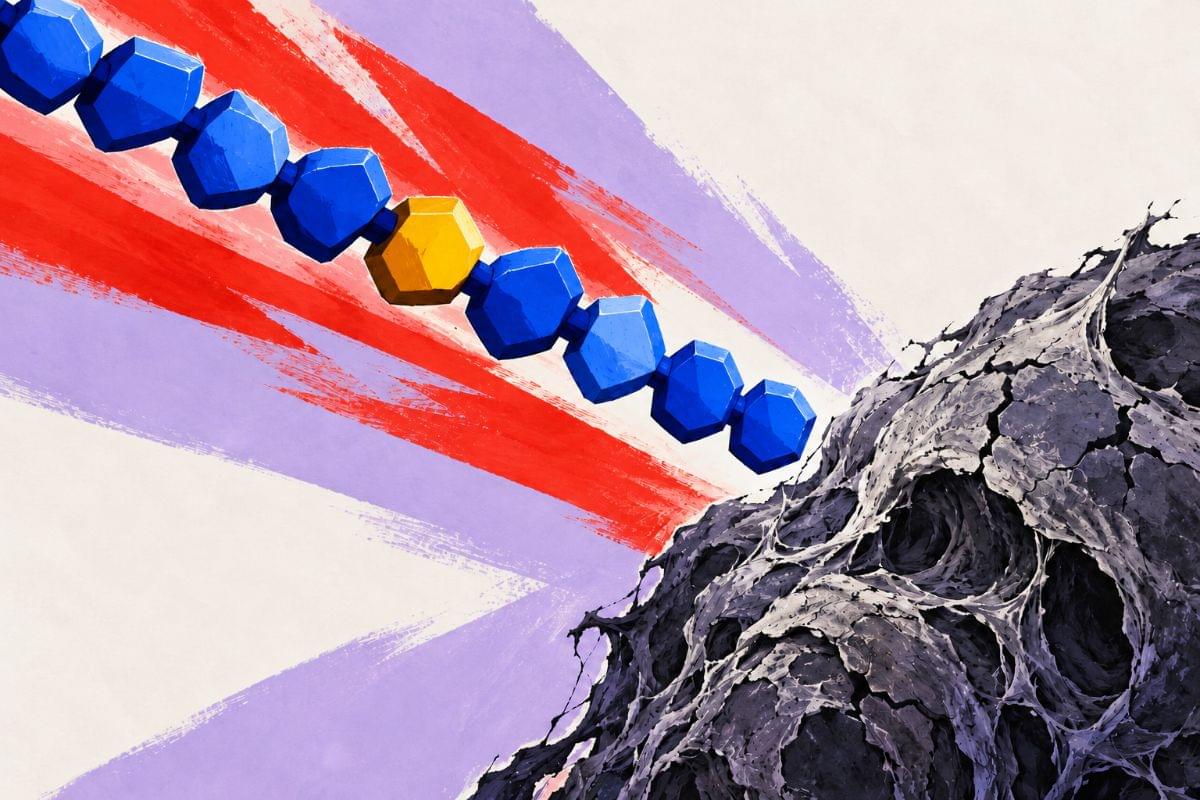
Chemists use single-electron transfers to synthesize complex, ring-shaped molecular structures found in many drug candidates and advanced materials, but current techniques still have limitations. A new study, accepted for publication in Nature, describes a technique that could steer these chemical reactions in ways that were previously limited by the redox potentials of the involved molecules.
Normally, in single-electron transfer (SET) reduction, the molecule that is easiest to reduce—according to its redox potential—grabs available electrons first. This ultimately blocks many useful reactions involving common but hard-to-reduce molecules, including many simple ketones. These ketones are useful in a wide range of applications, from making pharmaceuticals and agrochemicals to creating plastics and industrial solvents. Overcoming the limitations of competition for electrons based on redox potentials has been a goal for researchers looking for ways to streamline the synthesis of these useful chemicals.
Previous approaches to improve selectivity often relied on carefully matching reactants’ reduction potentials. Other methods used close catalyst-substrate interactions to alter selectivity, but these strategies were not broadly compatible with all reactants.
A new study led by astronomers at The University of Texas at Austin proposes a theory that could solve two astronomical riddles at once: the nature of Little Red Dots and the origin of globular clusters. Rather than representing distinct objects, the study suggests that one may instead be the ancestor of the other: Little Red Dots are, in fact, an early form of globular clusters. The findings are published in The Astrophysical Journal Letters.
First detected by the James Webb Space Telescope (JWST) in 2022, Little Red Dots are mysterious objects that appear 600 million years after the Big Bang, only to seemingly disappear 1.5 billion years later. They are compact, luminous and shine with a distinctive combination of red and ultraviolet light.
One theory is that Little Red Dots represent supermassive black holes, enshrouded in dense clouds of gas, that pull young stars into dramatic deaths. This scenario explains many of the objects’ signature properties. However, other scenarios could also fit.
Why do some brains survive long after death when most other soft tissue decays? That’s the question a research team led by Alexandra Morton-Hayward at the University of Oxford set out to answer.
The brain is one of the first organs to liquefy and decompose after death. Yet in recent decades, archaeologists have recovered more than 4,400 well-preserved human brains dating back 12,000 years. In more than 1,300 cases, the brain was the only soft tissue left inside skeletal remains.
This phenomenon occurs most often in waterlogged, low-oxygen graves, but scientists lacked a clear explanation for how such a fragile organ can sometimes outlast everything else.
From ocean waves and flowing rivers to the systems used to transport and treat water, vibrations are everywhere. But can vibrations do more than just shake water? Can they split water or drive the production of useful chemicals from water? A research team led by Professor Sai Kishore Ravi from the School of Energy and Environment (SEE) at City University of Hong Kong (CityUHK) has successfully demonstrated how mechanical vibrations can be harnessed to drive the production of useful chemicals from water.
The team showcased these breakthroughs in two recent studies: one on vibration-driven hydrogen peroxide generation, published in Nature Communications under the title “Bulk polarization field and interfacial electron sink in MXene-modified iodine-doped Bi4Ti3O12 enhance piezocatalytic H2O2 generation”; and another on hydrogen production, published in Advanced Energy Materials under the title “Enhanced Lattice Polarization and Directed Charge Transport Toward Pt Surface Sites Accelerate the Volmer Step in Piezocatalytic H2 Evolution on Co-Doped BiFeO3.”
The studies contribute to the emerging field of piezosynthesis, where mechanical deformation in piezoelectric materials generates charges that can be directed to drive redox reactions in water. A key challenge is preventing the loss of these charges through recombination before they reach surface reaction sites.
QUT researchers have overcome a challenge that has limited next-generation energy-harvesting materials for more than two decades, opening the door to more powerful wearable electronics and new ways of turning wasted heat into electricity. The breakthrough centers on carbon nanotubes, which are flexible, conductive microscopic rods that have long shown promise for wearable technologies but have been difficult to control.
QUT researchers have developed a new molecular strategy that prevents the nanotubes from clumping together and losing performance, enabling a new benchmark for materials that convert heat directly into electricity.
Lead author and QUT PhD researcher Shanshan Zhou said the work established a new way of tackling one of the biggest challenges facing carbon nanotubes.
Deep beneath the French-Swiss border, the world’s largest scientific instrument has fallen silent. After years of smashing protons together at nearly the speed of light, CERN’s Large Hadron Collider (LHC) has stopped operations and entered a long shutdown.
While no particle collisions are taking place at the LHC, thousands of scientists, engineers and technicians are dismantling parts of the machine, installing new technologies and preparing one of the most ambitious upgrades ever attempted in experimental physics.
When it switches on again, around 2030, it will become the High-Luminosity Large Hadron Collider (HL-LHC), capable of delivering roughly seven times more data than the collider that discovered the Higgs boson.
Metasurfaces are ultrathin optical components engineered with arrays of nanoscale structures that can control light in ways that are difficult for conventional optics. Unlike traditional optical components, which typically rely on their shape and thickness, metasurfaces manipulate light using carefully designed nanostructures patterned on a flat surface.
“Active metasurfaces are extending the capabilities of flat optics by enabling optical functions to be dynamically reconfigured,” says Professor Laura Na Liu, director of the 2nd Physics Institute at the University of Stuttgart. “To tap into this potential, we need to learn how to address individual pixels within a two-dimensional metasurface at visible wavelengths.”
Researchers at the University of Stuttgart have developed an interactively addressable organic metadevice that uses electrically switchable organic materials to dynamically control light. The new platform enables every metasurface pixel to be electronically controlled independently, allowing user commands to be translated directly into dynamic holographic images.