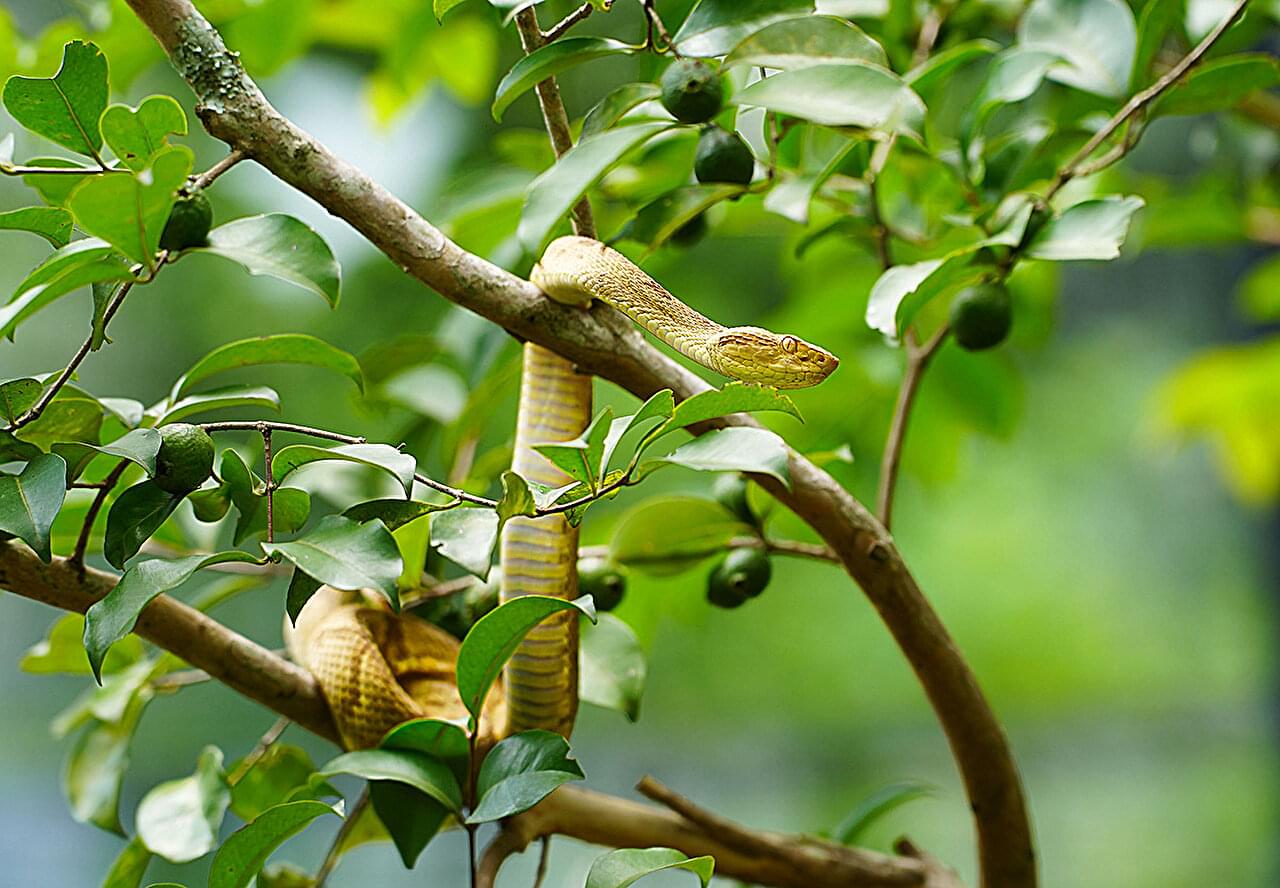
A research team led by scientists at the Butantan Institute in São Paulo, Brazil, has completed the most extensive genetic sequencing of a jararaca viper to date. The focus of the study was the genome of the golden lancehead (Bothrops insularis), particularly its venom genes. Since the species shares most of its genes with the other 48 species in the genus, the data serve as a reference for broader studies on the evolution of jararaca vipers and their toxins. The study is published in the journal Genome Biology and Evolution.
The golden lancehead was described in 1921 as a different species from the one known on the mainland, simply called jararaca (Bothrops jararaca). Isolated on Queimada Grande Island, off the coast of São Paulo, about 100,000 years ago, the population differed from its mainland counterparts to the point of separating into a new species.
In addition to having yellow skin, the golden lancehead is semi-arboreal and feeds on birds as an adult. Jararacas on the mainland, on the other hand, are dark in color and usually hunt small mammals, such as rats, on the ground. In 2021, B. jararaca became the first Brazilian snake to have its genome sequenced.