Toggle light / dark theme

Get the latest international news and world events from around the world.

Log in for authorized contributors

Magnetic clues inside atomic nuclei help explain how elements form in stars

A scientific team led by Facility for Rare Isotope Beams, or FRIB, has identified the origin of a mysterious excess of low-energy gamma rays emitted by the nucleus zinc-70. They found that the excess is caused by magnetic transitions within the nucleus. The study, “Magnetic Character of the Low-Energy Enhancement in 70 Zn,” published in Nature, sheds light on a long-standing puzzle in nuclear physics and has far-reaching implications for astrophysics.

The collaboration included scientists from 25 institutions in the United States, Canada, Italy, Germany, Norway and South Korea.

Algorithms create foundry-ready photonic circuits

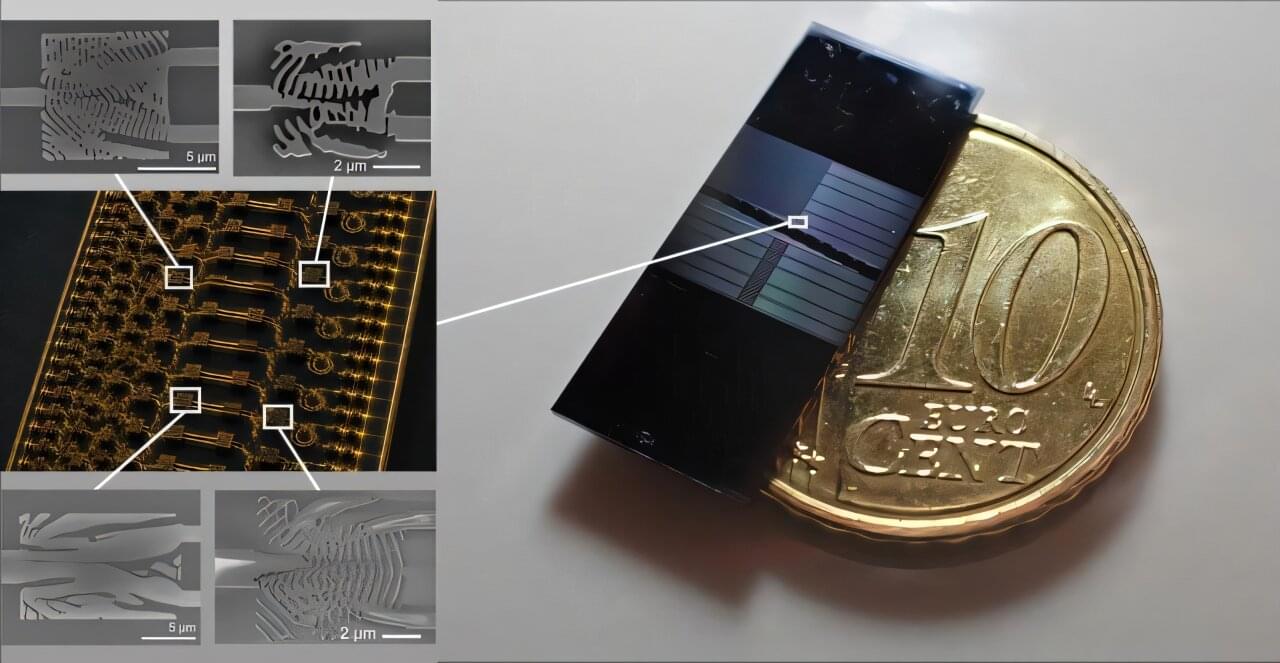
Photonic microchips can process data at extremely high speeds and are embedded in a wide variety of today’s technologies. Researchers at the Max Planck Institute for the Science of Light (MPL) and Harvard University have now succeeded in developing three functional components for such chips that are up to 500 times smaller than conventional designs. The researchers used inverse design, a computer algorithm, to achieve this. The results are published in Nature Communications.

Photonic microchips are among the key technologies of modern data processing. Their miniaturization and extremely fast data processing relative to electronic components make them essential building blocks in telecommunications, large-scale AI data centers, precision measurement and quantum technologies. Light is guided through micrometer-wide waveguides across chips only a few millimeters wide.

Photonic microchips incorporate various components, such as grating couplers, which couple light between fibers and the chip, and ring resonators, tiny circular structures that temporarily store light and strongly increase light intensity inside the chip.

Physicists turn to the universe’s ‘piano notes’ to detect hidden particles

It’s been said that a finely tuned ear knows the size and shape of a piano by merely listening to the instrument’s notes. An international team of physicists has now devised an analogous approach to detect the universe’s hidden particles at high energies—opening a potential pathway for discovering new laws of physics.

The work, which will appear in the journal Physical Review Letters, outlines how effective field theory (EFT) coefficients, which quantify how new laws of physics would influence known particle interactions at low energies, can be transformed into information about the nature of these hidden particles. CERN’s Large Hadron Collider, the scientists note, already searches for values of EFT coefficients through its measurement of particle collisions, thereby providing ready-to-use data for this approach.

“Like deducing the shape and mechanism of a piano from the sound of its notes, this breakthrough provides the means to use collider measurements to deduce the details of hidden particles at high energies,” explains Grant Remmen, the James Arthur Postdoctoral Fellow at New York University and one of the paper’s authors. “This solves a classic open problem in particle physics in an elegant and useful way, providing powerful and sharp mathematical tools that bridge high-energy theory and particle physics experiments.”
Prize honors discovery of altermagnetism as a third fundamental class of magnetism

One of Europe’s highest distinctions in condensed matter physics has been awarded for a discovery that is reshaping our understanding of magnetism: The 2026 Europhysics Prize of the European Physical Society (EPS) Condensed Matter Division goes to Professor Jairo Sinova of Johannes Gutenberg University Mainz (JGU), Dr. Libor Šmejkal and Professor Tomas Jungwirth for their discovery of altermagnetism—a previously unknown fundamental class of magnetism.

The prize recognizes their work establishing that nature hosts a third elementary form of collinear magnetism in addition to ferromagnetism and antiferromagnetism. The discovery overturns a century-old understanding of magnetic order and has opened an entirely new research field with major implications for quantum materials, condensed matter physics and future information technologies.

“This award recognizes a fundamental discovery that challenged one of the most established paradigms in condensed matter physics,” said Sinova, director of the Spin Phenomena Interdisciplinary Center (SPICE) at Mainz University. “Discovering that an entirely new magnetic phase had remained hidden for more than 100 years demonstrates that even the most mature scientific fields can still hold fundamental surprises.”

Golden Chickens Resurfaces With Four New Malware Families and Modular Implants

The threat actors behind the Golden Chickens malware-as-a-service (MaaS) ecosystem have resurfaced with four new malware families, indicating that the operators are showing no signs of stopping despite extensive public disclosures into their inner workings.

The malware families in question are: TinyEgg, ChonkyChicken, a modularized variant of ChonkyChicken, and a modified web browser credential theft utility codenamed ChromEggscalator. Recorded Future’s Insikt Group is tracking the group under the moniker TAG-195.

TAG-195 is a financially motivated malware-as-a-service (MaaS) developer whose tooling has been previously linked to TAG-127 as an operator and customer. The threat intelligence company said it has also observed TAG-127 deploying TinyEgg via ClickFix-style social engineering campaigns that trick unsuspecting users into manually executing malicious commands.

/* */