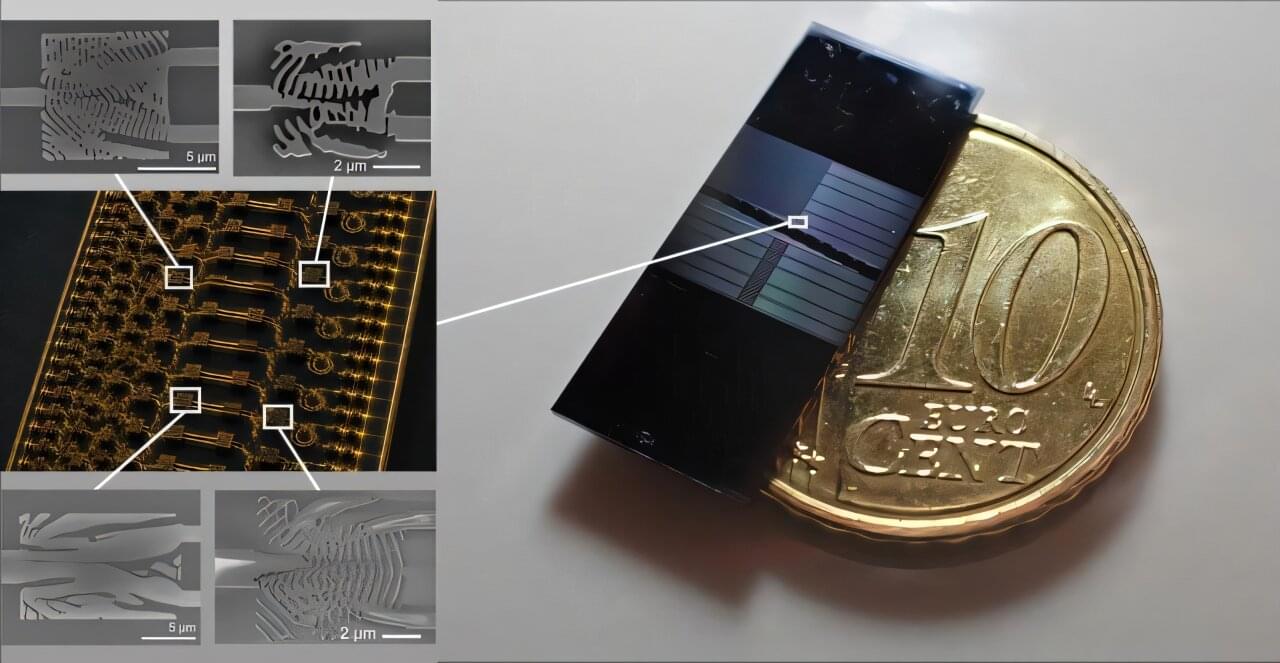
Photonic microchips can process data at extremely high speeds and are embedded in a wide variety of today’s technologies. Researchers at the Max Planck Institute for the Science of Light (MPL) and Harvard University have now succeeded in developing three functional components for such chips that are up to 500 times smaller than conventional designs. The researchers used inverse design, a computer algorithm, to achieve this. The results are published in Nature Communications.
Photonic microchips are among the key technologies of modern data processing. Their miniaturization and extremely fast data processing relative to electronic components make them essential building blocks in telecommunications, large-scale AI data centers, precision measurement and quantum technologies. Light is guided through micrometer-wide waveguides across chips only a few millimeters wide.
Photonic microchips incorporate various components, such as grating couplers, which couple light between fibers and the chip, and ring resonators, tiny circular structures that temporarily store light and strongly increase light intensity inside the chip.