Toggle light / dark theme

Get the latest international news and world events from around the world.

Log in for authorized contributors

Speech-to-reality system creates objects on demand using AI and robotics

Generative AI and robotics are moving us ever closer to the day when we can ask for an object and have it created within a few minutes. In fact, MIT researchers have developed a speech-to-reality system, an AI-driven workflow that allows them to provide input to a robotic arm and “speak objects into existence,” creating things like furniture in as little as five minutes.

With the speech-to-reality system, a robotic arm mounted on a table is able to receive spoken input from a human, such as “I want a simple stool,” and then construct the objects out of modular components. To date, the researchers have used the system to create stools, shelves, chairs, a small table, and even decorative items such as a dog statue.

“We’re connecting natural language processing, 3D generative AI, and robotic assembly,” says Alexander Htet Kyaw, an MIT graduate student and Morningside Academy for Design (MAD) fellow. “These are rapidly advancing areas of research that haven’t been brought together before in a way that you can actually make physical objects just from a simple speech prompt.”

Cosmic knots may finally explain why the Universe exists

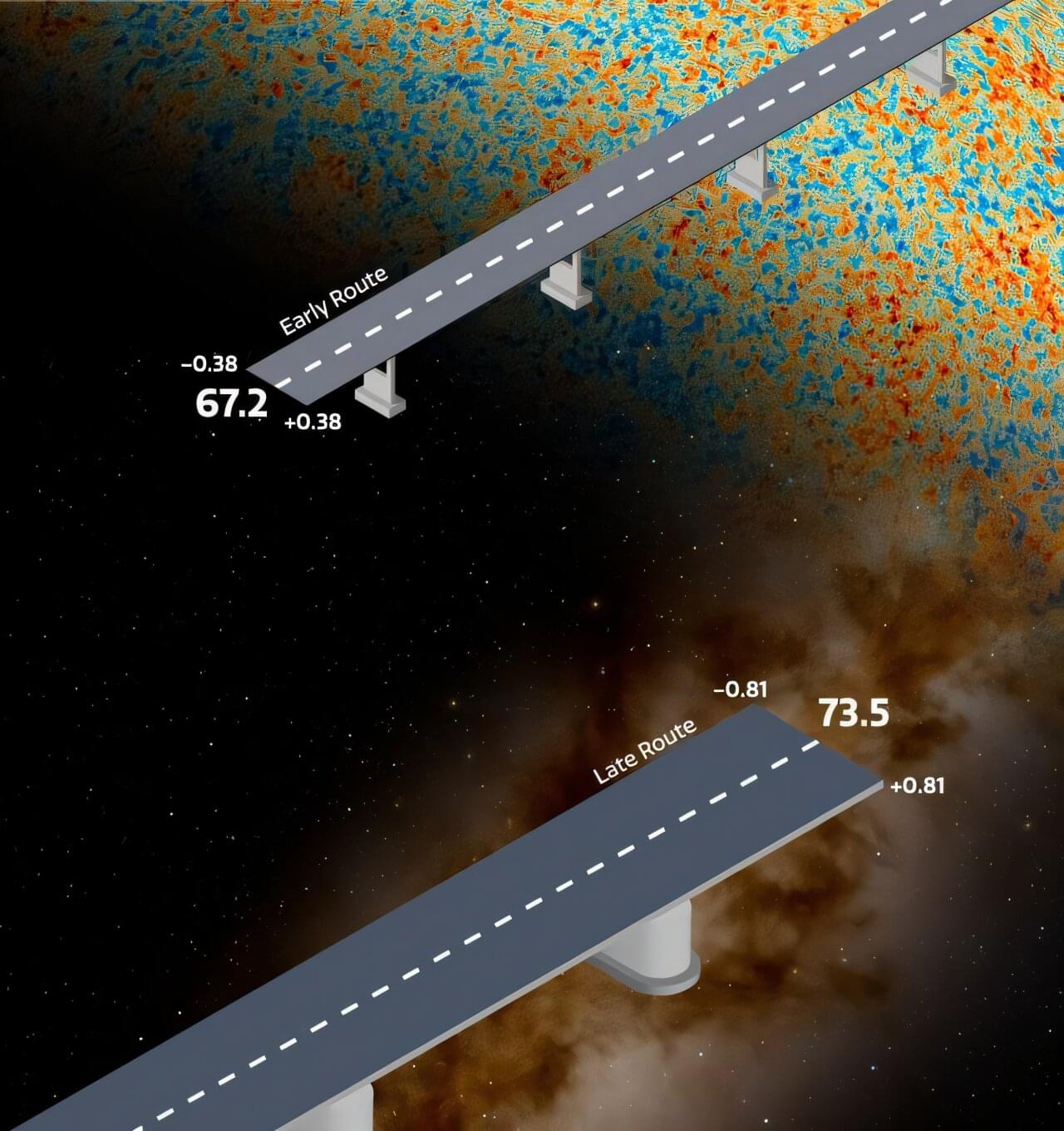
Knotted structures once imagined by Lord Kelvin may actually have shaped the universe’s earliest moments, according to new research showing how two powerful symmetries could have created stable “cosmic knots” after the Big Bang. These exotic objects may have briefly dominated the young cosmos, unraveled through quantum tunneling, and produced heavy right-handed neutrinos whose decays tipped the balance toward matter over antimatter.

In 1867, Lord Kelvin pictured atoms as tiny knots in an invisible medium called the ether. That picture turned out to be wrong, since atoms are built from subatomic particles rather than twists in space. Yet his discarded idea of knotted structures may still help explain one of the deepest questions in science: why anything in the universe exists at all.

A team of physicists in Japan has now shown that knotted structures can naturally appear in a realistic particle physics model that also addresses several major mysteries, including the origins of neutrino masses, dark matter, and the strong CP problem. Their study, published in Physical Review Letters, suggests that such “cosmic knots” could have formed in the violently changing early universe, briefly taken over as a dominant form of energy, and then collapsed in a way that slightly favored matter over antimatter. As they formed and decayed, these knots would have stirred spacetime itself, producing a distinctive pattern of gravitational waves that future detectors might be able to pick up, which is rare for a problem that is usually very difficult to test directly.

THE BRAVE AND THE COWARDS — SRI Newsletter December 2025

As the geopolitical climate shifts, we increasingly hear warmongering pronouncements that tend to resurrect popular sentiments we naïvely believed had been buried by history. Among these is the claim that Europe is weak and cowardly, unwilling to cross the threshold between adolescence and adulthood. Maturity, according to this narrative, demands rearmament and a head-on confrontation with the challenges of the present historical moment. Yet beneath this rhetoric lies a far more troubling transformation.

We are witnessing a blatant attempt to replace the prevailing moral framework—until recently ecumenically oriented toward a passive and often regressive environmentalism—with a value system founded on belligerence. This new morality defines itself against “enemies” of presumed interests, whether national, ethnic, or ideological.

Those who expected a different kind of shift—one that would abandon regressive policies in favor of an active, forward-looking environmentalism—have been rudely awakened. The self-proclaimed revolutionaries sing an old and worn-out song: war. These new “futurists” embrace a technocratic faith that goes far beyond a legitimate trust in science and technology—long maligned during the previous ideological era—and descends into open contempt for human beings themselves, now portrayed as redundant or even burdensome in the age of the supposedly unstoppable rise of artificial intelligence.

Ancient sea anemone sheds light on animal cell type evolution

One of the biggest quests in biology is understanding how every cell in an animal’s body carries an identical genome yet still gives rise to a kaleidoscope of different cell types and tissues. A neuron doesn’t look nor behave like a muscle cell but has the same DNA.

Researchers think it comes down to how cells allow different parts of the genome to be read. Controlling these permissions are regulatory elements, regions of the genome which switch genes on or off. A detailed overview of how they do this is largely restricted to a handful of classic model organisms like mice and fruit flies.

Turning plastic waste into valuable chemicals with single-atom catalysts

The rapid accumulation of plastic waste is currently posing significant risks for both human health and the environment on Earth. A possible solution to this problem would be to recycle plastic waste, breaking it into smaller molecules that can be used to produce valuable chemicals.

Researchers at Nanjing Forestry University and Tsinghua University recently introduced a new approach to convert polystyrene (PS), a plastic widely used to pack some foods and other products, into toluene, a hydrocarbon that is of value in industrial and manufacturing settings. Their proposed strategy, outlined in a paper published in Nature Nanotechnology, entails heating polystyrene waste in hydrogen and breaking it down into smaller vapor molecules, a process known as hydro-pyrolysis.

Life-cycle and techno-economic analyses performed by the team showed that the newly introduced process could reduce the carbon footprint of toluene production by 53%, producing toluene at an estimated cost of $0.61/kg, which is below the current industry benchmark.

Homer1 gene calms the mind and improves attention in mice

Attention disorders such as ADHD involve a breakdown in our ability to separate signal from noise. The brain is constantly bombarded with information, and focus depends on its ability to filter out distractions and detect what matters.

Stimulant medications improve attention by boosting activity in circuits known to govern attention, such as the prefrontal cortex. But a new study reveals a surprising alternative: reduce background activity as a way of turning down extraneous noise.

In a paper published in Nature Neuroscience, researchers show that the Homer1 gene plays a critical role in shaping attention in just that way. Mice with lower levels of two specific versions of the gene enjoyed quieter brain activity and improved ability to focus.

Prevalence and Factors Associated With Atrial Fibrillation Among Young Patients With Ischemic Stroke

Stra8 links neuronal activity to inhibitory circuit protection in the adult mouse brain.


Huang et al. show that Stra8, a gene previously thought to be germline specific, is expressed in the adult mouse hippocampus in an activity-dependent manner. Stra8 protects neuronal integrity and cognition by regulating neuromodulator genes and preserving inhibitory circuit function.

/* */