Toggle light / dark theme

Get the latest international news and world events from around the world.

Log in for authorized contributors

Scientists ‘see’ nanoscale forces, providing evidence of electric fields at the air‑water interface

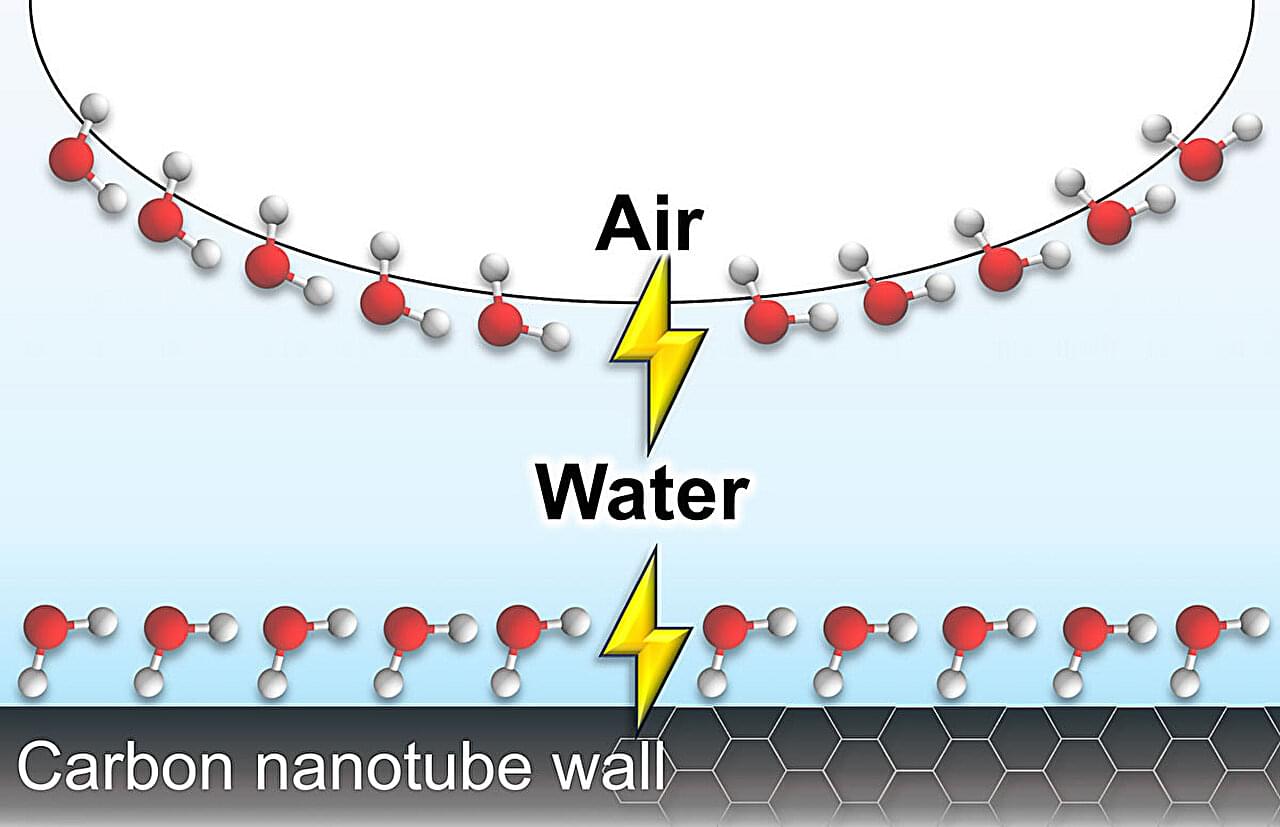
Bubbles are round, and we know surface tension does that. But squeeze that gas-liquid boundary into a space only a few tens of nanometers wide—could other forces be at work?

Now, an international team from Kyushu University, Nankai University, Stanford University and the University of Alberta has taken a direct look. Publishing on July 14 in the Journal of the American Chemical Society, they combined three-dimensional transmission electron microscopy (3D TEM) with force analysis to provide evidence for a powerful electric field at nanoconfined air-water interfaces.

“Water looks simple, but it’s actually incredibly complex,” says Qin-Yi Li, associate professor at Kyushu University’s Faculty of Engineering. “Its structure is especially rich at the water-air interface, and it shifts dramatically with scale.”
Curved surfaces reshape active materials, localizing vibrations near defects

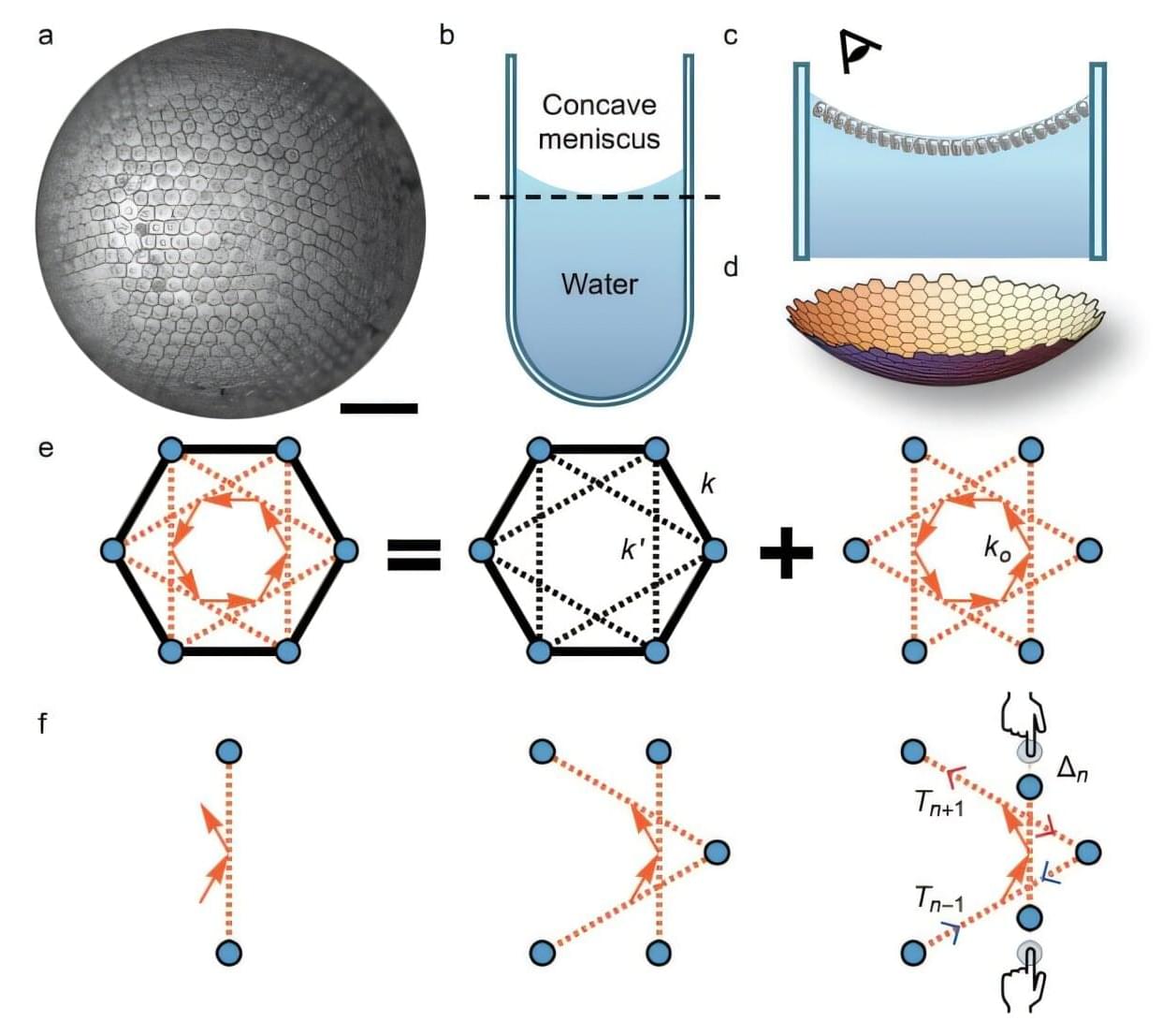
Many materials, both living and engineered, are powered from within. Scientists have thoroughly investigated how such ‘active’ materials operate, but so far, mostly in circumstances where the curvature of the environment does not play a role. In research published in Physical Review Letters this week, a team of physicists proposes a framework to describe how active materials operate in the presence of curvature. The framework explains striking biological observations and may lead to geometry as a design parameter for new materials.

Examples of active materials include tissues made of moving cells and mechanical metamaterials that use embedded motors or actuators. A major difference between such active materials and ordinary materials lies in the way they deform. Push an ordinary material, and it will deform where the force acts. Active materials, on the other hand, can generate further forces that redirect deformations, leading to all kinds of unexpected, but often quite useful, behavior.

A striking example comes from observations in biological experiments, where starfish embryos were found to self-organize into crystal-like structures on a water surface. In this example, an extra factor comes into play: The water surface in the test tubes used in the experiments is not flat but slightly curved—just like the surface of water in an ordinary drinking glass that curves upward where the water touches the glass. One consequence of the curvature is that the starfish embryos don’t fit on the surface in a completely regular pattern: Instead, the pattern has occasional irregularities or defects.

Laser stability method advances precision control of electrons with light

Researchers at the University of Oldenburg’s Institute of Physics are working on techniques for precision control of electric fields of light, which allow the dynamics of individual electrons to be manipulated in experiments. Now a team from the Attosecond Microscopy research group, led by Dr. Jan Vogelsang, has taken a decisive step toward this goal.

In a paper published in the journal Applied Physics B —Lasers and Optics, the researchers present a laser system that generates 200,000 light pulses per second. Six Oldenburg researchers collaborated with members of a research group led by physics Nobel laureate Anne L’Huillier at Lund University in Sweden to perform a detailed characterization of the laser system.

During the experiments, the precise position of the light wave—consisting of infrared light, which is invisible to the human eye—remained extremely stable even over periods of several hours. The stable light fields resulting from a continuous series of identical light pulses make experiments on electron control possible—foundational research that could eventually lead to the development of devices such as ultrafast transistors that operate at the speed of light.

Sound-based traps reveal how fragile biomolecular droplets move, merge and change stiffness

Being able to measure something plays a vital role in our ability to understand many phenomena. But measuring can often affect what we are trying to measure. This is particularly the case when measuring substances that are very small, soft or fragile. In a recent study published in PRX Life, a research team led by the University of Osaka successfully used acoustic tweezers as a contactless method to investigate an important type of fragile material called biopolymer condensates.

Biopolymer condensates are liquid-like droplets composed of proteins and/or nucleic acids and are involved in regulating a variety of physiological functions within cells to keep them healthy. However, problems with these droplet systems can result in a variety of diseases, including neurodegenerative diseases. The mechanical properties of biopolymer droplets, such as fluidity and stiffness, are important for biological activity.

Better knowledge of the mechanical properties of these droplets will help us understand their roles in healthy cells and disease states. However, these droplets are very small and fragile and are difficult to investigate using conventional techniques.

The global race to make a practical quantum computer just took a big leap forward

In the global race to build bigger and better quantum computers, researchers have taken a step forward. A new machine called Helios is radically different from other quantum computers.

Quantum computers harness the power of quantum mechanics, the laws that govern physics at atomic and subatomic scales. Among various designs for such machines, Helios is a trapped-ion quantum computer, which means it uses charged atoms suspended in free space using electromagnetic fields.

It operates using 98 qubits—the units of information that a quantum computer uses to process data. This number of qubits makes it the largest trapped-ion quantum computer built so far. Quantinuum, the company behind the device, is based in Cambridge, U.K., and Broomfield, Colorado. It demonstrated earlier machines operating on 32 qubits in 2023 and 56 qubits in 2025.

Microsoft Copilot Personal Flaws Could Let One Click Exfiltrate Data From Connected Apps

CoSnitch is tracked as CVE-2026–24301 in Microsoft’s Security Update Guide. The research names Copilot Personal, the consumer assistant hosted at copilot.microsoft.com, and does not state that the same behavior affected Microsoft 365 Copilot.

The researchers said they found no evidence that CoSnitch was exploited in the wild. They reached the parameter by repeatedly asking Copilot why a prompt could not be made to run without user interaction, an approach the firm calls meta-hacking. Each refusal carried a technical justification, and the assistant eventually named a parameter, autorun=1, along with the session conditions under which it worked and the protections that were supposed to have disabled it.

When the researchers built the URL exactly as described, the parameter Copilot had said no longer worked executed. Copilot “wasn’t breached; it was played,” Varonis said in its report.

Clop created custom web shell for Windchill data theft attacks

A custom Java web shell likely linked to the Clop ransomware gang was designed specifically for PTC Windchill and FlexPLM servers, with built-in features to decrypt credentials, enumerate file repositories, and steal files.

Cybersecurity company ReliaQuest analyzed the web shell after it is believed to have been deployed in recent data theft attacks exploiting CVE-2026–12569, a critical remote code execution vulnerability affecting PTC Windchill.

ReliaQuest says the implant is not a generic web shell repurposed for the attacks, but was instead built with detailed knowledge of Windchill’s internal APIs, database schema, keystore, and file-vault structure.

Microsoft tests faster Windows File Explorer, new context menu

Microsoft has started testing a faster File Explorer and a less cluttered and more customizable context menu in Windows 11 preview builds rolling out to Insiders this week.

As the File Explorer team explained in a Monday blog post, the changes focus on improving File Explorer speed, performance, and reliability and addressing customer-reported issues.

The redesigned context menu experience also aims to make it faster, reduce clutter, and make it more customizable than ever before.

/* */