Nice.
Forum on Quantum Information Science addresses challenges to the field, and identifies strategic options and innovative approaches to move QIS forward.
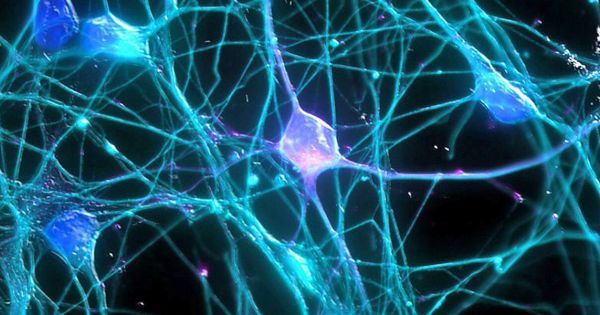
Spark Therapeutics is within striking distance of a landmark green light from the FDA for its treatment for certain forms of blindness.
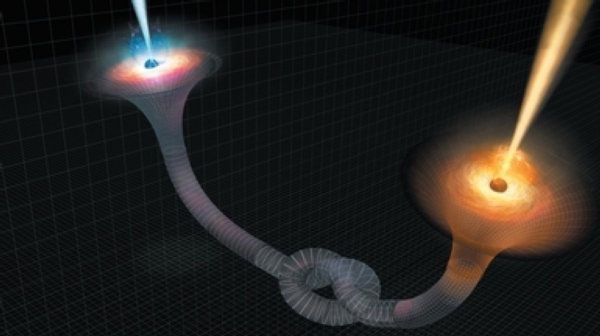
The weird quantum phenomenon of entanglement could produce shortcuts between distant black holes.
In Brief:
Great advancement around how to make QC available on small scale devices.
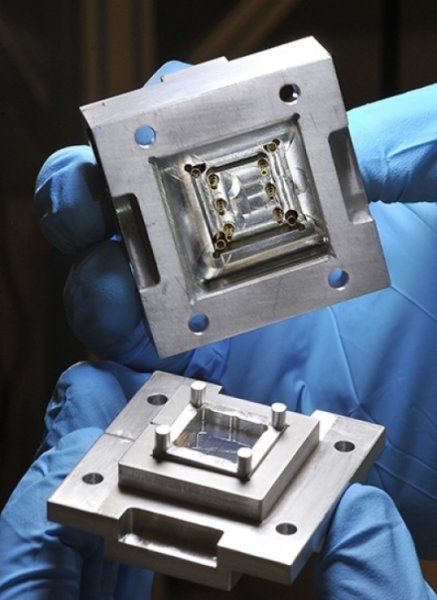
Researchers from the Institute for Quantum Computing (IQC) at the University of Waterloo led the development of a new extensible wiring technique capable of controlling superconducting quantum bits, representing a significant step towards to the realization of a scalable quantum computer.
“The quantum socket is a wiring method that uses three-dimensional wires based on spring-loaded pins to address individual qubits,” said Jeremy Béjanin, a PhD candidate with IQC and the Department of Physics and Astronomy at Waterloo. He and Thomas McConkey, PhD candidate from IQC and the Department of Electrical and Computer Engineering at Waterloo, are lead authors on the study that appears in the journal Physical Review Applied as an Editors’ Suggestion and is featured in Physics. “The technique connects classical electronics with quantum circuits, and is extendable far beyond current limits, from one to possibly a few thousand qubits.”
One promising implementation of a scalable quantum computing architecture uses a superconducting qubit, which is similar to the electronic circuits currently found in a classical computer, and is characterized by two states, 0 and 1. Quantum mechanics makes it possible to prepare the qubit in superposition states, meaning that the qubit can be in states 0 and 1 at the same time. To initialize the qubit in the 0 state, superconducting qubits are brought down to temperatures close to −273 degrees Celsius inside a cryostat, or dilution refrigerator.
They basically put a genie back in its bottle.
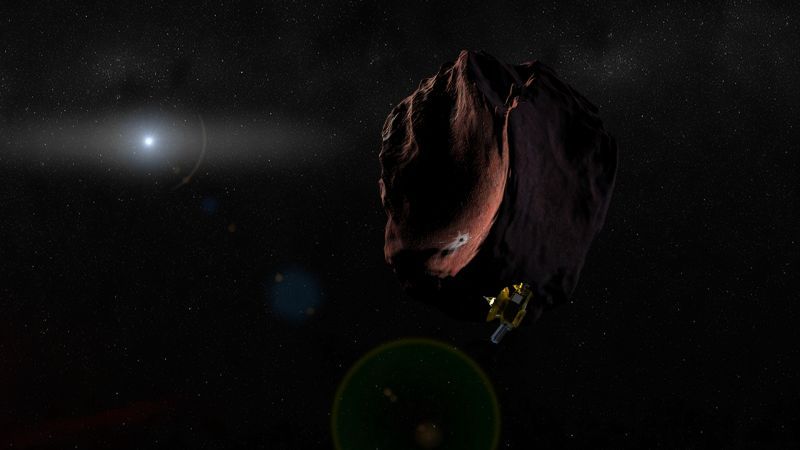
NASA’s New Horizons space probe is currently speeding towards a mysterious Kuiper Belt Object known as MU69. Recent observations of the distant object indicate a very reddish surface—possibly even redder than the splotches found on Pluto.
We are closer than ever to a world of unlimited energy.
Scientists create the highest plasma pressure ever recorded with the Alcator C-Mod reactor in a breakthrough for clean energy technology.
Mergers and acquisitions of artificial intelligence startups have been on the rise since 2011. This company is leading the trend.

By Tess Townsend
The ALIAS system, developed by DARPA, could cut down on crew requirements in military and civilian small aircraft by taking control with a robotic arm. Although it’s still a ways off production, the system has been successfully demonstrated on a Cessna Caravan aircraft.