Supercomputer simulations reveal how turbulence supports a Goldilocks regime for operating a fusion reactor.
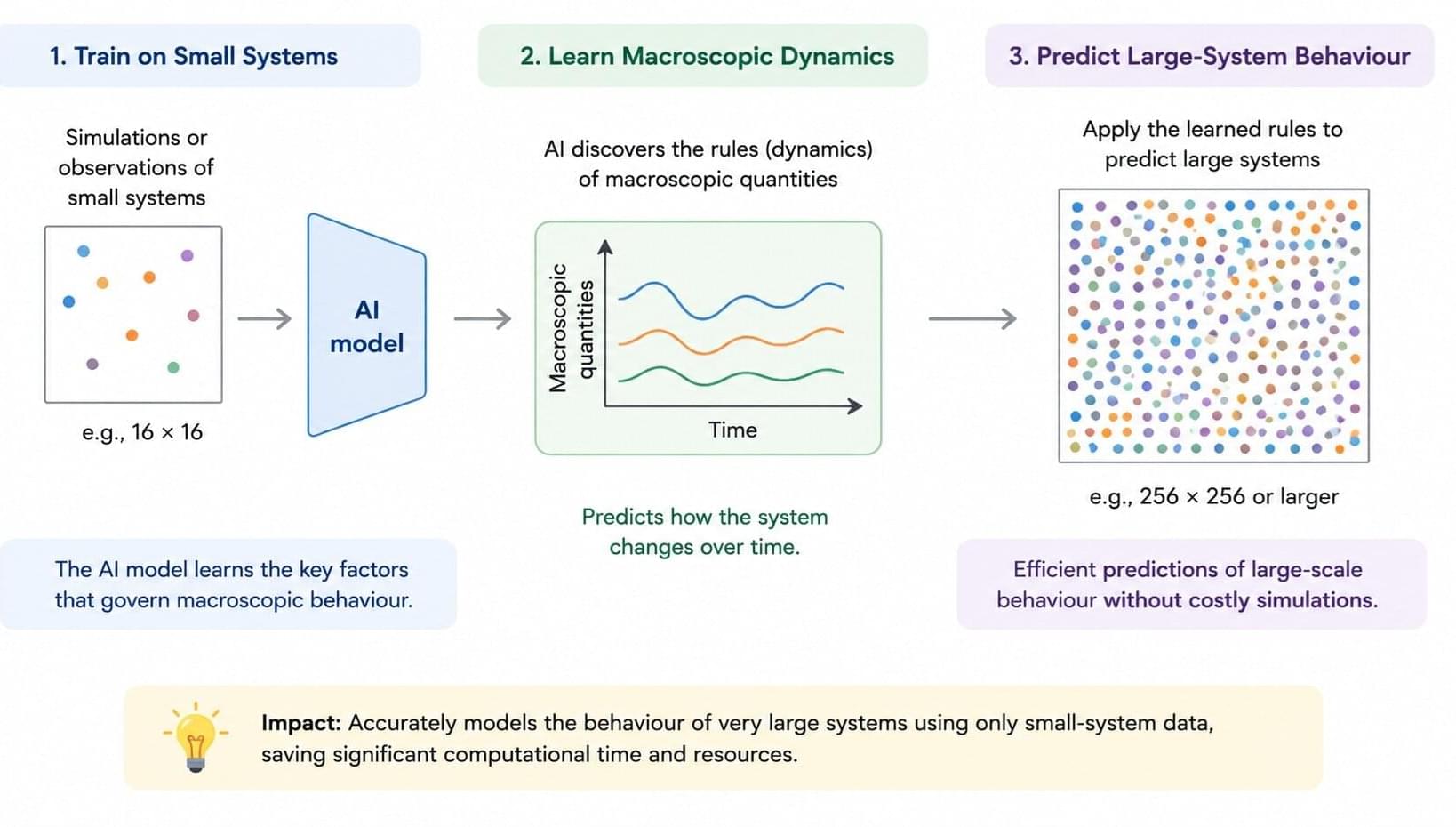
Researchers from the National University of Singapore (NUS) have developed artificial intelligence (AI) methods that learn the large-scale behavior of complex materials from microscopic data. By automatically identifying a small number of hidden variables that capture the collective behavior of a system, the methods can predict how materials evolve over time while reducing the need for costly simulations.
Understanding the behavior of materials at the macroscopic scale is essential for designing new technologies, from energy-efficient electronics to advanced alloys. However, material properties emerge from the interactions of vast numbers of atoms, and simulating every atom over long periods is often computationally impossible, even on modern supercomputers.
A major challenge in materials science is connecting these microscopic processes, such as atomic motion, to observable material properties. Existing approaches often require large-scale simulations that are prohibitively expensive.
The promise of quantum computing is to solve complex problems faster and more energy-efficiently than today’s supercomputers—from optimizing logistics to simulating molecules. This goal is coming within reach as the number of qubits—the computational units of quantum computing—increases.
But in addition to the technological challenges of scaling, there is another, less-considered issue: In the New Journal of Physics, researchers at the Helmholtz-Zentrum Dresden-Rossendorf (HZDR) demonstrate that, in extreme cases, the so-called quantum Zeno effect can nearly halt computational processes as the number of qubits increases—a dreaded phenomenon comparable to a traditional computer “freezing.”
“The quantum Zeno effect is a previously overlooked obstacle to a certain class of quantum computers,” says Dr. Gernot Schaller, head of Quantum Technologies at HZDR’s Institute of Theoretical Physics. These so-called adiabatic quantum computers operate according to a special principle: Their qubits are always in their ground state, the lowest energy state. To solve a computational problem, the qubits’ energy landscape is gradually altered—slowly enough for them to adapt continuously and follow the changing ground state. Once the transformation is complete, the ground state immediately encodes the solution to the problem.
In recent years, research using artificial intelligence to predict material properties has advanced rapidly. Neural network quantum Monte Carlo methods have attracted attention as highly accurate simulation techniques. However, their extremely high computational cost has limited their application to small molecular systems. This study introduces a new computational method that overcomes this limitation.
Methods that simulate electron-level mechanisms on supercomputers are widely used to explore novel materials and understand biological phenomena. There is strong demand for new approaches that can deliver faster predictions while maintaining high accuracy.
Playing board games can be fun, challenging, infuriating and a great way to pass the time. They can also help scientists understand how we solve new problems.
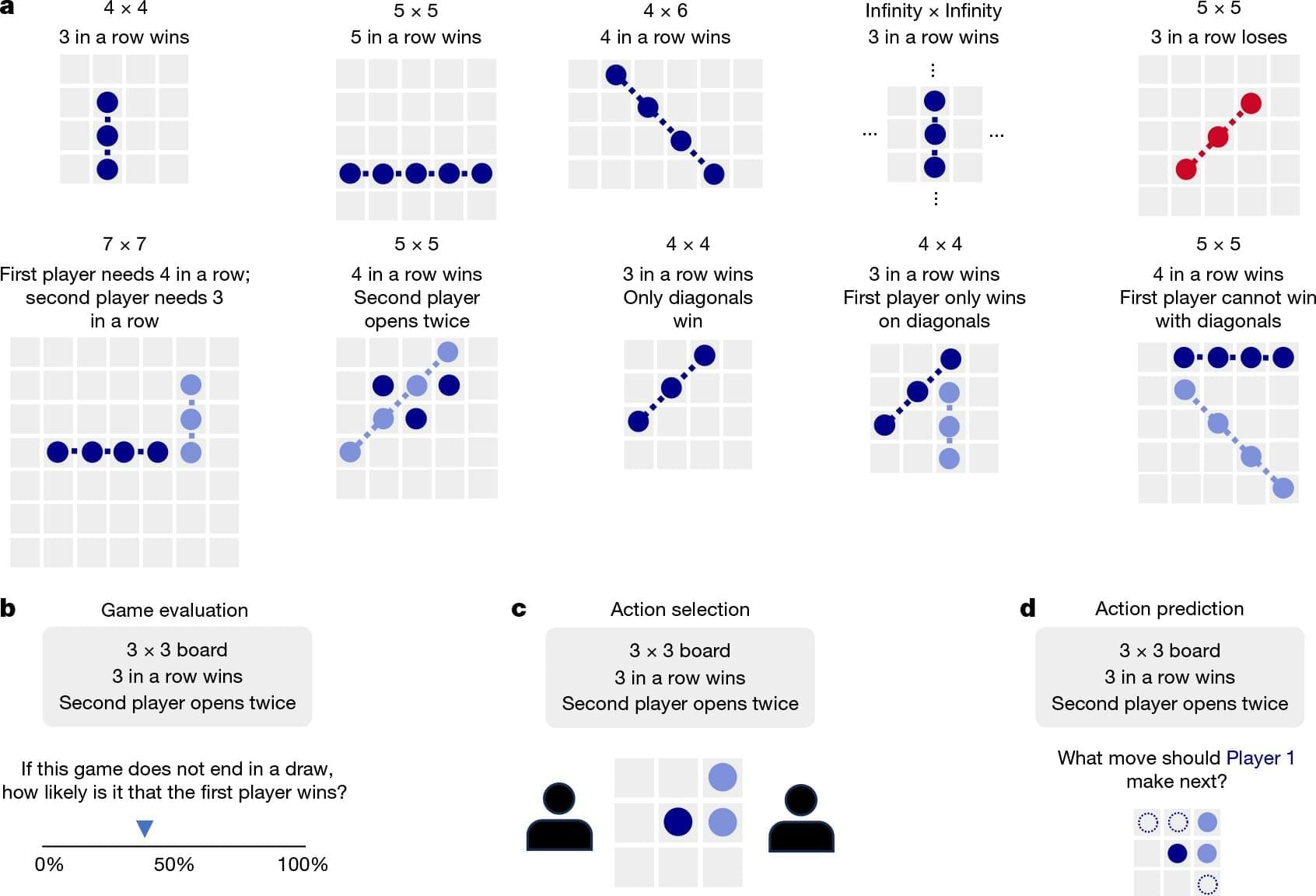
In a study published in the journal Nature, researchers created brand-new strategy games to see how players reason before tackling games they have no experience with. The goal of this research was to see how people react when they are thrown into an unfamiliar situation.
Most previous studies focused on how experts master games they already know or how massive supercomputers calculate millions of moves. What was missing was how everyday people reason about a game before they play it, which could provide insights into how we make quick decisions about situations we’ve never encountered before.
Quantum computers promise to solve problems that would take even the fastest conventional supercomputers a vast amount of time, but the quantum information they store and process is extremely sensitive to even tiny disturbances from their surroundings. To keep these systems operating reliably, they need to be constantly recalibrated—interrupting their calculations in the process.
In a new experiment published in Nature, researchers led by Volodymyr Sivak at Google Quantum AI developed a machine-learning approach that continuously adjusts a quantum computer as it works. Their approach could allow quantum calculations to run far longer without costly interruptions.
A team of scientists from Oak Ridge National Laboratory, Cleveland Clinic and IBM has calculated nine molecular configurations of a promising material to produce fuel for fusion energy—the first known instance of such computations on quantum computers.
Such calculations, demonstrated in a new paper published on the arXiv preprint server, are computationally challenging for classical computers to scale when working alone. They are a fundamental step toward optimizing the production and extraction of tritium—an extremely rare material in nature that is necessary to produce fusion energy with most of the proposed machines. Ensuring adequate supplies of tritium has long been a barrier to realizing the promise of clean, abundant energy from fusion power plants, and solving this issue is a key objective of the U.S. Department of Energy’s Genesis Mission.
Quantum computers are well-suited to computing the atomic-level chemistry of a liquid salt that contains fluorine, lithium and beryllium (FLiBe), one of the leading candidate materials for extracting tritium fuel in fusion reactors. To compute different configurations of clusters of FLiBe, the team used the same quantum-centric supercomputing techniques now being applied to 12,635-atom protein simulations with Cleveland Clinic. These methods can calculate the quantum behavior of electrons in complex materials, complementing and enhancing the capabilities of classical supercomputers and algorithms.
By remotely accessing an IBM quantum computer, a research scientist at Lawrence Berkeley National Laboratory has successfully simulated a key process in particle physics: hadronization. Although based on a simplified model of quantum mechanics, the project lays the groundwork for how physicists can leverage the power of quantum computers to make large scientific calculations beyond the capabilities of classical supercomputers. The research is published in the journal Physical Review D.
Hadronization occurs when two or more quarks—the subatomic building blocks of matter—bind together through the strong nuclear force to form composite particles called hadrons. The most familiar examples of hadrons are protons and neutrons, which form the nuclei of atoms. So, having a better understanding of the hadronization process means having a better understanding of the structure of matter, and—in turn—the universe.
Physical experiments have not been able to reveal every step of the process, however. Researchers at the Large Hadron Collider (LHC) at CERN accelerate protons to near light speeds, guide them into collisions and study the resulting debris of quarks and antiquarks. But these particles can only be indirectly measured before they immediately undergo hadronization—hence the need for computer simulations to fill in the gaps of these scientific observations.
Wright Patterson Air Force Base has a new advanced problem solver for future military systems and weapons. It’s called the Flyer, named in honor of Wilbur and Orville Wright and their research in aerodynamics.
The Flyer is the Pentagon’s latest supercomputer. It has more than 186,000 cores able to process millions of advanced calculations in a few seconds.
David Shahady, deputy director of the Air Force Research Laboratory’s Digital Capabilities Directorate, equated the abilities of this unit to a pop-culture sci-fi character.