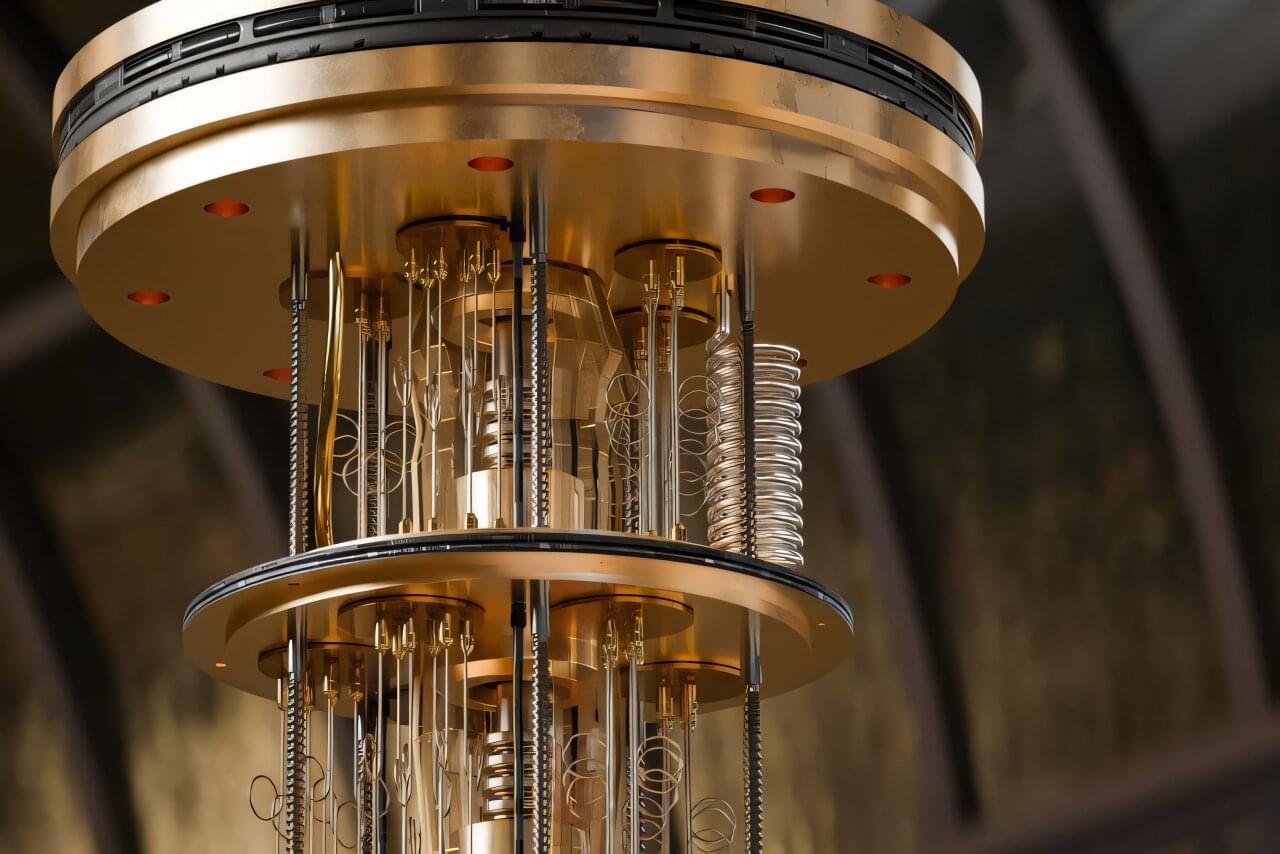
The promise of quantum computing is to solve complex problems faster and more energy-efficiently than today’s supercomputers—from optimizing logistics to simulating molecules. This goal is coming within reach as the number of qubits—the computational units of quantum computing—increases.
But in addition to the technological challenges of scaling, there is another, less-considered issue: In the New Journal of Physics, researchers at the Helmholtz-Zentrum Dresden-Rossendorf (HZDR) demonstrate that, in extreme cases, the so-called quantum Zeno effect can nearly halt computational processes as the number of qubits increases—a dreaded phenomenon comparable to a traditional computer “freezing.”
“The quantum Zeno effect is a previously overlooked obstacle to a certain class of quantum computers,” says Dr. Gernot Schaller, head of Quantum Technologies at HZDR’s Institute of Theoretical Physics. These so-called adiabatic quantum computers operate according to a special principle: Their qubits are always in their ground state, the lowest energy state. To solve a computational problem, the qubits’ energy landscape is gradually altered—slowly enough for them to adapt continuously and follow the changing ground state. Once the transformation is complete, the ground state immediately encodes the solution to the problem.