Toggle light / dark theme

Trillions of rogue planets may be wandering alone in our galaxy

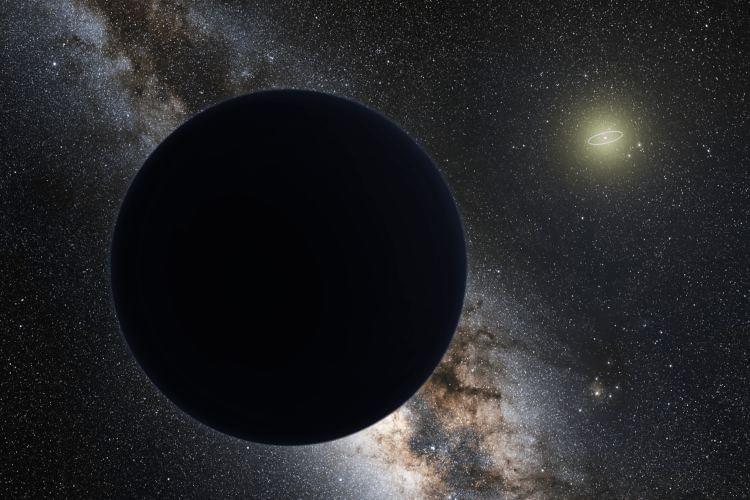
In an astonishing revelation, researchers from NASA and Japan’s Osaka University have uncovered data suggesting the rogue planets – those solitary wanderers unhinged from any star – significantly outnumber the approximately hundred billion planets which orbit stars.

The findings indicate that NASA’s Nancy Grace Roman Space Telescope, slated for launch by May 2027, could discover as many as 400 rogue planets similar in mass to Earth. A likely candidate for this category has already been singled out from the data.

David Bennett is a senior research scientist at NASA’s Goddard Space Flight Center and co-author of two papers detailing these findings.

Astronomers may have found two exoplanets sharing the same orbit

We may have the first concrete evidence of ‘mind-blowing’ Trojan exoplanets.

An international team of astronomers used the Atacama Large Millimeter/submillimeter Array (ALMA) to find what they believe is a ‘sibling’ alien world to an exoplanet orbiting a distant star.

The team detected a cloud of debris that may be sharing the planet’s orbit and could be the building blocks of a new planet or the remnants of one in the process of forming a press statement reveals.

Astronomers investigate recent star formation history of the Fireworks Galaxy

Astronomers from the University of Washington in Seattle and elsewhere have conducted Hubble Space Telescope (HST) observations of the nearby Fireworks Galaxy. Results of the observational campaign, presented July 10 on the preprint server arXiv, yield crucial insights into the recent star formation history of this galaxy.

Discovered in 1,798, the Fireworks Galaxy (also known as NGC 6946) is a nearby face-on star forming located some 25.5 million light years away. The galaxy has a size of 87,300 and its name was coined due to an unusually large number of supernovae observed in it—about ten times more than in the Milky Way.

Although many studies of the Fireworks Galaxy have been conducted to date, its star formation rate (SFR) is not well constrained, estimated to be between three and 12 per year. This discrepancy is mainly due to the diverse methods of measuring and the wide range of different distances used.

NASA’s first new wind tunnel in 40 years will turn science fiction to fact

Flying cars. Space tourism. Safe reentry for astronauts coming back from Mars.

These technologies are still , but some won’t be for much longer, according to Charles “Mike” Fremaux, NASA Langley Research Center’s chief engineer for intelligent flight systems.

To test these concepts, particularly in regard to public and military safety, NASA Langley is building its first new wind in over 40 years. The NASA Flight Dynamic Research Facility, a project Fremaux has been pursuing for 25 years, will replace two smaller wind tunnels that are around 80 years old. The center’s most recent and largest, the National Transonic Facility, was built in 1980.

Researchers use AI to help simulate and predict solar events

This could help us improve our understanding of the Sun and its impact on space weather.

A collaborative effort between researchers at the University of Graz in Austria and the Skolkovo Institute of Science and Technology (Skoltech) in Russia used artificial intelligence (AI) to study the magnetic field in the upper atmosphere of the Sun, a press release said.

The solar magnetic field is a poorly understood area of research among astronomers. Even after centuries of watching the Sun, we only have limited information about how sunspots are formed or whether they will lead to events like a flare or a coronal mass ejection (CME).

/* */