Toggle light / dark theme

Space Innovation Congress

The is a Space Technology Conference and Exhibition, taking place in London on 7–8 April 2016. It is set to showcase the most cutting edge technologies and uses of Space Technology providing insight from over 50 speakers sharing their unparalleled industry knowledge and real-life experiences.

This year’s Space Innovation Congress will be highlighting the most innovative advancements in Space technology and will look at how these are being applied to many industry verticals from farming to banking, and the practical case studies that are coming out of these projects.

With user cases with dedicated tracks covering the entire Space exploration and Earth observation ecosystems: Satellites, Big data, Crop monitoring, Space debris, Maritime surveillance, Space weather and its impact on banking systems, Biomedical, Commercial space collaboration and Telecoms.

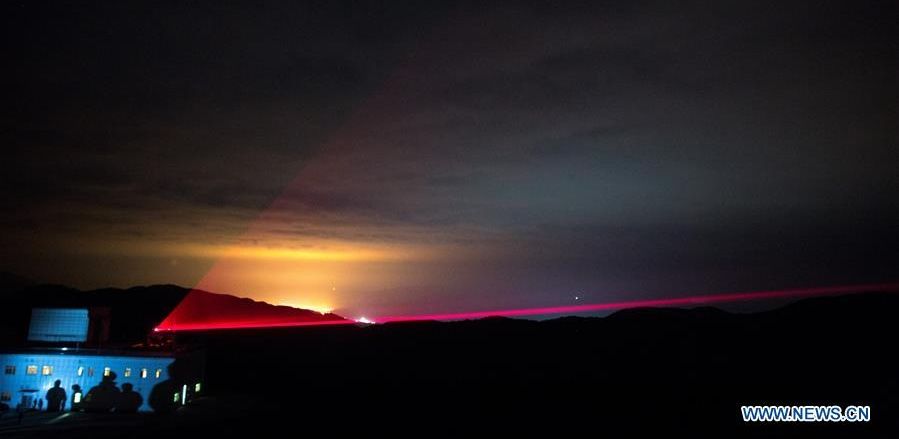
China to conduct more than 20 satellite launches in 2016

(File photo)

The year 2016 is a big year for China’s aerospace industry, as several rockets will be sent into space, including Tiangong-2, an orbiting space lab and Shenzhou-11, a manned spacecraft with two people on board.

Two new types of rockets will be launched in 2016. Long March-7, scheduled to be launched in June, will put the country’s first cargo ship, Tianzhou-1, into space in the first half of 2017 to dock with Tiangong-2 and conduct experiments.

Can SkyFi Really Give the Entire World Free Internet?

Wifi distribution across this planet is patchwork of crazy: You can tweet from Mt. Fuji but lord help you if you want to send an email in Cuba. Thursday, Israeli company SkyFi announced it will be the one to finally soak the world in wifi from space.

In a press release announcing $3 million in funding from Jerusalem Venture Partners and the Liberty Israel Venture Fund, the company said it would get around the problems preventing reliable wifi from traditional satellites by launching nano satellites whose 55-centimeter diameter antenna could be folded up to make launching cheaper, then expanding once in orbit.

“The high flexibility of our nano satellites and the ability to provide multiple services to different customers enables us to offer free internet access to the whole planet in the same manner as GPS services are free. We think this has the potential to bridge great divides and give everyone worldwide a part in the great global connected community,” Raz Itzhaki Tamir, Co-Founder and CEO of SkyFi, said in the press announcement.

Israel startup SkyFi gets $3M to spread internet globally

“We think the only way to effectively connect people all over the world is through satellites.”

Israel-Flag-Small Gedalyah Reback 23 hours ago.

There’s been much ado about getting internet to the world’s disaffected and disconnected populations. Large swathes of rural and underdeveloped areas of Asia, Africa and somewhat in Latin America have garnered the attention of Silicon Valley’s biggest superpowers Google and Facebook.

Can a tree grow in space?

Satellites and spacecraft are generally complex to build on the ground, expensive to launch and obsolete in a decade or less.

These objects end up floating in orbit around the planet contributing to the pollution surrounding the Earth. But what if there was an alternative?

That’s the question David Barnhart, director of USC’s Space Engineering Research Center and lead for the Space Systems and Technology group for the USC Information Sciences Institute, is contemplating. What if we could just “grow” spacecraft, repurpose a hybrid of inorganic and organic materials and even allow food to grow in space?

DigitalGlobe Partners with TAQNIA and KACST to Develop Constellation of Small Imaging Satellites

TAQNIA and KACST signed an agreement on February 21, 2016, to form a joint venture that will be responsible for developing six or more sub-meter resolution imaging satellites.

KACST will construct, integrate, and launch the satellites, and it will own 50% of the satellites’ imaging capacity inside of KACST’s communication cone, which includes Saudi Arabia and the surrounding region. And, DigitalGlobe will have rights to the other 50% of the capacity inside this region and 100% of the satellites’ capacity outside of the region.


WESTMINSTER, Colo.–()– DigitalGlobe, Inc. (NYSE: DGI), the global leader in earth imagery and information about our changing planet, today announced the formation of a joint venture with TAQNIA, a firm dedicated to accelerating technology development for the Kingdom of Saudi Arabia, in partnership with KACST to develop a constellation of highly capable small imaging satellites to support the needs of customers around the world.

DigitalGlobe and TAQNIA and KACST signed an agreement on February 21, 2016, to form a joint venture that will be responsible for developing six or more sub-meter resolution imaging satellites. The small satellites are expected to be capable of collecting imagery with anticipated 80 cm resolution and will leverage DigitalGlobe’s industry-leading ground infrastructure. TAQNIA and KACST will benefit from DigitalGlobe’s imagery production platform and expertise and massive catalog of high-resolution, high-accuracy imagery, which will improve the native accuracy of the small satellite imagery. TAQNIA and KACST will also benefit from DigitalGlobe’s global distribution capability and existing customer relationships with the world’s largest buyers of commercial satellite imagery and geospatial information.

Japan Launches Observatory To Study Black Holes And Dying Stars

Japan is studying the black holes.


This week the Japan Aerospace Exploration Agency (JAXA) successfully launched a new space observatory designed to study black holes, dying stars and the history of galaxy clusters. The X-ray Astronomy Satellite, known as ASTRO-H, will be able to detect X-rays more than 10 times fainter than its telescope predecessor, Suzaku.

ASTRO-H was launched on the Japanese launch vehicle H-IIA from Tanegashima Launch Center on Wednesday, February 17th at 3:45 am EST. Within hours, the satellite deployed its solar arrays and was functioning normally.

It’s tradition for Japan’s astronomy satellites to be given a provisional name before launch and be renamed once they’re in orbit. After its successful launch, JAXA announced ASTRO-H was renamed to Hitomi, a Japanese word that refers to an eye’s pupil, which is like an aperture collecting light for an eye.

Read more

/* */