Toggle light / dark theme

China’s first Sora-level text-to-video large model Vidu unveiled

China’s first Sora-level text-to-video large model Vidu was unveiled at the 2024 Zhongguancun Forum in Beijing on Saturday, intensifying the artificial intelligence competition globally.

Vidu, developed by Chinese AI firm Shengshu Technology and Tsinghua University, told China Daily that the model can create a high-definition video 16 seconds long and 1080p resolution in just one click.

The company said that it is China’s first inaugural video large model with extended duration, exceptional consistency, and dynamic capabilities and is “very close to” the level of Sora.


To Unlock AI Spending, Microsoft, OpenAI and Google Prep ‘Agents’

AI agents are part of the industry’s broader effort to turn the excitement ChatGPT sparked into recurring revenue for a slew of companies that sell such technology.


As many businesses remain cautious about spending on conversational artificial intelligence, AI providers such as Microsoft, OpenAI and Google are racing to make the technology more of a must-have—by introducing new features that can handle complex tasks with little guidance from the customer.

Microsoft, for instance, is making software to automate multiple actions such as creating, sending and tracking a client invoice based on their order history or rewriting an application’s code in a different language and verifying that it works as intended, according to current employees. The new software, which OpenAI’s technology will power, would improve upon Microsoft’s current suite of Copilots, which summarize meetings or draft emails. Microsoft is planning to announce some of these capabilities at its annual Build developer conference next month, two of the employees said.

High-precision blood glucose level prediction achieved by few-molecule reservoir computing

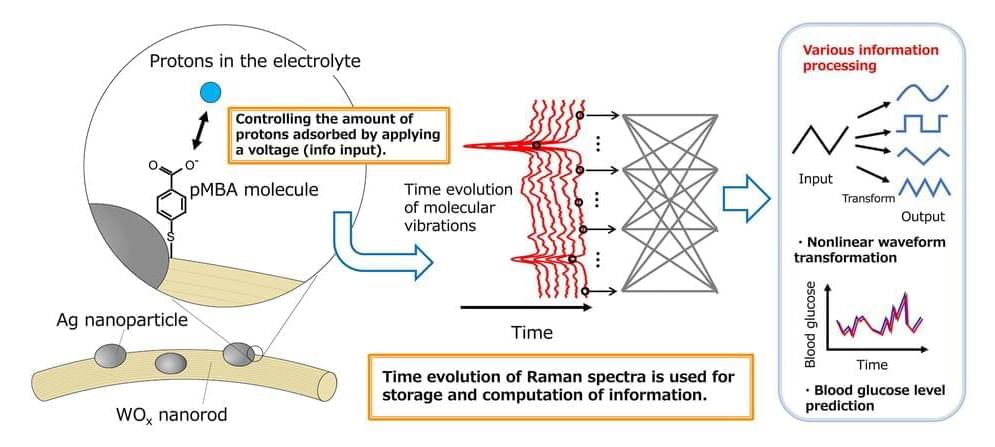
A collaborative research team from NIMS and Tokyo University of Science has successfully developed an artificial intelligence (AI) device that executes brain-like information processing through few-molecule reservoir computing. This innovation utilizes the molecular vibrations of a select number of organic molecules.

By applying this device for the blood glucose level prediction in patients with diabetes, it has significantly outperformed existing AI devices in terms of prediction accuracy.

The work is published in the journal Science Advances.

Bigger isn’t always better: How hybrid AI pattern enables smaller language models

Telcos are a prime example of an enterprise that would benefit from adopting this hybrid AI model. They have a unique role, as they can be both consumers and providers. Similar scenarios may be applicable to healthcare, oil rigs, logistics companies and other industries. Are the telcos prepared to make good use of gen AI? We know they have a lot of data, but do they have a time-series model that fits the data?

When it comes to AI models, IBM has a multimodel strategy to accommodate each unique use case. Bigger is not always better, as specialized models outperform general-purpose models with lower infrastructure requirements.

/* */