Curious about the societal shifts that AGI will bring, like Universal Basic Income or new forms of coexistence between humans and machines?
Want insights that help you make sense of this rapidly approaching future? Join us for a journey through the challenges and opportunities of living alongside AGI.
With each video, we aim to inform, inspire, and ignite a conversation to ensure we’re all ready for the world that’s unfolding.
In this video, we delve into The Future of Electronic Warfare, exploring how advancements in AI, drone swarms, and cyber integration are reshaping military strategies. Historically, electronic warfare (EW) began with basic communication interception in World War I and evolved through World War II with techniques like radar jamming. Today, we stand at the brink of a new era where technology significantly enhances operational capabilities.
The Evolution of Drone Swarms.
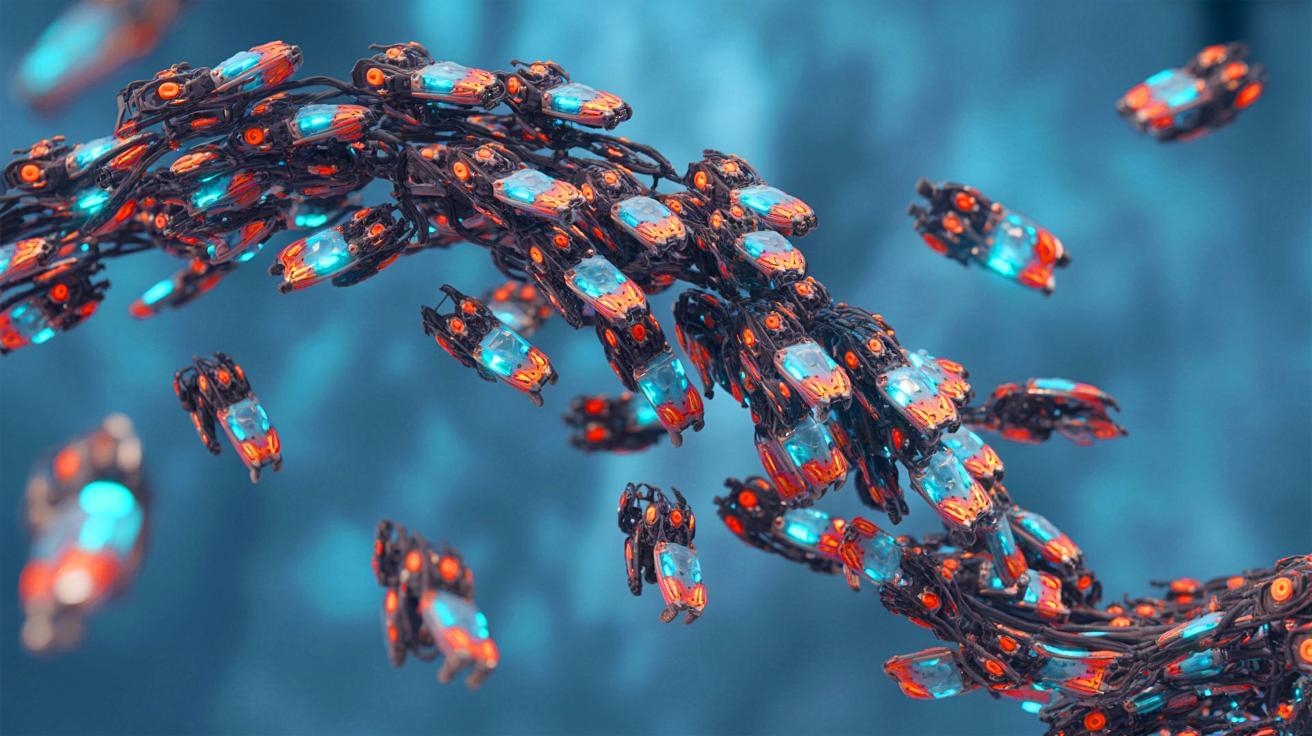
Recent developments have seen the emergence of AI-powered drone swarms, which offer unprecedented adaptability and efficiency on the battlefield. For instance, Thales’s COHESION demonstrator showcases how these swarms can operate autonomously, reducing the cognitive load on human operators while maintaining control during critical mission phases. Unlike traditional systems that require one operator per drone, these advanced systems leverage AI to allow multiple drones to work collaboratively, enhancing surveillance and attack capabilities across vast terrains.
Key features of ai-powered drone swarms.
Wide-Area Surveillance: Swarms can cover extensive areas, providing comprehensive monitoring and real-time situational awareness, ensuring no part of the terrain goes unmonitored.
Decentralized Coordination: Each drone operates autonomously while contributing to a collective intelligence network, allowing for effective mission execution even if individual drones are lost.
Breyt Coakley, Principal Investigator at Helios Remote Sensing Systems, Inc. discusses Cognitive Software Algorithms Techniques for Electronic Warfare. Helios is developing machine learning algorithms to detect agile emitters, not yet in Signal Intelligence (SIGINT) databases, without fragmentation. Traditional deinterleaving fragments these emitters into multiple unknown emitters, or even worse misidentifies them as matching multiple incorrect SIGINT database entries.
In this episode, we dive into the alarming concept of cognitive warfare—a new form of conflict where technology targets our minds to influence, control, and even manipulate our thoughts and emotions. Could governments and tech giants use these advanced tools to control how we think and feel? From artificial intelligence to neuromarketing, explore how cognitive warfare tactics are evolving and what they mean for personal freedom and mental autonomy in the digital age.
Join us as we uncover:
What cognitive warfare is and how it works. How tech companies and governments could potentially shape public opinion. The subtle ways AI-driven influence shapes our beliefs. Potential risks to mental freedom and democracy if cognitive warfare becomes widespread. If you’re concerned about AI manipulation, mind control technology, or the future of mental freedom, don’t miss this eye-opening video. Make sure to like, subscribe, and share to stay informed on critical issues at the intersection of technology, psychology, and control.
Protein prediction involves analyzing the amino acid sequence of a protein to determine its biological roles. Accurately predicting a protein’s provides valuable insights, allowing scientists to identify the roles of newly discovered proteins, search for proteins suited for specific tasks, or evaluate theality of computer-designed proteins.
Copilot provides an AI chat platform offering no-install, no-code, real-time access to advanced protein prediction tools, enabling researchers to efficiently analyze and explores using a single text prompt.
🌍 What will Earth look like in 1000 years?Will humanity thrive, evolve into an interstellar civilization, or face extinction? In this AI-generated cinematic…
Combining lab-grown muscle tissue with a series of flexible mechanical joints has led to the development of an artificial hand that can grip and make gestures. The breakthrough shows the way forward for a new kind of robotics with a range of potential applications.
While we’ve seen plenty of soft robots at New Atlas and a truly inspiring range of mechanical prosthetics, we’ve yet to see too many inventions that quite literally combine human tissue with machines. That’s likely because the world of biohybrid science is still in its very early stages. Sure, there was an artificial fish powered by human heart cells and a robot that used a locust’s ear to hear, but in terms of the practical use of the technology, the field has remained somewhat empty.
Now though, researchers at the University of Tokyo and Waseda University in Japan have shown a breakthrough demonstrating the real promise of the technology.
In a new study published in Science, a Belgian research team explores how genetic switches controlling gene activity define brain cell types across species. They trained deep learning models on human, mouse, and chicken brain data and found that while some cell types are highly conserved between birds and mammals after millions of years of evolution, others have evolved differently.
The findings not only shed new light on brain evolution; they also provide powerful tools for studying how gene regulation shapes different cell types, across species or different disease states.
Our brain, and by extension our entire body, is made up of many different types of cells. While they share the same DNA, all these cell types have their own shape and function. What makes each cell type different is a complex puzzle that researchers have been trying to put together for decades from short DNA sequences that act like switches, controlling which genes are turned on or off.
As the age of technology continues to explode, it is essential that we do not gloss over the amount of learning and skill it takes to address the ever-increasing complexity of technology, society and business. This moment affords us a unique opportunity. To design our learning levels and to design our professionals. I thought I would take that opportunity to show some of the skills necessary in architecture and how important they are to creating the next generation of leaders.
As one person said to me just yesterday, “The current business environment does not allow the application of such deep learning and reflection in architecture. We have to get in and do what we can fast.” I hear similar quotes regularly. And that is ok, there are times when we have to move quickly. But there are many more times we need a deeply experienced professional to be able to move quickly!
What does it mean to learn a skill? It means to have repeated success at that competency, over and over with the guidance of someone even more experienced. It means understanding theory, practice, and what can go wrong!