Thanks to advances in artificial intelligence being made at Carnegie Mellon University, computers may soon be able to give timely warnings when video surveillance cameras detect unusual activity.
During the press conference for the release of the Autopilot, Tesla CEO Elon Musk referred to each Model S owners as “expert trainers” – meaning that each driver will train the autonomous features of the system to feed the collective network intelligence of the fleet by simply driving the electric vehicle on Autopilot.
He said that the system should improve everyday, but that improvements might only become noticeable every week or so by adding up. Just a few weeks after the release, Model S owners are already taking to the Tesla Motors Club forum to describe how the Autopilot is improving…
These people have got a leg — or an arm — up on the future.
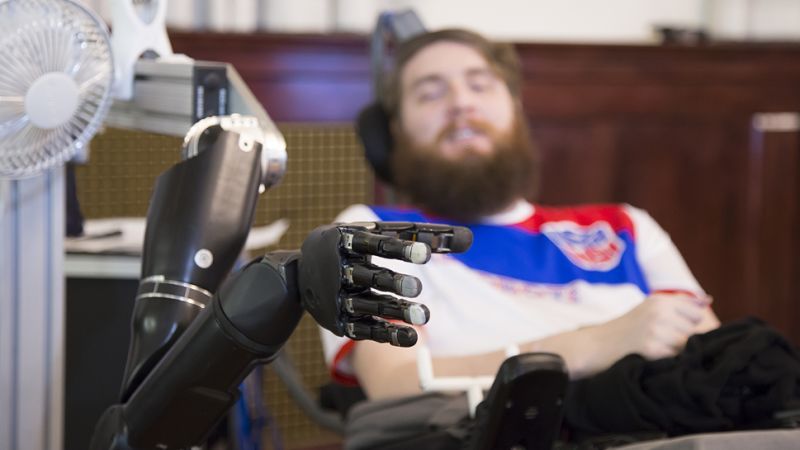
Thanks to the latest advancements in medical science, amputees are becoming part robot, with awe-inspiring artificial limbs that would make Luke Skywalker jealous.
These new limbs come armed with microprocessors and electrodes that sense muscle movement. Others can be controlled by a smartphone app. People missing limbs often tried to hide their prosthetics, but these New Yorkers are showing them off with pride.
Rebekah Marine.
Rebekah Marine had the modeling bug from a young age, playing dress-up as a kid and getting her mom to take her to try out for modeling agencies in New York.
The one problem? She was born without part of her right arm.
“I was just kind of quickly denied from [agencies] based on my quote-unquote disability,” the 28-year-old says.
“AI is achievable, but it will take more than computer science and neuroscience to develop machines that think like people”
On October 26, the Center for Technology Innovation at Brookings hosted a forum to explore the impact of robots, artificial intelligence, and machine learning on the workforce and the provision of benefits traditionally supplied by—or in conjunction with—employers.
http://www.brookings.edu/events/2015/10/26-robotics-employme…efits-west
Subscribe! https://www.youtube.com/subscription_center?add_user=BrookingsInstitution
Follow Brookings on social media!
Facebook: http://www.Facebook.com/Brookings
Twitter: http://www.twitter.com/BrookingsInst
Instagram: http://www.Instagram.com/brookingsinst
LinkedIn: http://www.linkedin.com/com/company/the-brookings-institution
Nissan says its autonomous car will be ready for sale to consumers by 2020.
Nissan Motor Co. is aggressively pushing forward with plans for a mostly autonomous car that will be ready for sale to consumers by 2020, putting it well ahead of its global competitors.
Chief Executive Carlos Ghosn said the technology would be ready by the Japanese auto maker’s self-imposed deadline—though he wasn’t sure if it would be legal on any nation’s roads.
“We are very excited about it and we want to come as soon as…
News to streamline the work measurements. smile
Free for iOS and Android here: http://goo.gl/mnNbZh
Follow the engineering is:
Who needs a peep hole when a wifi network will do? Researchers from MIT have developed technology that uses wireless signals to see your silhouette through a wall—and it can even tell you apart from other people, too.
The team from MIT’s Computer Science and Artificial Intelligence Lab are no strangers to using wireless signals to see what’s happening on the other side of a wall. In 2013, they showed off software that could use variations in wifi signal to detect the presence of human motion from the other side of a wall. But in the last two years they’ve been busy developing the technique, and now they’ve unveiled the obvious — if slightly alarming — natural progression: they can use the wireless reflections bouncing off a human body to see the silhouette of a person standing behind a wall.
Not only that, the team’s technique, known is RF-Capture, is accurate enough to track the hand of a human and, with some repeated measurements, the system can even be trained to recognise different people based just on their wifi silhouette. The research, which is to be presented at SIGGRAPH Asia next month, was published this morning on the research group’s website.
At the Tokyo Motor Show 2015, Nissan unveiled a concept vehicle that embodies Nissan’s vision of the future of autonomous driving and zero emission EVs: the Nissan IDS Concept.
Presenting at the show, Nissan president and CEO Carlos Ghosn said: “Nissan’s forthcoming technologies will revolutionize the relationship between car and driver, and future mobility.”
After leading the development and expansion of EV technology, Nissan once again stands at the forefront of automotive technology. By integrating advanced vehicle control and safety technologies with cutting-edge artificial intelligence (AI), Nissan is among the leaders developing practical, real-world applications of autonomous drive technology.
In August 2013, Ghosn said that by 2020 Nissan plans to equip innovative autonomous drive technology on multiple vehicles. Progress is well on track to achieve this goal.
Nissan Intelligent Driving is Nissan’s concept of autonomous drive technology and represents what Nissan believes next-generation vehicles should be. “Nissan Intelligent Driving improves a driver’s ability to see, think and react. It compensates for human error, which causes more than 90 percent of all car accidents. As a result, time spent behind the wheel is safer, cleaner, more efficient and more fun,” said Ghosn.