Toggle light / dark theme

Norwegian robot learns to self-evolve and 3D print itself in the lab

Experts at the University of Oslo, Norway have discovered a new way for robots to design, evolve and manufacture themselves, without input from humans, using a form of artificial evolution called “Generative design,” and 3D printers – although admittedly the team, for now at least, still has to assemble the final product, robot, when it’s printed.

Generative design is something we’ve talked about several times before and it’s where artificial intelligence programs – creative machines, if you will – not humans, innovate new products – such as chairs and even Under Armour’s new Architech sneakers.

Soft robotic sleeve developed to aid failing hearts

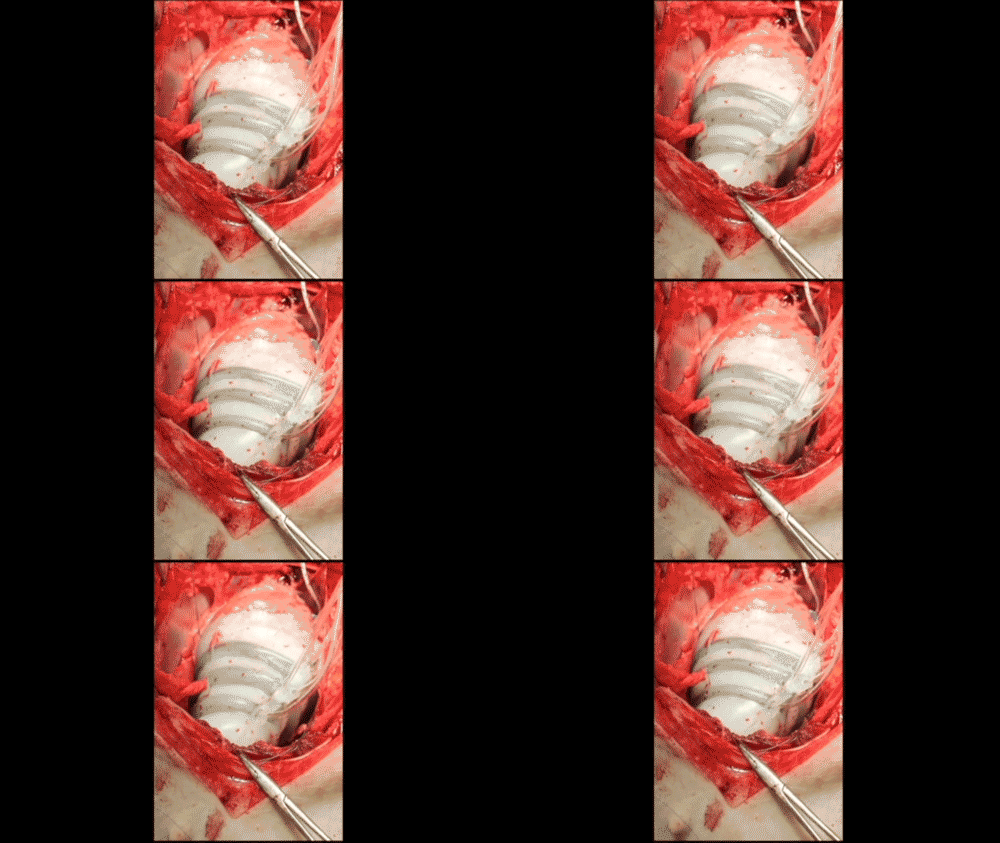
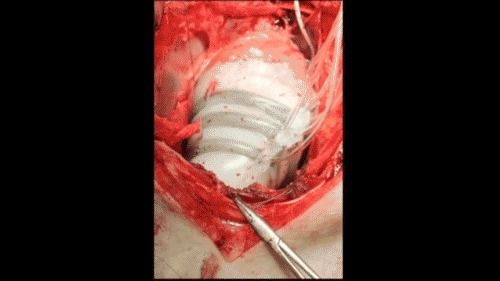
A soft robotic sleeve placed around the heart in a pig model of acute heart failure. The actuators embedded in the sleeve support heart function by mimicking the outer heart muscles that induce the heart to beat. (credit: Harvard SEAS)

An international team of scientists has developed a soft robotic sleeve that can be implanted on the external surface of the heart to restore blood circulation in pigs (and possibly humans in the future) whose hearts have stopped beating.

The device is a silicone-based system with two layers of actuators: one that squeezes circumferentially and one that squeezes diagonally, both designed to mimic the movement of healthy hearts when they beat.

Is Tesla working on computers that can be implanted into BRAINS?

In the hope of creating a ‘human-AI’ cyborgs, Elon Musk has revealed that Tesla may be working on computers that can be implanted into people’s brains.

The astonishing revelation came in response to a tweet, asking Musk if he was working on ‘neural lace’ – a way of installing computers into the human brain.

It is not known what the brain chip could be used for, but Musk has previously said that it will be the ‘thing that really matters for humanity to achieve symbiosis with machines.’

Great, Robots Just Learned To 3D Print Themselves

Robots are cloning again.


Robots can evolve. Robots can reproduce. All hail our robot overlords.

The design, evolution and manufacture of robots, by robots, is called “Generative Design”. As reported by Global Futurist, generative design will see a future where products and services delivered by robots are designed by the robots themselves. It’s practical artificial intelligence with results you can touch and hold.

Watch for yourself.

F-35 Pilots Will Control UAVs Flying Nearby

This post is also available in: heעברית (Hebrew)

Several fighter jet models will soon use artificial intelligence to control nearby UAVs that will be able to carry weapons, test enemy air defenses or perform intelligence, surveillance and reconnaissance missions in high-risk areas, Senior US Air Force officials said recently.

US Air Force Chief Scientist Gregory Zacharias said that much higher degrees of autonomy and manned-unmanned teaming are expected to emerge in the near future from work at the Air Force Research Lab. “This involves an attempt to have another platform fly alongside a human, perhaps serving as a weapons truck” Zacharias told DefenseSystems.com.

HDFC Bank deploys humanoid built by Kochi firm in Mumbai

KOCHI: HDFC Bank has deployed an interactive humanoid at its Kamala Mills branch in Mumbai. Intelligent Robotic Assistant (IRA) was developed in partnership with Kochi-based startup Asimov Robotics. IRA will be used for customer service.

With the launch of IRA, HDFC has become the first bank in the country to deploy humanoid for customer service. “Our first humanoid is unique and will serve as a technology demonstrator in the field of artificial intelligence and robotics,” said HDFC Bank digital banking country head Nitin Chugh.

Developed using robotics and artificial intelligence technology, IRA will be initially positioned near the bank’s welcome desk where it will display the services, greet customers and guide them to the counters — cash deposit, foreign exchange, loans etc.

Will Robots Be the Solution to a Growing Demand for Assisted Living?

Actually, I have began looking seriously into an at home robot for my home; still not where I want them to be why I began looking closer and more seriously at building my own line.


One of the coming great challenges of senior care is facilitating assisted living, according to experts. The so-called Baby Boomer generation that is now entering retirement age lives longer, expects the world from its twilight years, and insists on staying independent for as long as possible. Most Boomers don’t even think about going out quietly, withering away in homes that offer little more than warehousing. Instead, they want to stay active and engaged until the very end, and they welcome all the help they can get to achieve that goal. And when they cannot do it anymore on their own, futuristic technology like robots for personal use may just be the ticket.

If you have seen the 2012 movie “Robot & Frank,” you already had a – albeit comical – glimpse of how the future of assisted living might look like. In a nutshell, the story is about the “relationship” between an elderly gentleman (played by Frank Langella), who just retired from a lifetime career as a cat burglar, and a humanoid robot given to him by his children as a home caretaker. Of course, the film’s particular angle on robotic technology is not to be taken too seriously. But the fact is that intelligent machines are progressively affecting every aspect of life as we know it, and will do so much more in coming years.

On a recent trip to Tokyo, I had the chance to see for myself how far we have already moved in that direction. Here, robots designed for personal assistance are readily available in department stores, just like any other household appliances. Although, many of the existing models have only limited capabilities like finding information on the Internet or compiling music playlists, or even less useful features like responding with a cute smile and offering a handshake when approached, it is clear that these creatures of our own making will eventually be the ones we partner up with on countless tasks, both at work and in our homes.
Who’s Responsible If An Open Source Software Powered Self-Driving Vehicle Kills Someone?

Who is responsible if a self-driving car crashes and causes property damages, physical harm or even death? Autonomous vehicle legislation is still very much in its infancy though it will certainly be an evolutionary process over the years. Corporations such as Tesla and Volvo have publicly stated that they will take responsibility for any faults in their software. However, Comma.ai’s CEO George Hotz (geohot) has stated that he is not responsible for any accidents caused by those who download his free self-driving vehicle software.

/* */