Toggle light / dark theme

AI is the Great Filter

Artificial intelligence is now finding planets human astronomers missed and scanning for alien signals 600 times faster than ever before.
Yet the more powerful our search tools become, the louder the silence from the cosmos grows.

This video explores why the same technology helping us look for extraterrestrial life may also explain why we cannot find any.

We examine the Great Filter hypothesis, the mathematics of self-replicating probes, and the growing consensus that any aliens out there would be machines, not biological beings.

From Matrioshka brains to the aestivation hypothesis to the Dark Forest, the universe may be hiding minds we cannot recognise, or warning us about a test every civilisation faces.

Chapters.

00:00 — Intro.
Robotics’ End Game: Nvidia’s Jim Fan

Dream Zero: NVIDIA’s latest paradigm where a robot “dreams” its success in a world model before executing the motor commands in reality [[06:12](https://www.youtube.com/watch?v=3Y8aq_ofEVs&t=372)].


Jim Fan, who leads the embodied autonomous research group at Nvidia, returns to AI Ascent to argue that robotics is entering its end game — and that the playbook is already written. He walks through what he calls \.

AI surrogate accelerates nonlinear optics simulations by orders of magnitude

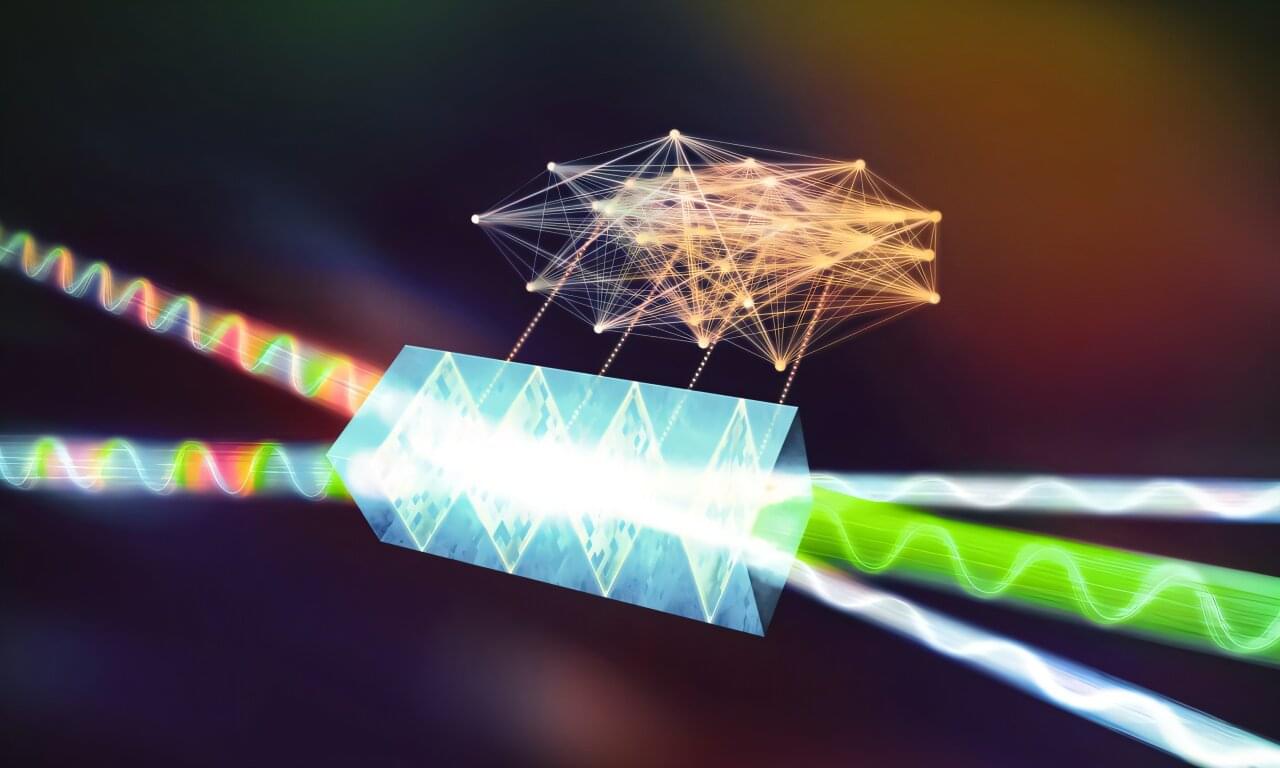
Simulating the nonlinear optical physics that underlies ultrafast laser systems is computationally demanding—a practical bottleneck in settings that require rapid feedback. A study by researchers at Stanford University, University of California, Los Angeles (UCLA), and SLAC National Accelerator Laboratory introduces a deep learning surrogate that delivers orders-of-magnitude acceleration over conventional simulation methods, while maintaining high fidelity across a challenging range of pulse shapes.

The work centers on second-order nonlinear optics (χ² processes), in which light waves exchange energy inside specially engineered crystals to generate new frequencies and tailored pulse shapes. In particle accelerator facilities, these processes play a key role. At SLAC’s upgraded Linac Coherent Light Source (LCLS-II), infrared laser pulses are first to green light and then to ultraviolet (UV). The UV pulse strikes a cathode to liberate an electron bunch that is subsequently accelerated and modulated to produce intense X-ray pulses. The temporal shape of the UV pulse directly influences the properties of that electron bunch—and ultimately the quality of the X-rays available for science.

A surrogate model for the nonlinear χ² frequency conversion step at the heart of this process is reported in Advanced Photonics.

Open-source ‘digital twin’ enables end-to-end testing of applications over wireless

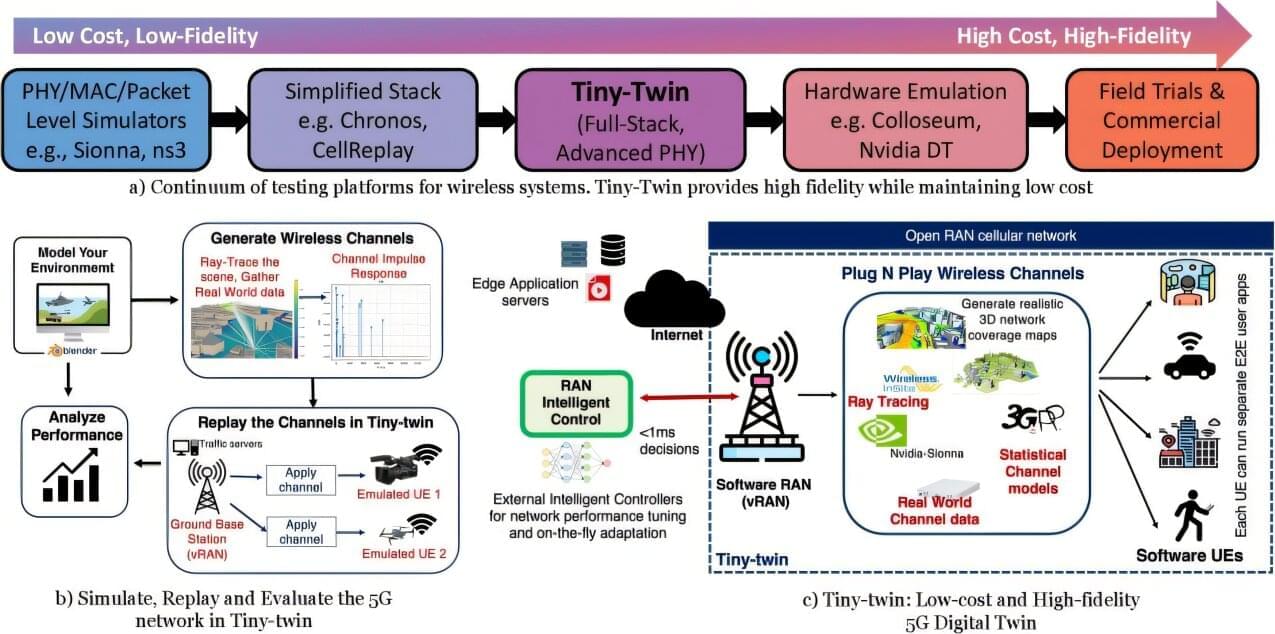
Researchers at the University of California San Diego have developed an open-source “digital twin” of a wireless network, giving graduate students, startups and other innovators a free, easy-to-use way to test new technologies and get fast, realistic feedback. The platform could help accelerate the pace of wireless innovation.

“We are building a software replica of everything that happens when you use your phone, from the wireless signals traveling through the environment to the cellular network and apps that deliver data and services like video and Instagram,” said Dinesh Bharadia, associate professor in the Department of Electrical and Computer Engineering at the UC San Diego Jacobs School of Engineering, an affiliate of the UC San Diego Qualcomm Institute and senior author of the paper.

“This will help industry and academia build new protocols and algorithms faster using software and AI, with less need for real-world experiments.”

Popular PlayStation emulator clamps down on AI submissions: ‘Leave behind something useful to humanity when you’re gone, instead of peddling slop’

In response to questions (and more than a little AI evangelist bellyaching), the devs pointed out that it is not the use of AI code in PRs that is the issue for them, but that it is undisclosed. “We won’t ban if disclosed, except for abuse cases, e.g. throwing a lot of random slop at us to see what passes reviews. Hint: programmers that can understand the problem, the solution, and the implementation can write the same code without AI, and tend to use LLMs to automate repetitive code refactoring instead. It is not the case with the AI slop PRs we have seen.”

The final result is a new set of hard-and-fast rules about AI code right there on RPCS3’s GitHub repo: “Use of AI tools for research and reverse engineering purposes is permitted. However, contributors are expected to fully own and understand all code they submit. Any communication with the team—including code, code comments, and GitHub comments—must come from the human contributor, not an AI agent acting autonomously.”

Back on X, the team signed off with a final message: “As for all the AI bros seething on our socials, we’re simply blocking you. Learn how to debug, code, and leave behind something useful to humanity when you’re gone, instead of peddling slop.”