Tactical Robotics’ Cormorant drone design allows it to navigate tight areas where a helicopter’s blades would get caught on the environment. The remote-controlled military drone can transport two injured people from a battle zone. The Israeli-based company believes the drone could one day also be used to inspect bridges, deliver medical supplies and spray crops.
Category: robotics/AI – Page 2,715
Do You Trust This Computer
Elon Musk Wants You to Watch ‘Do You Trust This Computer?’ in Memory of Stephen Hawking, and It’s Free.
Because “nothing will affect the future of humanity more than digital super-intelligence,” Elon Musk thinks you should watch Chris Paine’s artificial-intelligence movie “Do You Trust This Computer?” And, wouldn’t you know it, the film is streaming for free until later tonight.
Here’s the synopsis: “Science fiction has long anticipated the rise of machine intelligence. Today, a new generation of self-learning computers has begun to reshape every aspect of our lives. Incomprehensible amounts of data are being created, interpreted, and fed back to us in a tsunami of apps, personal assistants, smart devices, and targeted advertisements. Virtually every industry on earth is experiencing this transformation, from job automation to medical diagnostics, even military operations. ‘Do You Trust This Computer?’ explores the promises and perils of our new era. Will A.I. usher in an age of unprecedented potential, or prove to be our final invention?”
Nothing will affect the future of humanity more than digital super-intelligence. Watch Chris Paine’s new AI movie for free until Sunday night at http://doyoutrustthiscomputer.org/watch
[email protected]
Telegram Group: https://telegram.me/mcgregorrecruitme…
Telegram Channel: https://telegram.me/vacanciesinuae
LinkedIn Group: https://www.linkedin.com/groups/12102…

This company is using facial recognition to fight human trafficking
We’ve heard so many stories lately about the frankly horrifying degree to which facial recognition leads to tracking or privacy invasions. But a startup specializing in AI is instead leveraging facial recognition technology to find human trafficking victims.
Marinus Analytics is a startup that licenses technology to law enforcement with the express purpose of fighting human trafficking. It’s founder and CEO, Emily Kennedy, created a program called Traffic Jam during her time at Carnegie Mellon that uses AI tools to identify victims. Nowadays, Traffic Jam is available to any law enforcement agency that works with Marinus.
According to Marinus’ website:

Scientists Use DNA And A Test Tube To Develop A.I. That May Be Capable Of Creating Its Own ‘Memories’
A new study by Caltech researchers has shown that the A.I. they created is fully capable of reading handwritten numbers.
Scientists have been able to create a completely artificial neural network by using DNA and a test tube, and the results of this AI experiment have been nothing short of astonishing.
During experiments, this artificial intelligence was able to accurately assess handwritten numbers, with scientists suggesting that this research shows that humans are edging ever closer to taking AI and placing it in organic circuits, as the Daily Mail reports.

What if AI made actors immortal?
I’m not that interested in this on the movie end, because i think most movies already suck, and couldnt really get any worse.
AUDREY HEPBURN DIED in 1993, but in 2013 she nevertheless starred in an advertisement for Galaxy, a type of chocolate bar. She was shown riding a bus along the Amalfi coast before catching the eye of a passing hunk in a convertible. In 2016 Peter Cushing, who died in 1994, reprised his role as the villainous Grand Moff Tarkin in the Star Wars film “Rogue One”. Such resurrections are not new, but they are still uncommon enough to count as news. Yet advances in special effects—and, increasingly, in artificial intelligence (AI)—are making it ever easier to manufacture convincing forgeries of human beings.
In recent months this has led to concern that propagandists will use the technology to generate videos in which political figures appear to say compromising things. A video created by BuzzFeed, a news website, in April shows Barack Obama apparently saying “We’re entering an era in which our enemies can make it look like anyone is saying anything at any point in time,” for example. In May a Belgian political party produced a fake video of Donald Trump saying implausible things about Belgium’s climate policy. In both cases the video looks slightly off, and the voice is provided by an impersonator. But the technology is improving fast, prompting a dozen AI researchers to place bets on whether a fake video will disrupt America’s midterm elections later this year. (Tim Hwang, a Harvard academic, is overseeing the wager.)
Whatever happens in the arena of fake news, the same techniques are sure to revolutionise fiction of a different kind, in the form of film and television. In future, actors need not be creatures of flesh and blood, but could, like so many other things in an increasingly digitised world, exist as nothing more than long strings of 1s and 0s. Such digital actors would sit quietly in digital storage systems until their services were needed—there would be no need for luxury trailers, chefs and make-up people.
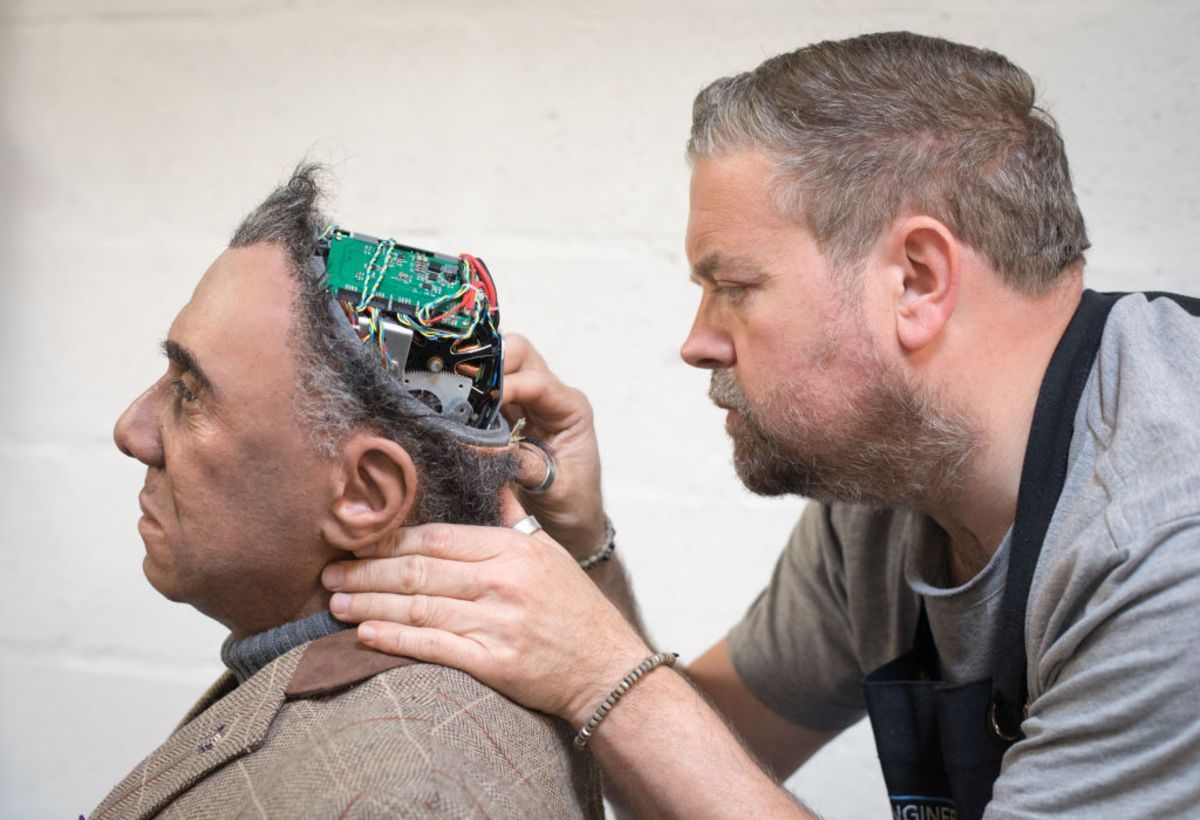

Billionaire Ray Dalio: A.I. is widening the wealth gap, ‘national emergency should be declared’
It’s amusing that these people know where this is headed, but arent interested enough to stop it.
The co-chief investment officer and co-chairman of Bridgewater Associates shared his thoughts in a Facebook post on Thursday.
Dalio says he was responding to a question about whether machine intelligence would put enough people out of work that the government will have to pay people to live with a cash handout, a concept known as universal basic income.
My view is that algorithmic/automated decision making is a two edged sword that is improving total productivity but is also eliminating jobs, leading to big wealth and opportunity gaps and populism, and creating a national emergency.
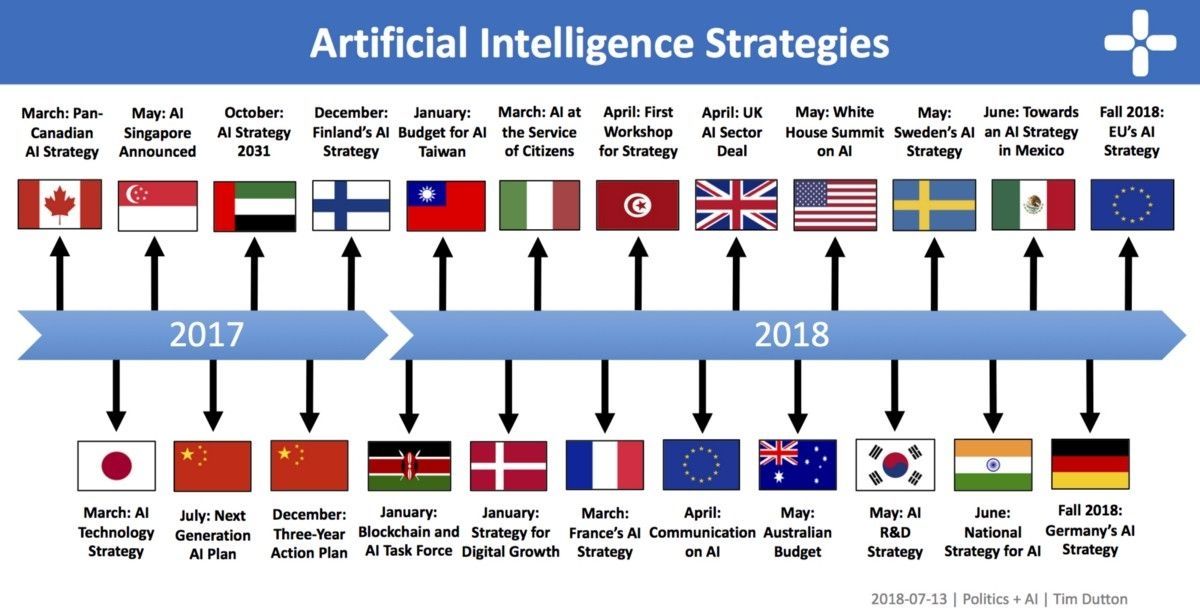
An Overview of National AI Strategies
Dont really care about the competition, but this horse race means AI hitting the 100 IQ level at or before 2029 should probably happen.
The race to become the global leader in artificial intelligence (AI) has officially begun. In the past fifteen months, Canada, Japan, Singapore, China, the UAE, Finland, Denmark, France, the UK, the EU Commission, South Korea, and India have all released strategies to promote the use and development of AI. No two strategies are alike, with each focusing on different aspects of AI policy: scientific research, talent development, skills and education, public and private sector adoption, ethics and inclusion, standards and regulations, and data and digital infrastructure.
This article summarizes the key policies and goals of each national strategy. It also highlights relevant policies and initiatives that the countries have announced since the release of their initial strategies.
I plan to continuously update this article as new strategies and initiatives are announced. If a country or policy is missing (or if something in the summary is incorrect), please leave a comment and I will update the article as soon as possible.
Robot able to mimic an activity after observing it just one time
A team of researchers at UC Berkeley has found a way to get a robot to mimic an activity it sees on a video screen just a single time. In a paper they have uploaded to the arXiv preprint server, the team describes the approach they used and how it works.
Robots that learn to do things simply by watching a human carry out an action a single time would be capable of learning many more new actions much more quickly than is now possible. Scientists have been working hard to figure out how to make it happen.
Historically though, robots have been programmed to perform actions like picking up an object by via code that expressly lays out what needs to be done and how. That is how most robots that do things like assemble cars in a factory work. Such robots must still undergo a training process by which they are led through procedures multiple times until they are able to do them without making mistakes. More recently, robots have been programmed to learn purely through observation—much like humans and other animals do. But such imitative learning typically requires thousands of observations. In this new effort, the researchers describe a technique they have developed that allows a robot to perform a desired action by watching a human being do it just a single time.
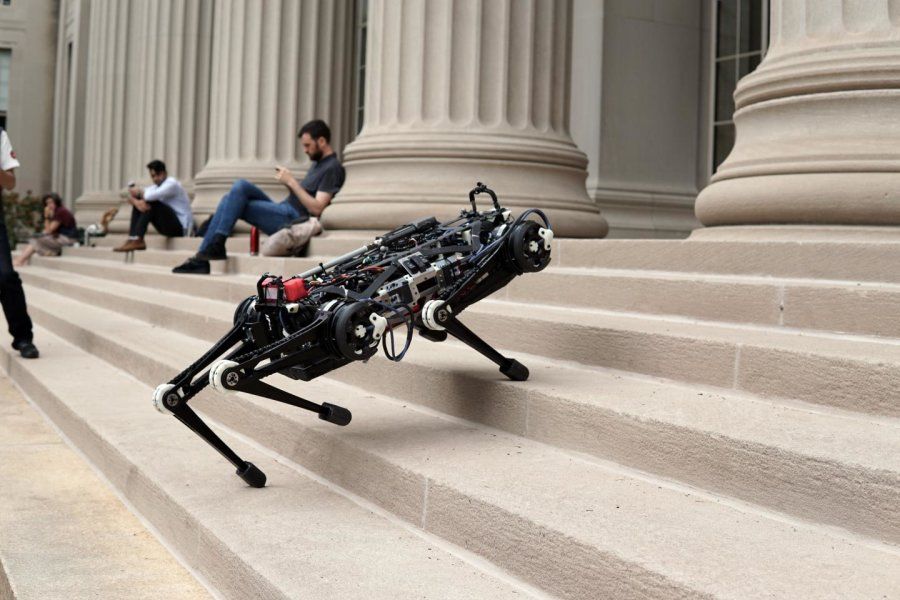
‘Blind’ Cheetah 3 robot can climb stairs littered with obstacles
The 90-pound mechanical beast — about the size of a full-grown Labrador — is intentionally designed to do all this without relying on cameras or any external environmental sensors. Instead, it nimbly “feels” its way through its surroundings in a way that engineers describe as “blind locomotion,” much like making one’s way across a pitch-black room.
“There are many unexpected behaviors the robot should be able to handle without relying too much on vision,” says the robot’s designer, Sangbae Kim, associate professor of mechanical engineering at MIT. “Vision can be noisy, slightly inaccurate, and sometimes not available, and if you rely too much on vision, your robot has to be very accurate in position and eventually will be slow. So we want the robot to rely more on tactile information. That way, it can handle unexpected obstacles while moving fast.”
Researchers will present the robot’s vision-free capabilities in October at the International Conference on Intelligent Robots, in Madrid. In addition to blind locomotion, the team will demonstrate the robot’s improved hardware, including an expanded range of motion compared to its predecessor Cheetah 2, that allows the robot to stretch backwards and forwards, and twist from side to side, much like a cat limbering up to pounce.