Alan DeRossettPutin propaganda is dividing opinions on Elon Musk for helping Ukraine and standing up to the Fossil fuel industry.
Walter LynsdaleI’m all for people making billions through technical advancement (teslas, space X rockets, the dojo chip are all pretty cool), but he comes out with a fair amount of double speak:
“people aren’t having enough babies” vs “we can make a humanoid robot”… See more.
🙏 We would like to thank our generous Patreon supporters who make Two Minute Papers possible: Aleksandr Mashrabov, Alex Balfanz, Alex Haro, Andrew Melnychuk, Angelos Evripiotis, Benji Rabhan, Bryan Learn, B Shang, Christian Ahlin, Eric Martel, Gordon Child, Ivo Galic, Jace O’Brien, Javier Bustamante, John Le, Jonas, Jonathan, Kenneth Davis, Klaus Busse, Lorin Atzberger, Lukas Biewald, Matthew Allen Fisher, Michael Albrecht, Michael Tedder, Nikhil Velpanur, Owen Campbell-Moore, Owen Skarpness, Paul F, Rajarshi Nigam, Ramsey Elbasheer, Steef, Taras Bobrovytsky, Ted Johnson, Thomas Krcmar, Timothy Sum Hon Mun, Torsten Reil, Tybie Fitzhugh, Ueli Gallizzi. If you wish to appear here or pick up other perks, click here: https://www.patreon.com/TwoMinutePapers.
For centuries, mathematicians have tried to prove that Euler’s fluid equations can produce nonsensical answers. A new approach to machine learning has researchers betting that “blowup” is near.
Was AI instrumental to the advancements behind Ada Lovelace?
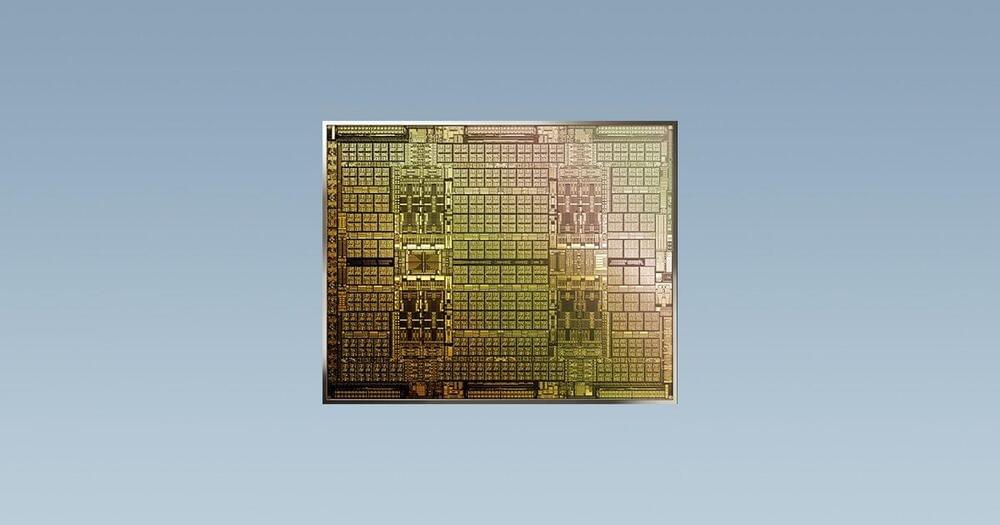
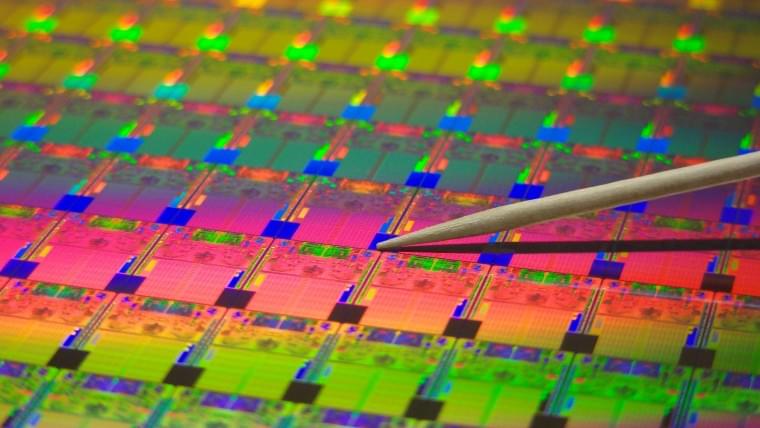
AI training is particularly useful to speed several traditionally slow iterative processes in GPU design. As an example, AI can reduce power map inference times from three hours to three seconds with 94% accuracy.
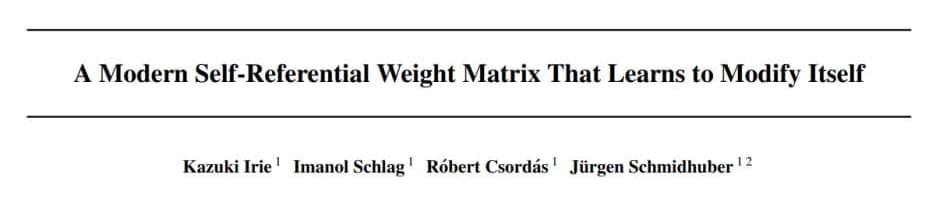
Back in 1993, AI pioneer Jürgen Schmidhuber published the paperA Self-Referential Weight Matrix, which he described as a “thought experiment… intended to make a step towards self-referential machine learning by showing the theoretical possibility of self-referential neural networks whose weight matrices (WMs) can learn to implement and improve their own weight change algorithm.” A lack of subsequent practical studies in this area had however left this potentially impactful meta-learning ability unrealized — until now.
In the new paper A Modern Self-Referential Weight Matrix That Learns to Modify Itself, a research team from The Swiss AI Lab, IDSIA, University of Lugano (USI) & SUPSI, and King Abdullah University of Science and Technology (KAUST) presents a scalable self-referential WM (SRWM) that leverages outer products and the delta update rule to update and improve itself, achieving both practical applicability and impressive performance in game environments.
The proposed model is built upon fast weight programmers (FWPs), a scalable and effective method dating back to the ‘90s that can learn to memorize past data and compute fast weight changes via programming instructions that are additive outer products of self-invented activation patterns, aka keys and values for self-attention. In light of their connection to linear variants of today’s popular transformer architectures, FWPs are now witnessing a revival. Recent studies have advanced conventional FWPs with improved elementary programming instructions or update rules invoked by their slow neural net to reprogram the fast neural net, an approach that has been dubbed the “delta update rule.”
10 people will take the better part of a year to port a new technology library. Now we can do it with a couple of GPUs running for a few days.
Nvidia has been quick to hop on the artificial intelligence bus一with many of its consumer facing technologies, such as Deep Learning Super Sampling (DLSS) and AI-accelerated denoising exemplifying that. However, it has also found many uses for AI in its silicon development process and, as Nvidia’s chief scientist Bill Dally said in a GTC conference, even designing new hardware.
Dally outlines a few use cases for AI in its own development process of the latest and greatest graphic cards (among other things), as noted by HPC Wire.
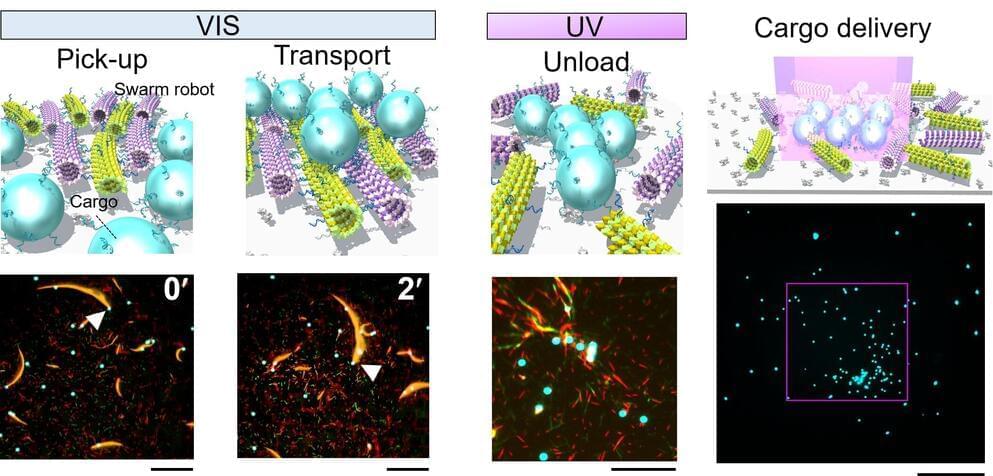
In a global first, scientists have demonstrated that molecular robots are able to accomplish cargo delivery by employing a strategy of swarming, achieving a transport efficiency five times greater than that of single robots.
Swarm robotics is a new discipline, inspired by the cooperative behavior of living organisms, that focuses on the fabrication of robots and their utilization in swarms to accomplish complex tasks. A swarm is an orderly collective behavior of multiple individuals. Macro-scale swarm robots have been developed and employed for a variety of applications, such as transporting and accumulating cargo, forming shapes, and building complex structures.
A team of researchers, led by Dr. Mousumi Akter and Associate Professor Akira Kakugo from the Faculty of Science at Hokkaido University, has succeeded in developing the world’s first working micro-sized machines utilizing the advantages of swarming. The findings were published in the journal Science Robotics. The team included Assistant Professor Daisuke Inoue, Kyushu University; Professor Henry Hess, Columbia University; Professor Hiroyuki Asanuma, Nagoya University; and Professor Akinori Kuzuya, Kansai University.
Nvidia is impressed with the chip making capabilities of NVCell, its AI chip designer. The firm says that it using it, just two GPUs can do nearly the same work that takes ten people a year’s time.
AI brings many benefits but as with any rapidly advancing technology it needs ethical frameworks that protect society, in particular children and young people.