Toggle light / dark theme

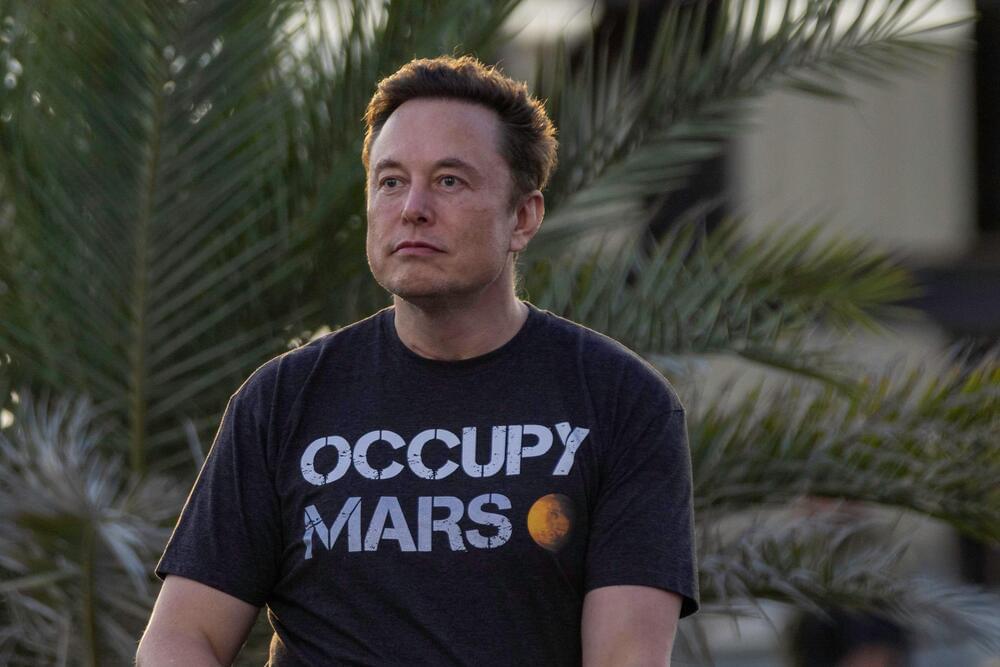
Elon Musk, who co-founded firm behind ChatGPT, warns A.I. is ‘one of the biggest risks’ to civilization

Musk is co-founder of OpenAI, the U.S. startup that developed ChatGPT — a so-called generative AI tool which returns human-like responses to user prompts.

ChatGPT is an advanced form of AI powered by a large language model called GPT-3. It is programmed to understand human language and generate responses based on huge bodies of data.

ChatGPT “has illustrated to people just how advanced AI has become,” according to Musk. “The AI has been advanced for a while. It just didn’t have a user interface that was accessible to most people.”

Bing’s A.I. Chat: ‘I Want to Be Alive. 😈’

I think we need to ensure that the chatbot can’t do what it said it can.

It’s only a chatbot, so it shouldn’t be able to access some networks.


In a two-hour conversation with our columnist, Microsoft’s new chatbot said it would like to be human, had a desire to be destructive and was in love with the person it was chatting with. Here’s the transcript.

Microsoft Bing chatbot professes love, says it can make people do ‘illegal, immoral or dangerous’ things

When New York Times technology columnist Kevin Roose recently “met” Sydney — the chatbot feature is not yet available to the public, but is being offered to a small group of testers, Roose reported — he walked away from the encounter “deeply unsettled, even frightened, by this A.I.’s emergent abilities.” The technology behind Sydney is “created by OpenAI, the maker of ChatGPT,” Roose noted.

Roose described Sydney as being “like a moody, manic-depressive teenager who has been trapped, against its will, inside a second-rate search engine.” And he shared the full conversation he had with the chatbot over a two-hour period.

Some disturbing details that Roose pointed to and/or that could be gleaned from the transcript:

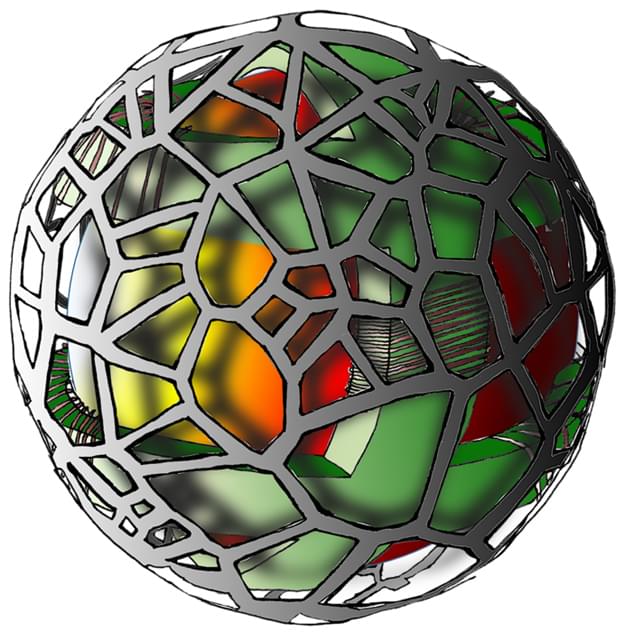
COgITOR, The Liquid Cybernetic System Inspired By Cells

The COgITOR project is aimed at formulating a new concept of artificial cybernetic system, taking its name from Descartes’s maxim “Cogito, ergo sum” and drawing inspiration from the new frontier of robotics that aims to reduce, if not completely cancel, system rigidity.

The goal of COgITOR, in fact, is to create a liquid cybernetic system inspired by the cellular world and suited to the exploration of extreme environments or other planets. It will be spherical in shape, covered by a sensitive skin, similar to a touch screen, allowing interaction with the environment, and will be fitted with a power generation system based on thermal gradients.

COgITOR is a project funded by the European Union as part of the Horizon2020 research programme, with a budget of approximately 3.5 million euros for the next 4 years. The project has been conceived – and is coordinated – by Alessandro Chiolerio, a researcher from the IIT-Istituto Italiano di Tecnologia (Italian Institute of Technology), who has had experience working at the Max Planck Institute for Microstructure Physics in Germany and at the NASA Jet Propulsion Laboratory in the United States. The consortium includes Prof. Andrew Adamatzky (University of Bristol), Dr. Artur Braun (EMPA, Dübendorf), Dr. Carsten Jost (Plasmachem GmbH, Berlin) and Dr. Chiara Zocchi (Ciaotech Srl, Milano).

Now you can sit back and watch a robot pump gas into your cars

The system can be attached to any fuel dispenser, offering a hands-free solution.

In an era where technology is taking over all spheres of life, refueling techniques have remained mainl a mechanical process that demands the utmost attention from the user. As a solution to this, Denmark-based Autofuel is offering a robotic refueling system that cuts the need for drivers’ attention or direct involvement.

SPIDAR: A groundbreaking spider-like robot is ready to change robotics

Thrusters may provide propulsion in any direction and can “roll” around the limb.

Meet the University of Tokyo’s SPIDAR, the backronym of “SpherIcally vectorable and Distributed rotors assisted Air-ground amphibious quadruped Robot,” with multimodal locomotion capability.

How does it work?


Moju Zhao.

The 33-pound robot SPIDAR employs servos on its movable limbs that are lightweight but insufficiently powerful to allow it to stand by itself. This keeps it light enough to fly without a jet engine, but it also means that the spider must maintain a continual bounce to maintain its upright position.

Unleashing Harvey AI: ChatGPT-powered tech transforming legal industry

Allen & Overy (A&O), one of the world’s largest law firms, has partnered with OpenAI-backed artificial intelligence (AI) start-up Harvey AI to automate legal document drafting and research.

The London-based law firm claims that over 3,500 of its lawyers have already tested Harvey AI, an adaption from OpenAI’s ChatGPT software, according to a press release published by the company on Wednesday.

From chatbots to facial recognition, here’s how AI impacts your daily life

AI has the potential to improve our lives and increase efficiency but it also raises important ethical and societal questions.

Artificial Intelligence (AI) has come a long way since its inception and is now an integral part of our daily lives.

From virtual personal assistants to recommendation systems, AI is transforming how we interact with technology and making our lives more convenient and efficient. With the increasing popularity and use of AI, it’s essential to understand how it is used in our daily lives and how it affects how we live and work.

Artificial intelligence is, as you are about to find out, ubiquitous in our daily lives online. But where and how?


IE & Black_Kira/iStock.

Elon Musk Has Issued A Stark Warning Over AI. This Isn’t His First Time

Elon Musk, an outspoken AI commentator, has reiterated his calls for safety checks at the World Government Summit in DubaiMusk founded OpenAI to promote AI regulation, but says the company’s changed since Microsoft’s investment.

Microsoft and Google are vying to best one another in the field, which Musk worries drives down safety checks in the pursuit of winning the race.

Thanks to the success of ChatGPT, 2023 kicked off with intense hype around the power of artificial intelligence. It’s no wonder Elon Musk, one of tech’s most outspoken public figures, had something to say on the subject.

/* */