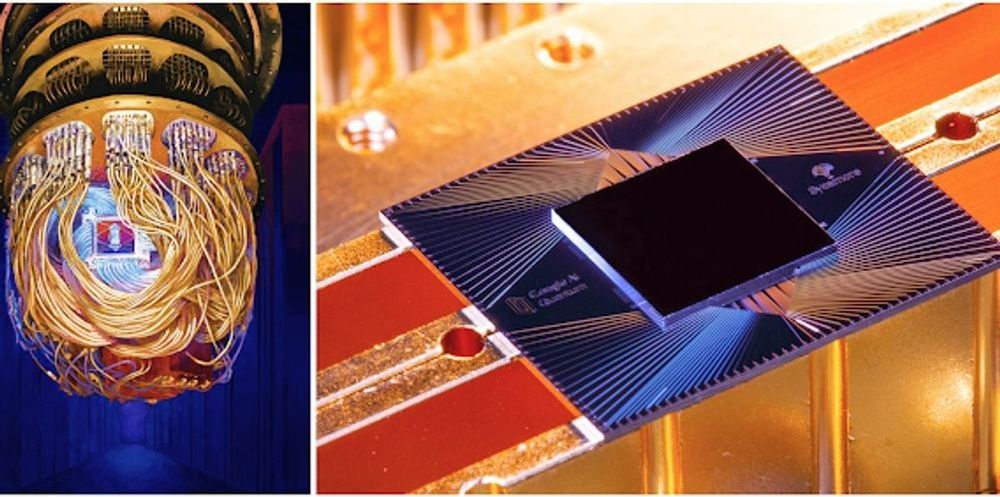
Lasers and microwaves used to study crystal spinning at 200,000 rpm.


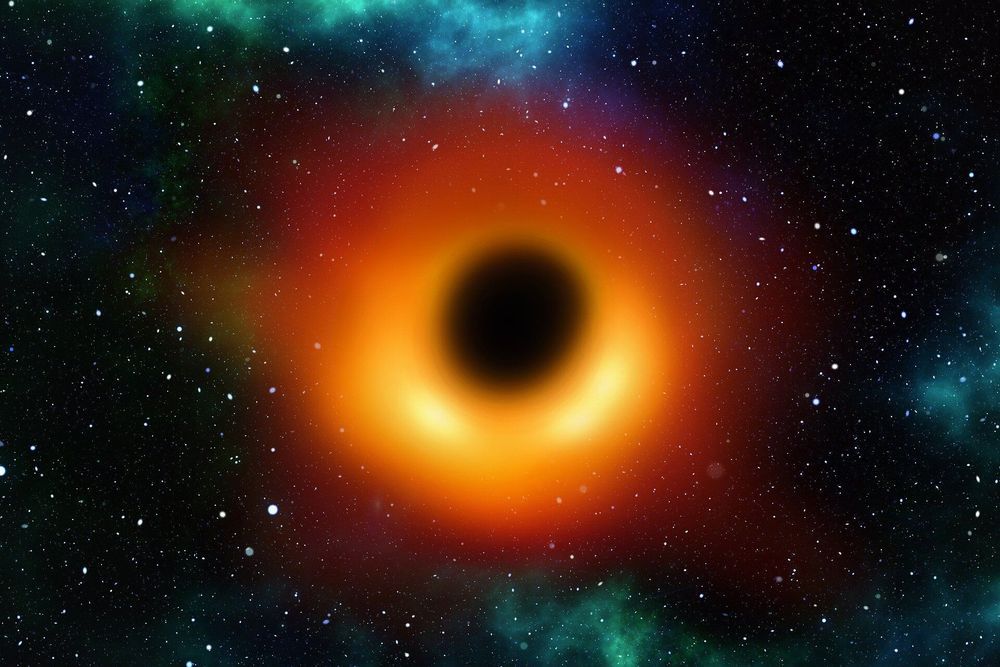
Echoes in gravitational wave signals suggest that the event horizon of a black hole may be more complicated than scientists currently think.
Research from the University of Waterloo reports the first tentative detection of these echoes, caused by a microscopic quantum “fuzz” that surrounds newly formed black holes.
Gravitational waves are ripples in the fabric of space-time, caused by the collision of massive, compact objects in space, such as black holes or neutron stars.

Quantum physics now states that matter is merely an illusion and that everything is energy at a different frequency in vibratory motion. This is something that science has only started to take seriously since the turn of the last century. However, this was something Hermes Trismegistus (the founder of the hermetic teachings) taught as one of the 7 principles of existence and recorded history of his teachings have dated back as far as the 1st century AD.
These teachings go further than modern science has the ability to quantify, but science is slowly catching up with many of the ideas shared. Here is a section on vibration which has been taken from the book The Kybalion is an introduction into the teachings of occult hermeticism and was derived from the ancient teachings of Hermes Trismegistus.
Nothing rests; everything moves; everything.
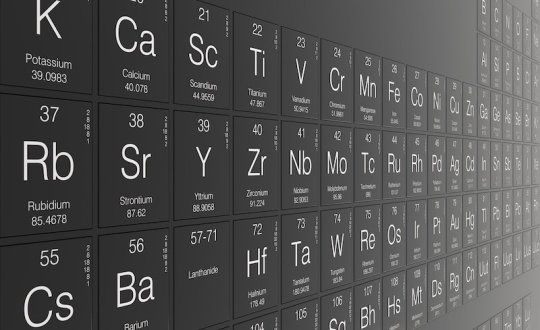
The research, which appears this week in Science, examined the electronic and magnetic behavior of a “strange metal” compound of ytterbium, rhodium and silicon as it both neared and passed through a critical transition at the boundary between two well-studied quantum phases.
The study at Rice University and Vienna University of Technology (TU Wien) provides the strongest direct evidence to date of entanglement’s role in bringing about quantum criticality, said study co-author Qimiao Si of Rice.
“When we think about quantum entanglement, we think about small things,” Si said. “We don’t associate it with macroscopic objects. But at a quantum critical point, things are so collective that we have this chance to see the effects of entanglement, even in a metallic film that contains billions of billions of quantum mechanical objects.”
Circa 2012
Imagine a clock that will keep perfect time forever or a device that opens new dimensions into quantum phenomena such as emergence and entanglement.
Imagine a clock that will keep perfect time forever, even after the heat-death of the universe. This is the “wow” factor behind a device known as a “space-time crystal,” a four-dimensional crystal that has periodic structure in time as well as space. However, there are also practical and important scientific reasons for constructing a space-time crystal. With such a 4D crystal, scientists would have a new and more effective means by which to study how complex physical properties and behaviors emerge from the collective interactions of large numbers of individual particles, the so-called many-body problem of physics. A space-time crystal could also be used to study phenomena in the quantum world, such as entanglement, in which an action on one particle impacts another particle even if the two particles are separated by vast distances.
A space-time crystal, however, has only existed as a concept in the minds of theoretical scientists with no serious idea as to how to actually build one – until now. An international team of scientists led by researchers with the U.S. Department of Energy (DOE)’s Lawrence Berkeley National Laboratory (Berkeley Lab) has proposed the experimental design of a space-time crystal based on an electric-field ion trap and the Coulomb repulsion of particles that carry the same electrical charge.
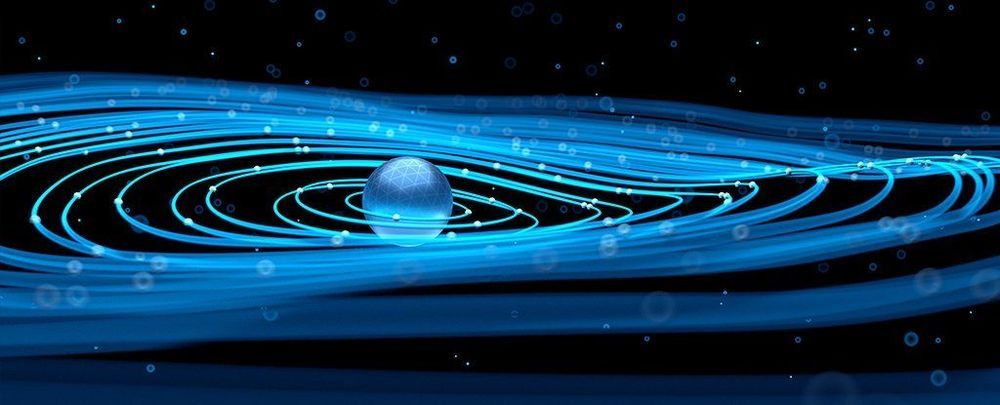
Scientists have created the fastest spinning object ever made, taking them a big step closer to being able to measure the mysterious quantum forces at play inside ‘nothingness’.
The record-breaking object in question is a tiny piece of silica, capable of whipping around billions of times per second — creating sufficient sensitivity that the team think they’ll be able to use it to detect unfathomably small amounts of drag caused by the ‘friction’ within a vacuum.
The science of nothingness is quickly becoming a big deal in physics, as we strive to understand how the Universe operates at its very foundations.
And it could help in the development of quantum computers.