Chinese government confirms it has been funding EmDrive research since 2010 and believes in its benefits.

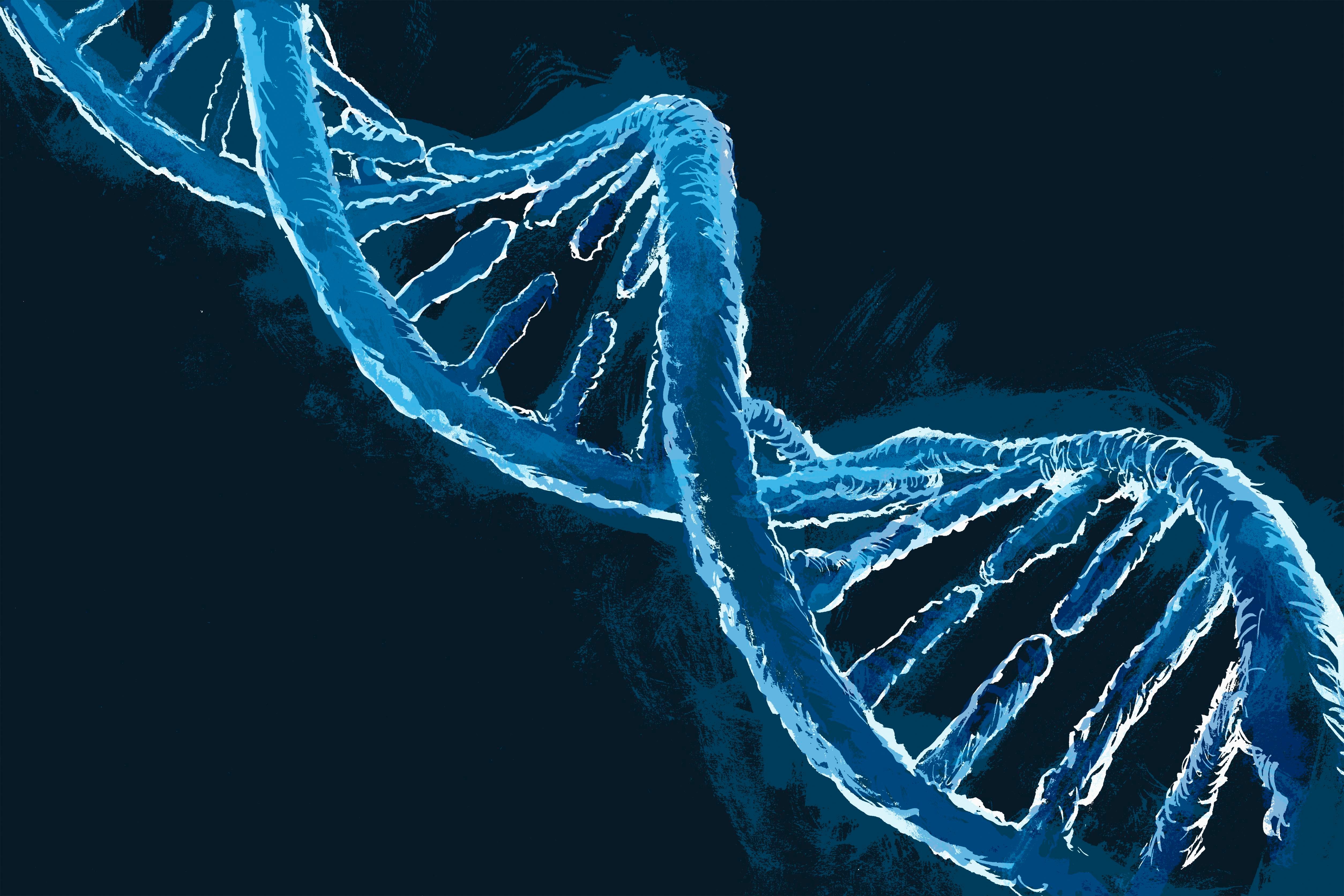
Definitely yes on gene mutations; however, those where the disease has already appeared, or cancer that has occurred before will require another form of eradication/ prevention. And, that is where Quantum Biosystem technology will be effective in eliminating disease.
ALL inherited diseases could be cured within 20 years, a leading British expert claims.
It includes eradicating life-limiting conditions such as cystic fibrosis and Huntington’s disease.
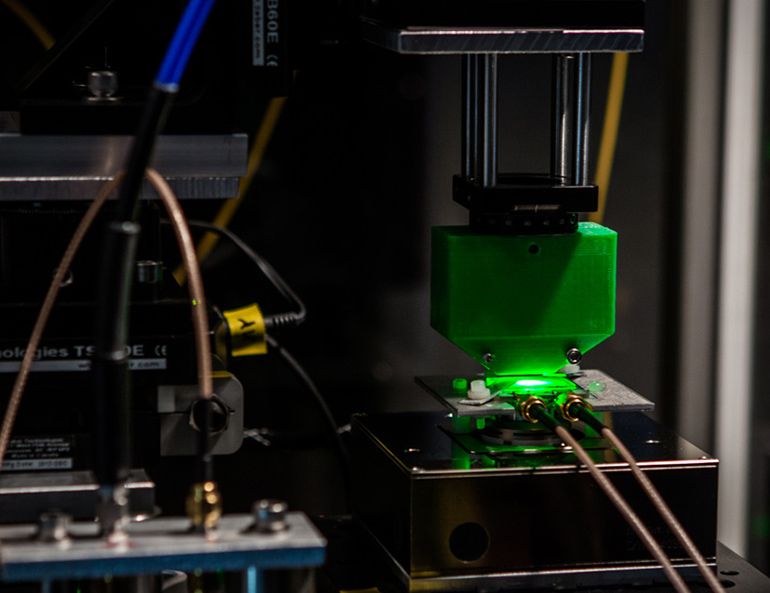
Quantum interpolation makes viewing Biomolecules at room temp. possible without freezing. This technique will enable more powerful sensors than we have ever had before.
In the latest issue of Proceedings of the National Academy of Sciences, researchers from MIT and Singapore University of Technology and Design are describing a new technique that may finally give life scientists a detailed view into many of the biomolecules they work with. These days, X-ray diffraction is typically used to see the structure of a molecule. But this requires crystallization, a process not all molecules, including many proteins, are unwilling to undergo.
The technology uses tiny diamond crystals that have a nitrogen atom in place of a single carbon atom. These so-called “nitrogen vacancy centers” make the crystals react to minute fluctuations of magnetic and electric fields surrounding them. They’re so sensitive that the spins of individual atoms of a nearby molecule affect them enough to be detected by an external device.
Using nitrogen vacancy centers is not new, but previously the resolution that was achieved has not been sufficient to accurately image most molecules. That is because microwaves were typically used to detect the state of the diamond crystals, and the way they’ve been used has led to limited results. The latest research relies on “quantum interpolation,” which in simplified terms means taking multiple readings of the magnetic field around the diamond crystals using different microwave pulses at the same time.
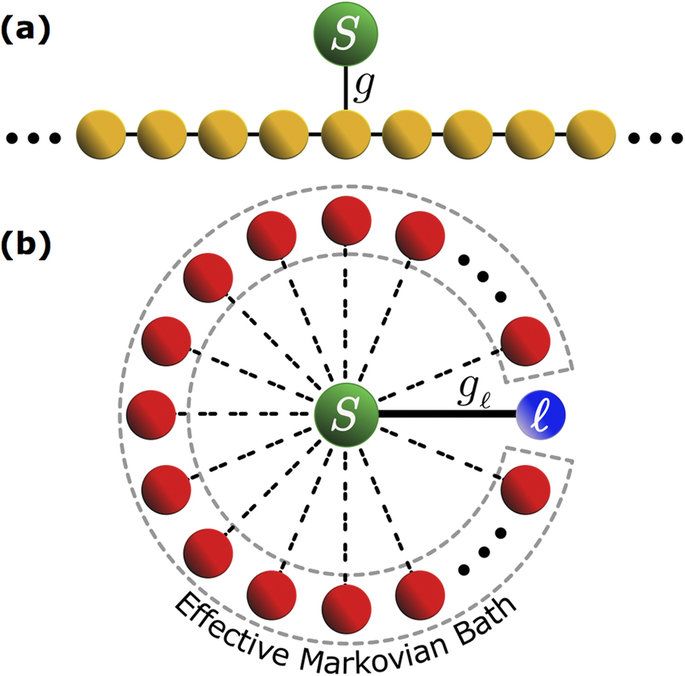
Nice information on Quantum open systems via the existence of a functional relationship between a rigorous measure of quantum non–Markovian ity and the CCA localization. Sharing with my other QC R&D friends.
As discovered by P. W. Anderson, excitations do not propagate freely in a disordered lattice, but, due to destructive interference, they localise. As a consequence, when an atom interacts with a disordered lattice, one indeed observes a non-trivial excitation exchange between atom and lattice. Such non-trivial atomic dynamics will in general be characterised also by a non-trivial quantum information backflow, a clear signature of non–Markovian dynamics. To investigate the above scenario, we consider a quantum emitter, or atom, weakly coupled to a uniform coupled-cavity array (CCA). If initially excited, in the absence of disorder, the emitter undergoes a Markovian spontaneous emission by releasing all its excitation into the CCA (initially in its vacuum state). By introducing static disorder in the CCA the field normal modes become Anderson-localized, giving rise to a non–Markovian atomic dynamics. We show the existence of a functional relationship between a rigorous measure of quantum non–Markovian ity and the CCA localization. We furthermore show that the average non–Markovian ity of the atomic dynamics is well-described by a phenomenological model in which the atom is coupled, at the same time, to a single mode and to a standard — Markovian — dissipative bath.
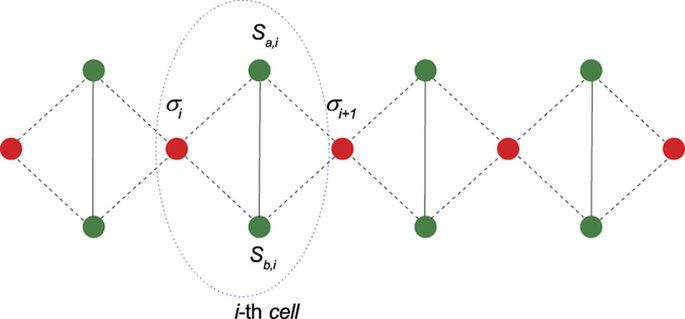
Nice research on finite temperatures and diamond structure spins.
Here the quantum criticality in the Ising-XXZ diamond structure at finite temperature have been studied by the trance distance discord calculations. Around the critical lines, the first-order derivative of the trace distance discord exhibits a maximal at a finite temperature and diverges under the thermodynamic limits T → 0. By analyzing the finite-temperature scaling behaviors, we show that the trace distance discord can detect exactly the quantum phase transition from the entangled state in ferrimagnetic phase to an unentangled state in ferrimagnetic phase or to an unentangled state in ferromagnetic phase. The results also show that the trace distance can distinguish the two kinds of transitions by consulting to the different finite-temperature scaling behaviors. As a comparison, we also study the behaviors of some other typical quantum correlations (e.g., concurrence, quantum discord and Hellinger distance) around the critical points, and the results state that the trance distance discord is more reliable than the others to spotlight the critical points for this Ising-XXZ diamond structure at finite temperatures.
Surely, this model system has three different critical phases, and it would be significant and challenging in the future to consider the multipartite quantum correlations which may grasp all these transitions. The bipartite quantum correlations imposed on this Ising-XXZ diamond structure, as studied in this work, can not detect the transition from UFI phase to UFM phase at finite temperature, an issue for future investigations.

More on DARPA’s Quantum Biosystem program “RadioBio”
During Phase 1, performers will be asked to theoretically model and simulate hypothesized electromagnetic signaling pathways and then experimentally test those theoretical predictions.
In Phase 2, the goal would be to independently develop test beds to replicate, confirm, and demonstrate the pathways modeled in Phase 1 and reveal design principles potentially relevant to biological or other applications aka can we enable human to human communication without a device.
ARLINGTON, Va. Defense Advanced Research Projects Agency (DARPA) officials launched a new program that seeks to establish if purposeful electromagnetic wave signaling between biological cells exists — and if evidence supports that it does — to determine what information is being transferred.
The RadioBio program is a research effort and even if it proves that electromagnetic signal occur between cells applications are years away, officials say. The validity of existing and new electromagnetic biosignaling claims requires an understanding of how the structure and function of microscopic, natural antennas are capable of generating and receiving information in a noisy spectral environment.
“There are many complex interactions within and between cells, so determining if electromagnetic waves, which could be low or high frequencies, somehow play a role in transmitting and receiving meaningful signals through what might be an ion-rich, aqueous solution is a significant challenge,” says Mike Fiddy, DARPA program manager. “If we can prove that purposeful signaling is happening, the next step would be to discover how the process works. This insight could eventually lead to a broad range of technologies important in biology as well as new small antenna designs, and other innovative concepts for communication systems in ever increasing cluttered electromagnetic environments.”
So true; as many of us have stated that the infrastructure for QC is a must 1st. A good video to review; as many of the themes are often repeated in many commentaries as well as this video provides some additional insights on QC.

The problems that I have seen when limiting the topic of quantum mechanics to the human mind topic is that the relationship around Quantum Mechanics to biology is missed completely. For example, it has only be in the recent few years that scientists began to understand Quantum Mechanics Action of ELF electromagnetic fields and its relationship to human cells. And, this find has open valuable research in how cells can (through electromagnetic fields can spin a low temperatures) mimic telepathy communicating between the human cells.
Nobody understands what consciousness is or how it works. Nobody understands quantum mechanics either. Could that be more than coincidence?

Nice advancement; looking forward indeed to the day I know longer look or touch a keypad again or even markers to a white or imaging board.
Memristors are resistive elements retaining information of their past dynamics. They have garnered substantial interest due to their potential for representing a paradigm change in electronics, information processing and unconventional computing. Given the advent of quantum technologies, a design for a quantum memristor with superconducting circuits may be envisaged. Along these lines, we introduce such a quantum device whose memristive behavior arises from quasiparticle-induced tunneling when supercurrents are cancelled. For realistic parameters, we find that the relevant hysteretic behavior may be observed using current state-of-the-art measurements of the phase-driven tunneling current. Finally, we develop suitable methods to quantify memory retention in the system.
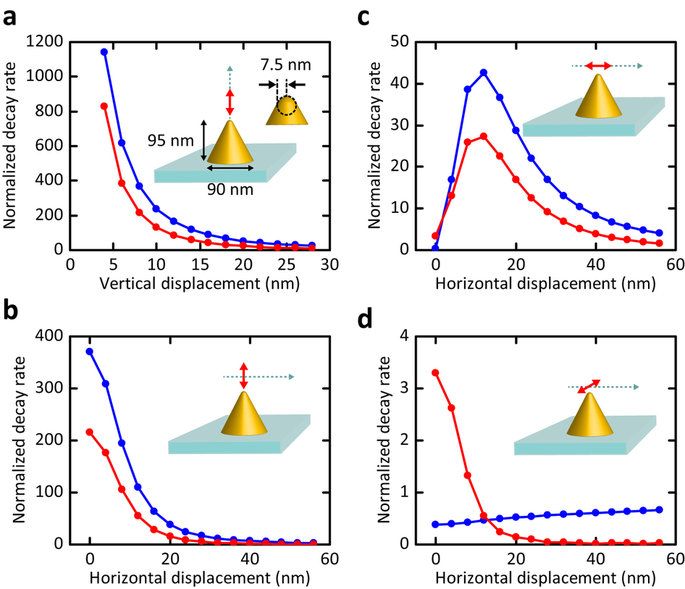
Multiexcitonic transitions and emission of several photons per excitation comprise a very attractive feature of semiconductor quantum dots for optoelectronics applications. However, these higher-order radiative processes are usually quenched in colloidal quantum dots by Auger and other nonradiative decay channels. To increase the multiexcitonic quantum efficiency, several groups have explored plasmonic enhancement, so far with moderate results. By controlled positioning of individual quantum dots in the near field of gold nanocone antennas, we enhance the radiative decay rates of monoexcitons and biexcitons by 109 and 100 folds at quantum efficiencies of 60 and 70%, respectively, in very good agreement with the outcome of numerical calculations. We discuss the implications of our work for future fundamental and applied research in nano-optics.