Google’s quantum computer outperformed the most powerful supercomputer on a task, the company reported. But some scientists aren’t fully convinced.
Less than 3 million Bitcoin (BTC) remain to be mined, with the process expected to take around 121 years. Some allege however, that Google’s quantum computer, Sycamore, could do it in “less than 2 seconds”. But is that really possible?
One computer to rule them all
Despite having the most difficult network to mine, Bitcoin (BTC) could have met its match in the face of the Google’s quantum processor, Sycamore. According to one medium post, the device has enough computational power to mine all the remaining BTC in less than two seconds.
Entanglement, once called “spooky action at a distance” by Einstein, is the phenomenon in which the quantum states of separated particles cannot be described independently. This puzzling phenomenon is widely exploited in the quantum physicist’s toolbox, and is a key resource for applications in secure quantum communication over long distances and quantum cryptography protocols. Unfortunately, entangled particles are easily disturbed by their surroundings, and their entanglement is readily diminished by the slightest interaction with the environment.
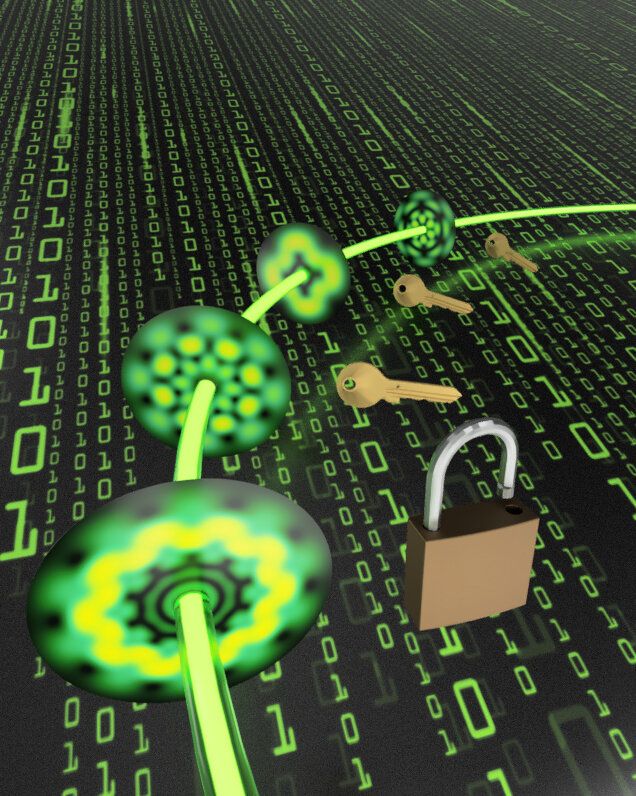
In a recent study published in the journal Physical Review X, an international team of physicists from Austria, Scotland, Canada, Finland and Germany have demonstrated how quantum entanglement can be strengthened to overcome particle loss or very high levels of noise, which are inevitable in real-life applications outside the laboratory. This strengthening is accomplished by departing from commonly used two-level quantum bits, or qubits. Qubits are bi-dimensional systems, the quantum analogue to the classical bit, with values zero or one. In this study, the researchers instead employed entanglement of systems with more than two levels. By entangling particles of light through their spatial and temporal properties, scientists have now observed the survival of quantum entanglement under harsh environmental conditions for the first time.
When it comes to distributing particles of light outside of a protected laboratory, the environmental conditions are identical to the tested ones. Therefore, the experiment is not only a proof-of-principle implementation, but is ready for long-distance quantum communication under real-world conditions. This new method could hence prove helpful for distributing entanglement in a future quantum internet.
Sean Carroll is a theoretical physicist at the California Institute of Technology. He specialises in quantum mechanics, gravitation, cosmology, statistical mechanics and foundations of physics. His latest book is Something Deeply Hidden: Quantum Worlds and the Emergence of Spacetime (2019). He lives in Los Angeles.
2,600 words.
The idea that the universe splits into multiple realities with every measurement has become an increasingly popular proposed solution to the mysteries of quantum mechanics. But this “many-worlds interpretation” is incoherent, Philip Ball argues in this adapted excerpt from his new book Beyond Weird.
Atomic physicists at NASA are working to create an exotic state of matter in space 🤯
Via Seeker