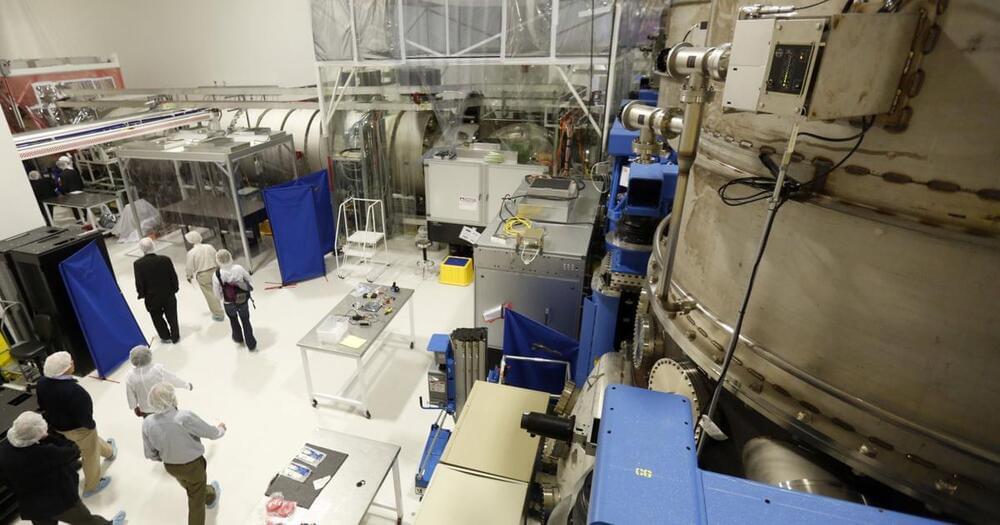
Lasers have been used to throw and catch extremely cold, single atoms. The technique could be used to assemble quantum computers in the future.
Ordinarily, to measure an object we must interact with it in some way. Whether it’s by a prod or a poke, an echo of sound waves, or a shower of light, it’s near impossible to look without touching.
In the world of quantum physics, there are some exceptions to this rule.
Researchers from Aalto University in Finland propose a way to ‘see’ a microwave pulse without the absorption and re-emission of any light waves. It’s an example of a special interaction-free measurement, where something is observed without being rattled by a mediating particle.
This year’s Nobel Prize in Physics celebrated the fundamental interest of quantum entanglement, and also envisioned the potential applications in “the second quantum revolution”—a new age when we are able to manipulate the weirdness of quantum mechanics, including quantum superposition and entanglement. A large-scale and fully functional quantum network is the holy grail of quantum information sciences. It will open a new frontier of physics, with new possibilities for quantum computation, communication, and metrology.
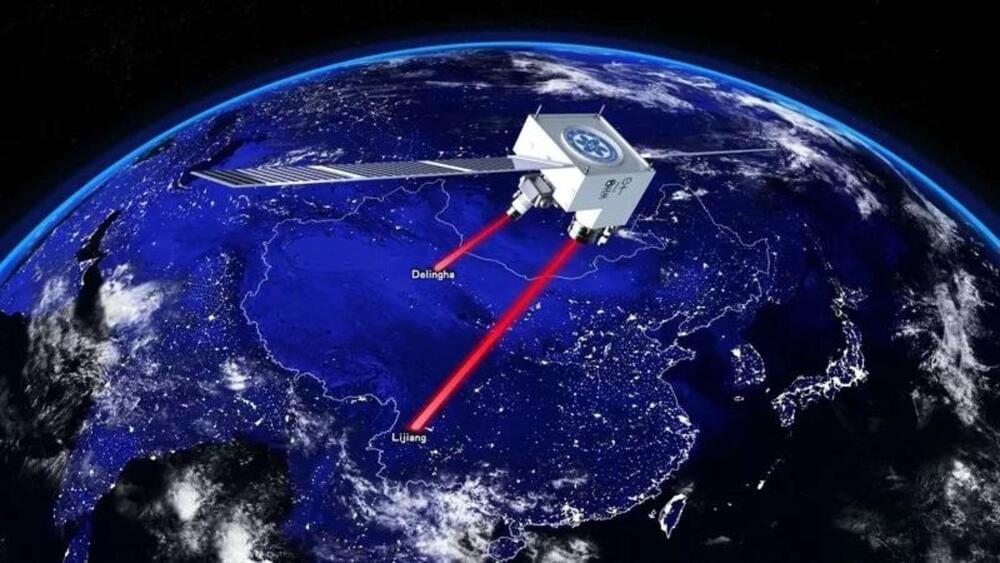
One of the most significant challenges is to extend the distance of quantum communication to a practically useful scale. Unlike classical signals that can be noiselessly amplified, quantum states in superposition cannot be amplified because they cannot be perfectly cloned. Therefore, a high-performance quantum network requires not only ultra-low-loss quantum channels and quantum memory, but also high-performance quantum light sources. There has been exciting recent progress in satellite-based quantum communications and quantum repeaters, but a lack of suitable single-photon sources has hampered further advances.
What is required of a single-photon source for quantum network applications? First, it should emit one (only one) photon at a time. Second, to attain brightness, the single-photon sources should have high system efficiency and a high repetition rate. Third, for applications such as in quantum teleportation that require interfering with independent photons, the single photons should be indistinguishable. Additional requirements include a scalable platform, tunable and narrowband linewidth (favorable for temporal synchronization), and interconnectivity with matter qubits.
As a general rule, if you want sight, you need light. You’re only reading this right now thanks to the light from your screen being beamed onto your retinas, converted into electrical signals, and sent up the optic nerve for your brain to interpret as a bunch of words and images.
But what if you could see things without all that rigamarole? It might sound impossible – perhaps even counter to the very definition of sight – but thanks to the bizarre world of quantum mechanics, it’s actually perfectly possible.
“Since the inception of quantum mechanics, the quest to understand measurements has been a rich source of intellectual fascination,” notes a new paper published this month.
Craig Wright’s time theory states that quantum entanglement doesn’t require any information traveling under observable physics and suggests that an infinite amount of data is contained in the universe.
Yet the notion that we inhabit a space with any mathematical structure is a radical innovation of Western culture, necessitating an overthrow of long-held beliefs about the nature of reality. Although the birth of modern science is often discussed as a transition to a mechanistic account of nature, arguably more important – and certainly more enduring – is the transformation it entrained in our conception of space as a geometrical construct.
Over the past century, the quest to describe the geometry of space has become a major project in theoretical physics, with experts from Albert Einstein onwards attempting to explain all the fundamental forces of nature as byproducts of the shape of space itself. While on the local level we are trained to think of space as having three dimensions, general relativity paints a picture of a four-dimensional universe, and string theory says it has 10 dimensions – or 11 if you take an extended version known as M-Theory. There are variations of the theory in 26 dimensions, and recently pure mathematicians have been electrified by a version describing spaces of 24 dimensions. But what are these ‘dimensions’? And what does it mean to talk about a 10-dimensional space of being?
The Condor processor is just one quantum-computing advance slated for 2023.