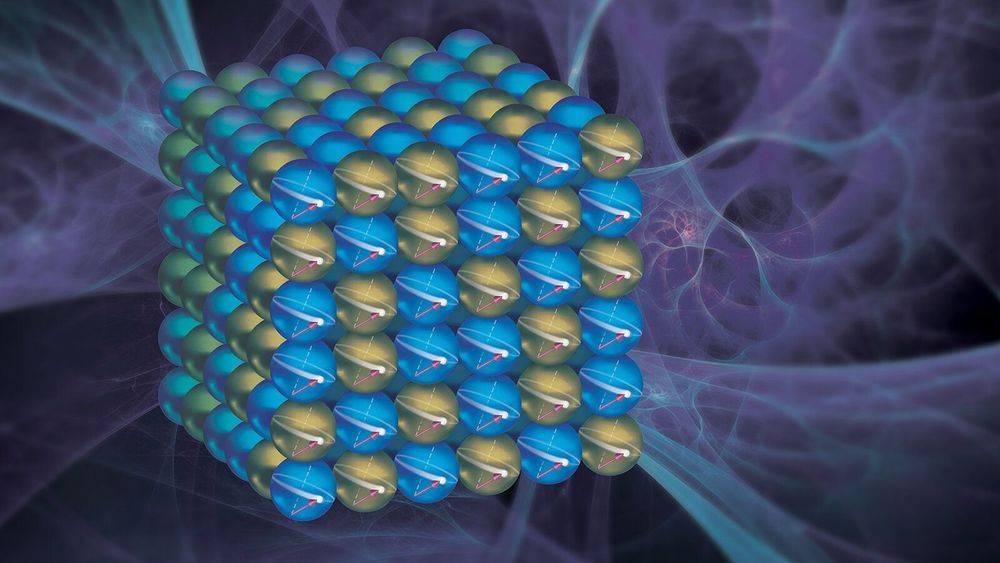
Although I shared an article last week about this new record being acheived; this version of the story seems to have some additional insights.
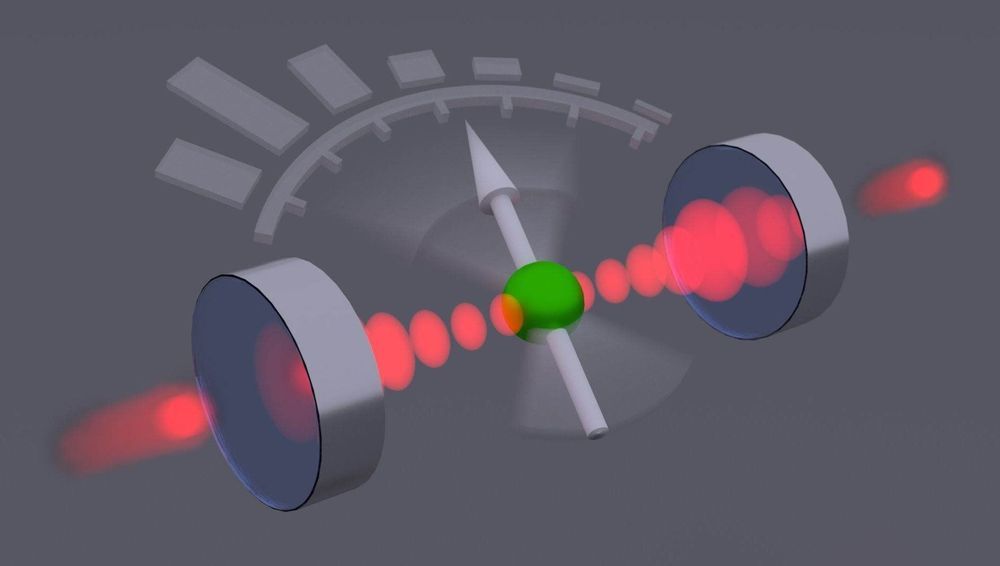
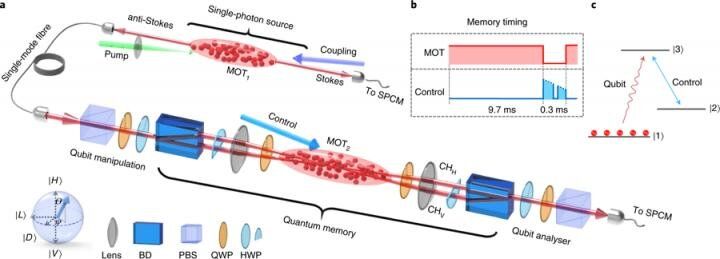
A recent experiment could open new doors in space-based quantum communication.
Spectroscopy studies of charge transfer from cadmium selenide quantum dots to molecular nickel catalysts reveal unexpectedly fast electron transfer, enabling exceptional photocatalytic hydrogen production.
![]()
A key challenge facing the US is the harvesting, production, storage, and distribution of energy to support economic prosperity with responsible environmental management. Currently, fossil fuels provide more than 80% of the energy consumed in the US (even when significant increases in the use of alternative sources of energy in recent years are accounted for).1 For the US Department of Defense in particular, volatility in the price and availability of fossil fuels leads to significant short- and long-term financial, operational, and strategic risks.2 There is, therefore, clearly a need for new alternative sources of energy.
Over 20 years ago, I was interviewed by a group that asked me about the future of technology. I told them due to advancements such as nanotechnology that technology will definitely go beyond laptops, networks, servers, etc.; that we would see even the threads/ fibers in our clothing be digitized. I was then given a look by the interviewers that I must have walked of the planet Mars. However, I was proven correct. And, in the recent 10 years, again I informed others how and where Quantum would change our lives forever. Again, same looks and comments.
And, lately folks have been coming out with articles that they have spoken with or interviewed QC experts. And, they in many cases added their own commentary and cherry picked people comments to discredit the efforts of Google, D-Wave, UNSW, MIT, etc. which is very misleading and negatively impacts QC efforts. When I come across such articles, I often share where and why the authors have misinformed their readers as well as negatively impacted efforts and set folks up for failure who should be trying to plan for QC in their longer term future state strategy so that they can plan for budgets, people can be brought up to date in their understanding of QC because once QC goes live on a larger scale, companies and governments will not have time to catch up because once hackers (foreign government hackers, etc.) have this technology and you’re not QC enabled then you are exposed, and your customers are exposed. The QC revolution will be costly and digital transformation in general across a large company takes years to complete so best to plan and prepare early this time for QC because it is not the same as implementing a new cloud, or ERP, or a new data center, or rationalizing a silo enterprise environment.
The recent misguided view is that we’re 30 or 50 years away from a scalable quantum chip; and that is definitely incorrect. UNSW has proven scalable QC is achievable and Google has been working on making a scalable QC chip. And, lately RMIT researchers have shared with us how they have proven method to be able to trace particles in the deepest layers of entanglement which means that we now can build QC without the need of analog technology and take full advantage of quantum properties in QC which has not been the case.
So, sharing these three news releases for my QC friends to share with their non-believers and the uninformed.
http://www.zdnet.com/article/googles-quantum-computer-inches…akthrough/
https://www.sciencedaily.com/releases/2015/10/151030153108.htm
Nice.
Chapman University Institute for Quantum Studies (IQS) member Yutaka Shikano, Ph.D., recently had research published in Scientific Reports. Superconductors are one of the most remarkable phenomena in physics, with amazing technological implications. Some of the technologies that would not be possible without superconductivity are extremely powerful magnets that levitate trains and MRI machines used to image the human body. The reason that superconductivity arises is now understood as a fundamentally quantum mechanical effect.
The basic idea of quantum mechanics is that at the microscopic scale everything, including matter and light, has a wave property to it. Normally the wave nature is not noticeable as the waves are very small, and all the waves are out of synchronization with each other, so that their effects are not important. For this reason, to observe quantum mechanical behavior experiments generally have to be performed at a very low temperature, and at microscopic length scales.
Superconductors, on the other hand, have a dramatic effect in the disappearance of resistance, changing the entire property of the material. The key quantum effect that occurs is that the quantum waves become highly synchronized and occur at a macroscopic level. This is now understood to be the same basic effect as that seen in lasers. The similarity is that in a laser, all the photons making up the light are synchronized, and appear as one single coherent wave. In a superconductor the macroscopic wave is for the quantum waves of the electrons, instead of the photons, but the basic quantum feature is the same. Such macroscopic quantum waves have also been observed in Bose-Einstein condensates, where atoms cooled to nanokelvin temperatures all collapse into a single state.
This is huge! They have been able to develop a method to trace high-dimensional entanglement.
Before this point, we had a method that could trace entanglement to limited level among particles; this method allows us to detect high-dimensional entanglement and even enable us to certify whether or not the system has reached the maximum level of entanglement.
So, we are now going to finally see “real” full-scale quantum computing. This changes everything.
RMIT quantum computing researchers have developed and demonstrated a method capable of efficiently detecting high-dimensional entanglement.
Entanglement in quantum physics is the ability of two or more particles to be related to each other in ways which are beyond what is possible in classical physics.
Having information on a particle in an entangled ensemble reveals an “unnatural” amount of information on the other particles.
Congrats DiAmante! Synthetic Diamond perfection for Quantum Computing and other technologies such as medical technology usage. Synthetic Diamonds (for all you startups or folks looking for something to get into) mass manufacturing is a huge demand area and it is only going to grow in demand with QC and the new medical technologies that are coming over the next 5 to 7 years. I have been researching 3D printers to see what can be done to mimic the process. Suggest HP and Intel to work hard in this space. I did locate one printer so far that is mass producing synthetic diamonds; the quality needs to be improved.
DiAmante makes synthetic diamonds for the semiconductor market.
The founder’s goal: ‘a diamond-based technology revolution’
The tiny company’s competitors include diamond giant DeBeers.
A walk down memory lane: I thought it would be fun to revisit an article from 1998 about Los Alamos’ announcement about their move to Quantum Computing which we found out later they expanded it to include a Quantum Network which they announced in 2009 their success in that launch. Times certainly have changed.
LOS ALAMOS, N.M., March 17, 1998 — Researchers at the Department of Energy’s Los Alamos National Laboratory have answered several key questions required to construct powerful quantum computers fundamentally different from today’s computers, they announced today at the annual meeting of the American Physical Society.
“Based on these recent experiments and theoretical work, it appears the barriers to constructing a working quantum computer will be technical, rather than fundamental to the laws of physics,” said Richard Hughes of Los Alamos’ Neutron Science and Technology Group.
Hughes also said that a quantum computer like the one Los Alamos is building, in which single ionized atoms act like a computer memory, could be capable of performing small computations within three years.
Einstein called it “spooky action at a distance.”
That’s because entanglement, a voodoo-like phenomenon in quantum physics linking particles that once interacted, seems to surpass the speed of light, violating the cosmic speed limit.
Because of this, it doesn’t fit in with Einstein’s theory of relativity, so he concluded that it was too ludicrous to be real.
RMIT quantum computing researchers have developed and demonstrated a method capable of efficiently detecting high-dimensional entanglement.
Entanglement in quantum physics is the ability of two or more particles to be related to each other in ways which are beyond what is possible in classical physics.
Having information on a particle in an entangled ensemble reveals an “unnatural” amount of information on the other particles.