Physics is on the brink of peering more deeply into nature’s foundations than ever before.
The four dimensions of spacetime that we experience could be like a hologram projected by a three-dimensional quantum state.
Read more
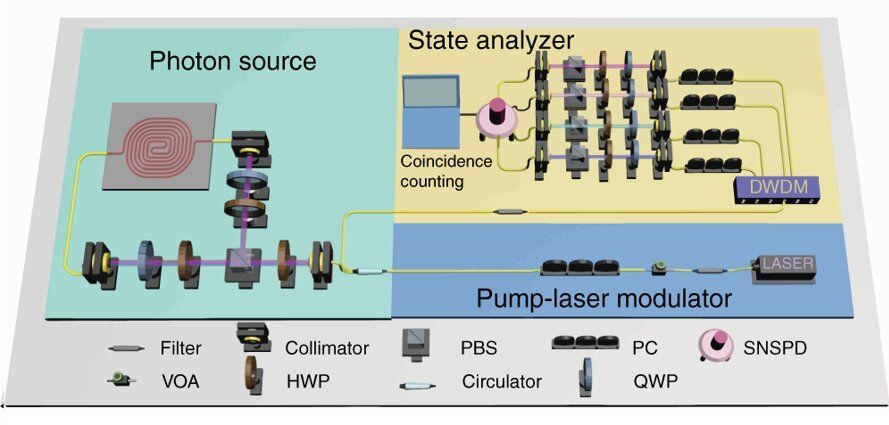
In a recent study now published in Light: Science & Applications, Ming Zhang, Lan-Tian Feng and an interdisciplinary team of researchers at the departments of quantum information, quantum physics and modern optical instrumentation in China, detailed a new technique to generate photon-pairs for use in quantum devices. In the study, they used a method known as four-wave mixing to allow three electromagnetic fields to interact and produce a fourth field. The team created the quantum states in a silicon nanophotonic spiral waveguide to produce bright, tunable, stable and scalable multiphoton quantum states. The technology is comparable with the existing fiber and integrated circuit manufacturing processes to pave the way to engineer a range of new generation photonic quantum technologies for applications in quantum communication, computation and imaging. The multiphoton quantum sources detailed in the work will play a critical role to improve the existing understanding of quantum information.
The scientists generated multiphoton quantum states using a single-silicon nanophotonic waveguide and detected four-photon states with a low pump power of 600 µW to achieve experimental multiphoton quantum interference verified with quantum state tomography. Zhang and Feng et al. recorded the quantum interference visibilities at a value greater than 95 percent with high fidelity. The multiphoton quantum source is fully compatible with on-chip processes of quantum manipulation and quantum detection to form large-scale quantum photonic integrated circuits (QPICs). The work has significant potential for multiphoton quantum research.
Multiphoton quantum sources are critical to build several practical platforms for quantum communication, computation, simulation and metrology. Physicists have made great efforts to realize high quality, bright and scalable multiphoton quantum states in previous work, to activate powerful quantum technologies by multiplexing several biphoton sources to generate eight-photon and 10-photon entanglement. However, the efficacy of such multiplexing systems decreased with the number of entangled photons. At present, quantum photonic integrated circuits (QPCIs) and silicon-on-insulator (SOI) technology remain promising to realize high quality photon-pair sources.

A new type of money that allows users to make decisions based on information arriving at different locations and times, and that could also protect against attacks from quantum computers, has been proposed by a researcher at the University of Cambridge.
The theoretical framework, dubbed ‘S–money’, could ensure completely unforgeable and secure authentication, and allow faster and more flexible responses than any existing financial technology, harnessing the combined power of quantum theory and relativity. In fact, it could conceivably make it possible to conduct commerce across the Solar System and beyond, without long time lags, although commerce on a galactic scale is a fanciful notion at this point.
Researchers aim to begin testing its practicality on a smaller, Earth-bound scale later this year. S-money requires very fast computations, but may be feasible with current computing technology. Details are published in the Proceedings of the Royal Society A.

Logic and memory devices, such as the hard drives in computers, now use nanomagnetic mechanisms to store and manipulate information. Unlike silicon transistors, which have fundamental efficiency limitations, they require no energy to maintain their magnetic state: Energy is needed only for reading and writing information.
One method of controlling magnetism uses electrical current that transports spin to write information, but this usually involves flowing charge. Because this generates heat and energy loss, the costs can be enormous, particularly in the case of large server farms or in applications like artificial intelligence, which require massive amounts of memory. Spin, however, can be transported without a charge with the use of a topological insulator—a material whose interior is insulating but that can support the flow of electrons on its surface.
In a newly published Physical Review Applied paper, researchers from New York University introduce a voltage-controlled topological spin switch (vTOPSS) that requires only electric fields, rather than currents, to switch between two Boolean logic states, greatly reducing the heat generated and energy used. The team is comprised of Shaloo Rakheja, an assistant professor of electrical and computer engineering at the NYU Tandon School of Engineering, and Andrew D. Kent, an NYU professor of physics and director of the University’s Center for Quantum Phenomena, along Michael E. Flatté, a professor at the University of Iowa.
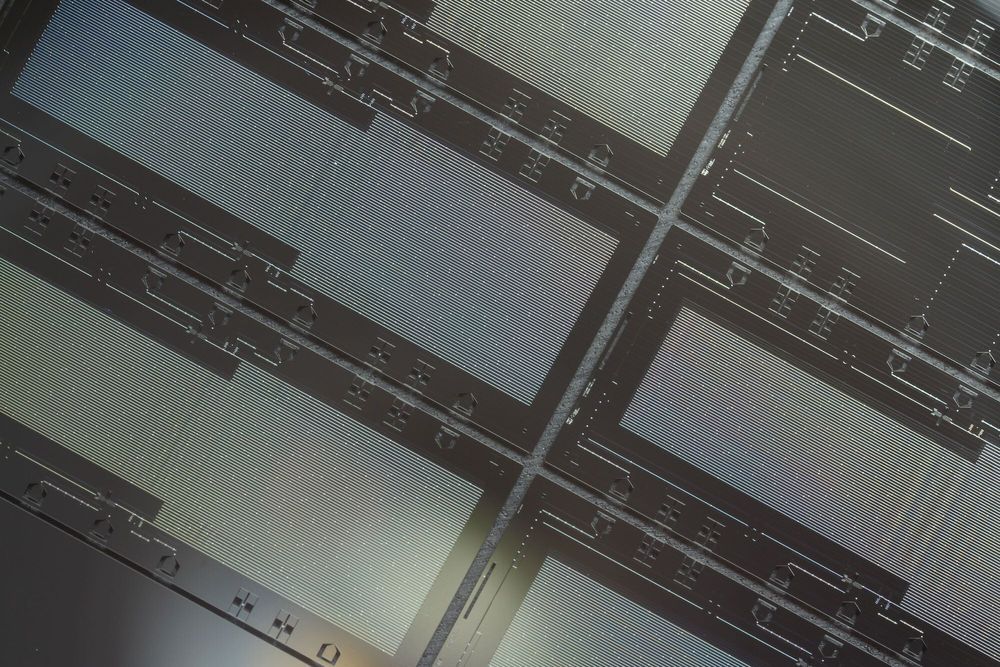
The efficient generation of entanglement between remote quantum nodes is a crucial step in securing quantum communications. In past research, entanglement has often been achieved using a number of different probabilistic schemes.
Recently, some studies have also offered demonstrations of deterministic remote entanglement using approaches based on superconducting qubits. Nonetheless, the deterministic violation of Bell’s inequality (a strong measure of quantum correlation) in a superconducting quantum communication architecture has so far never been demonstrated.
A team of researchers based at the University of Chicago has recently demonstrated a violation of Bell’s inequality using remotely connected superconducting qubits. Their paper, published in Nature Physics, introduces a simple and yet robust architecture for achieving this benchmark result in a superconducting system.

Matter waves constitute a crucial feature of quantum mechanics, in which particles have wave properties in addition to particle characteristics. This wave-particle duality was postulated in 1924 by the French physicist Louis de Broglie. The existence of the wave property of matter has been successfully demonstrated in a number of experiments with electrons and neutrons, as well as with more complex matter, up to large molecules.
For antimatter, the wave-particle duality has also been proven through diffraction experiments. However, researchers of the QUPLAS collaboration have now established wave behavior in a single positron (antiparticle to the electron) interference experiment. The results are reported in Science Advances.
The QUPLAS scientific collaboration includes researchers from the University of Bern and from the University and Politecnico of Milano. To demonstrate the wave duality of single positrons, they performed measurements with a setup similar to the so-called double-slit experiment. This setup was suggested by physicists including Albert Einstein and Richard Feynman; it is often used in quantum theory to demonstrate the wave nature of particles.

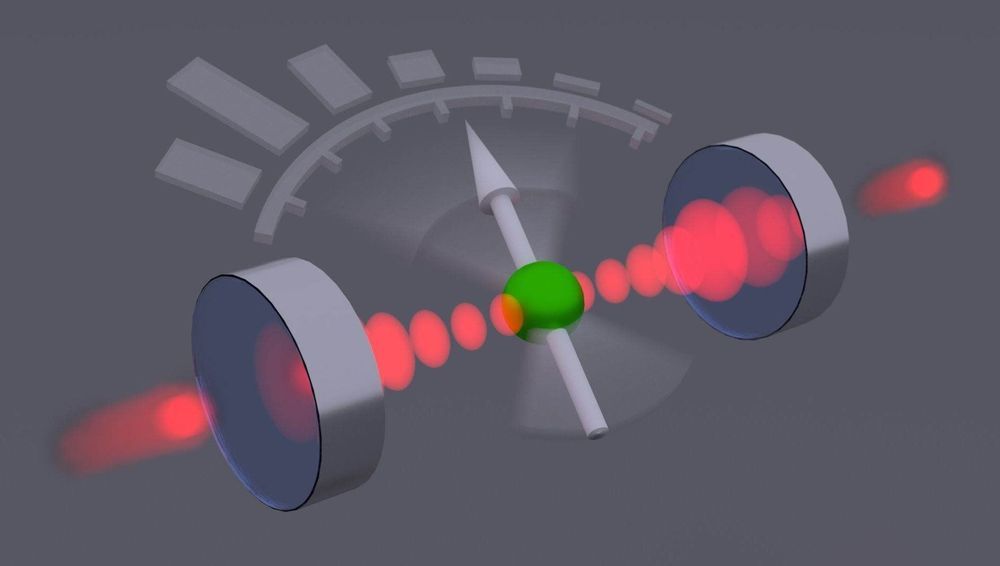
A photodetector converts light into an electrical signal, causing the light to be lost. Researchers led by Tracy Northup at the University of Innsbruck have now built a quantum sensor that can measure light particles non-destructively. It can be used to further investigate the quantum properties of light.
Physicist Tracy Northup is currently researching the development of quantum internet at the University of Innsbruck. The American citizen builds interfaces with which quantum information can be transferred from matter to light and vice versa. Over such interfaces, it is anticipated that quantum computers all over the world will be able to communicate with each other via fiber optic lines in the future. In their research, Northup and her team at the Department of Experimental Physics have now demonstrated a method with which visible light can be measured non-destructively. The development follows the work of Serge Haroche, who characterized the quantum properties of microwave fields with the help of neutral atoms in the 1990s and was awarded the Nobel Prize in Physics in 2012.
In work led by postdoc Moonjoo Lee and Ph.D. student Konstantin Friebe, the researchers place an ionized calcium atom between two hollow mirrors through which visible laser light is guided. “The ion has only a weak influence on the light,” explains Tracy Northup. “Quantum measurements of the ion allow us to make statistical predictions about the number of light particles in the chamber.” The physicists were supported in their interpretation of the measurement results by the research group led by Helmut Ritsch, a Innsbruck quantum optician from the Department of Theoretical Physics. “One can speak in this context of a quantum sensor for light particles”, sums up Northup, who has held an Ingeborg Hochmair professorship at the University of Innsbruck since 2017. One application of the new method would be to generate special tailored light fields by feeding the measurement results back into the system via a feedback loop, thus establishing the desired states.