…our techniques may enable quantum enhanced AIs to learn the effect of their actions much more efficiently.
Read more

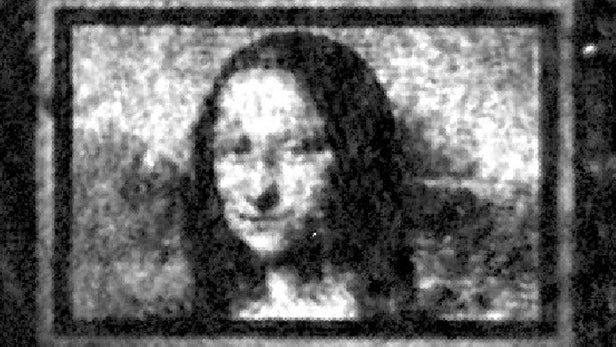
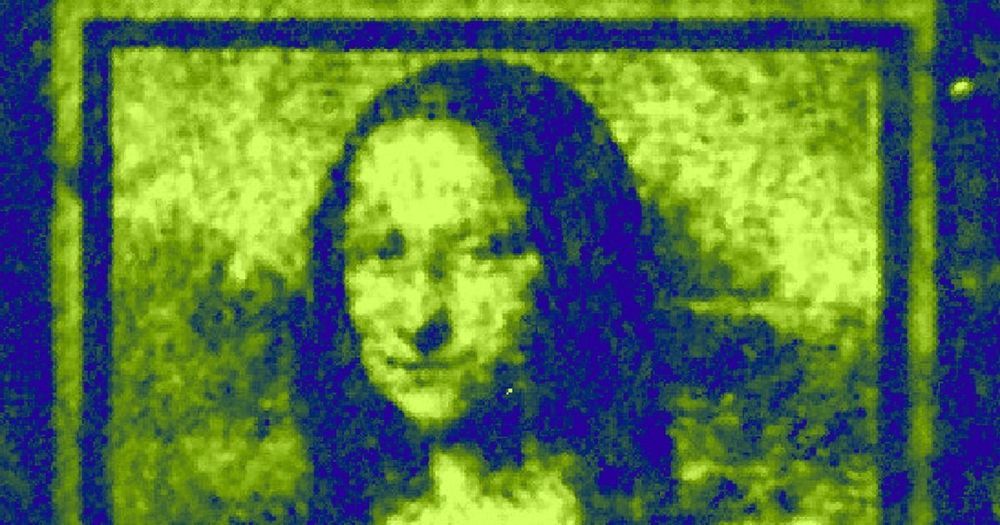
Researchers at the University of Queensland (UQ) have produced what may very well be the first pieces of art made using non-classical matter. The team has reproduced famous artworks like the Mona Lisa and Starry Night on a “quantum canvas” as small as a human hair, by projecting light onto Bose-Einstein condensates (BECs).

VIENNA—Over the past several days, I attended a fascinating conference that explored an old idea of Einstein’s, one that was largely dismissed for decades: that quantum mechanics is not the root level of reality, but merely a hazy glimpse of something even deeper.
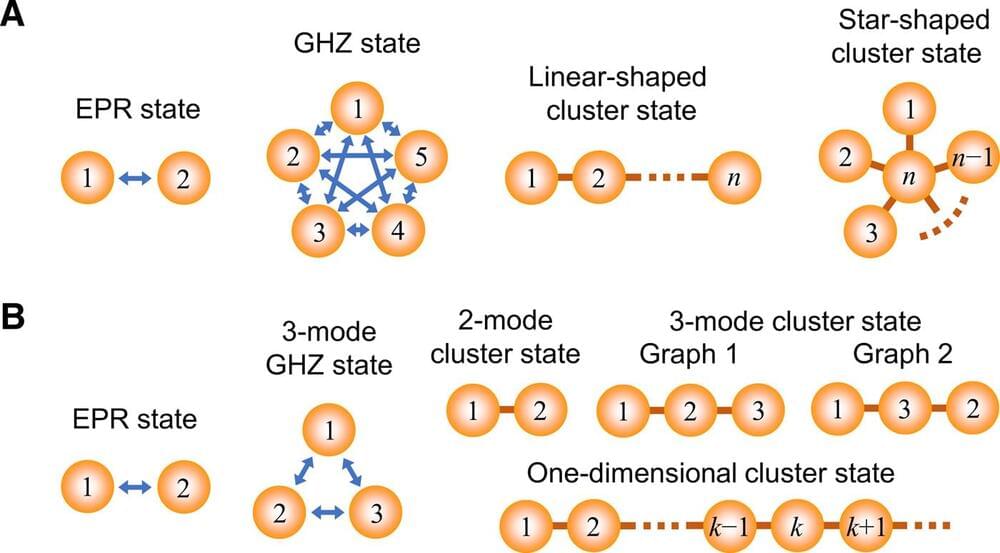
Quantum information protocols require various types of entanglement, such as Einstein-Podolsky-Rosen, Greenberger-Horne-Zeilinger, and cluster states. In optics, on-demand preparation of these states has been realized by squeezed light sources, but such experiments require different optical circuits for different entangled states, thus lacking versatility. Here, we demonstrate an on-demand entanglement synthesizer that programmably generates all these entangled states from a single squeezed light source. This is achieved by a loop-based circuit that is dynamically controllable at nanosecond time scales and processes optical pulses in the time domain. We verify the generation of five different small-scale entangled states and a large-scale cluster state containing more than 1000 modes without changing the optical circuit. Moreover, this circuit enables storage and release of one part of the generated entangled state, thus working as a quantum memory. Our demonstration should open a way for a more general entanglement synthesizer and a scalable quantum processor.
Entanglement is an essential resource for many quantum information protocols in both qubit and continuous variable (CV) regimes. However, different types of entanglement are required for different applications (Fig. 1A). The most commonly used maximally entangled state is a two-mode Einstein-Podolsky-Rosen (EPR) state (1), which is the building block for two-party quantum communication and quantum logic gates based on quantum teleportation (2, 3). Its generalized version is an n-mode Greenberger-Horne-Zeilinger (GHZ) state (4, 5), which is central to building a quantum network; this state, once shared between n parties, enables any two of the n parties to communicate with each other (5, 6). In terms of quantum computation, a special type of entanglement called cluster states has attracted much attention as a universal resource for one-way quantum computation (7–9).
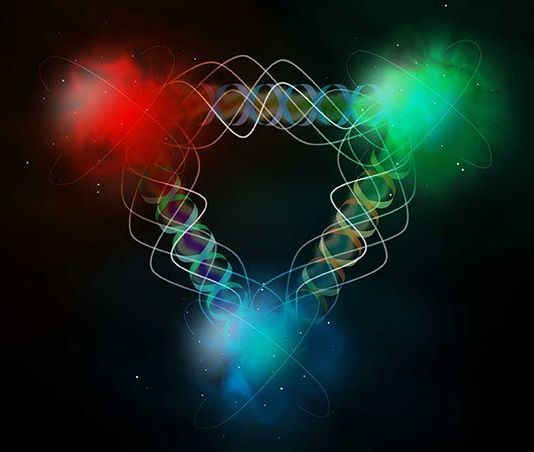
Protons are complicated. The subatomic particles are themselves composed of smaller particles called quarks and gluons. Now, data from the Large Hadron Collider hint that protons’ constituents don’t behave independently. Instead, they are tethered by quantum links known as entanglement, three physicists report in a paper published April 26 at arXiv.org.
Quantum entanglement has previously been probed on scales much larger than a proton. In experiments, entangled particles seem to instantaneously influence one another, sometimes even when separated by distances as large as thousands of kilometers (SN: 8/5/17, p. 14). Although scientists suspected that entanglement occurs within a proton, signs of that phenomenon hadn’t been experimentally demonstrated inside the particle, which is about a trillionth of a millimeter across.
“The idea is, this is a quantum mechanical particle which, if you look inside it, … it’s itself entangled,” says theoretical physicist Piet Mulders of Vrije Universiteit Amsterdam, who was not involved with the research.
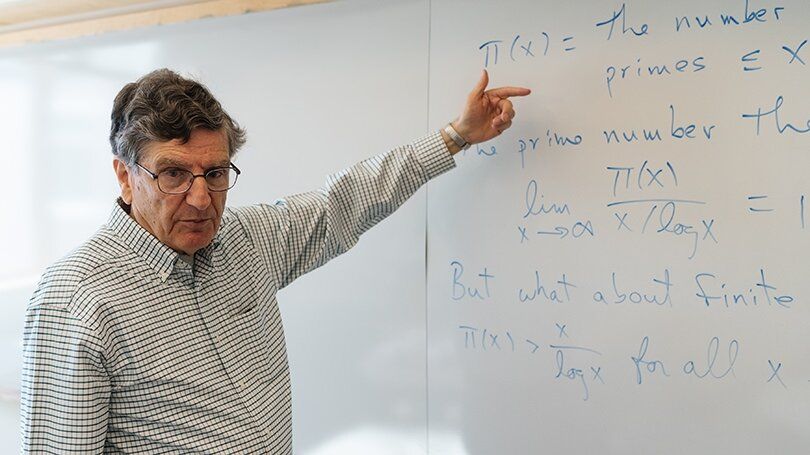
A prime number theory equation by mathematics professor emeritus Carl Pomerance turned up on The Big Bang Theory, where it was scrawled on a white board in the background of the hit sitcom about a group of friends and roommates who are scientists, many of them physicists at the California Institute of Technology.
In a recent paper, “Proof of the Sheldon Conjecture,” Pomerance, the John G. Kemeny Parents Professor of Mathematics Emeritus, does the math on a claim by fictional quantum physicist Sheldon Cooper that 73 is “the best number” because of several unique properties. Pomerance’s proof shows that 73 is indeed unique.
The Big Bang Theory is known for dressing the set with “Easter eggs” to delight the self-avowed science nerds in the audience. When UCLA physics professor David Saltzberg, technical consultant for The Big Bang Theory, heard about the Sheldon proof, he contacted Pomerance to ask if they could use it in the show, which was broadcast April 18.
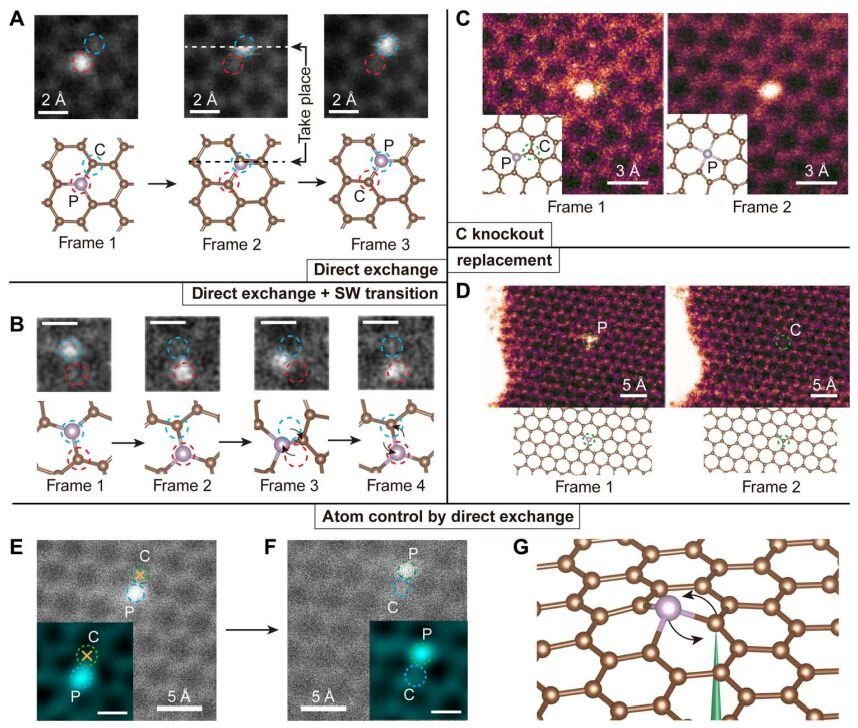
The ultimate degree of control for engineering would be the ability to create and manipulate materials at the most basic level, fabricating devices atom by atom with precise control.
Now, scientists at MIT, the University of Vienna, and several other institutions have taken a step in that direction, developing a method that can reposition atoms with a highly focused electron beam and control their exact location and bonding orientation. The finding could ultimately lead to new ways of making quantum computing devices or sensors, and usher in a new age of “atomic engineering,” they say.
The advance is described today in the journal Science Advances, in a paper by MIT professor of nuclear science and engineering Ju Li, graduate student Cong Su, Professor Toma Susi of the University of Vienna, and 13 others at MIT, the University of Vienna, Oak Ridge National Laboratory, and in China, Ecuador, and Denmark.
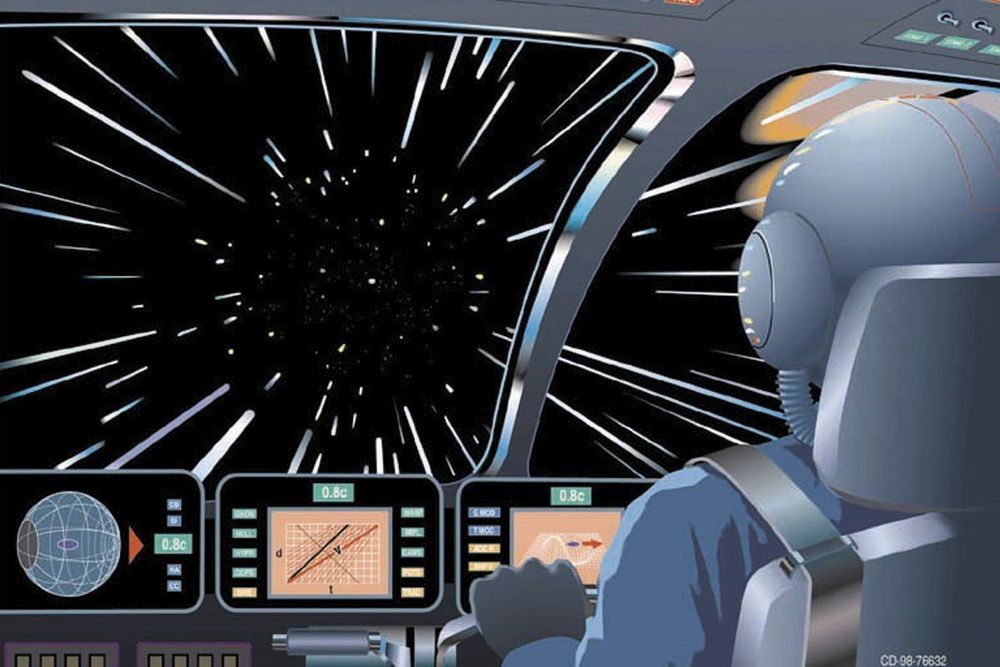
THE results of a NASA test into “warp drive” technology have been leaked onto the internet — and apparently show it is possible.
The findings appear to be good news — that the new technology that could fly spaceships to Mars, put men on the moon in four hours and make flying cars possible actually works in theory.
The much-anticipated review of EmDrive space propulsion was not supposed to be released until December according to the International Business Times.

Circa 2013
Physicists have long thought that the singularities associated with gravity (like the inside of a black hole) should vanish in a quantum theory of gravity. It now appears that this may indeed be the case. Researchers in Uruguay and Louisiana have just published a description of a quantum black hole using loop quantum gravity in which the predictions of physics-ending singularities vanish, and are replaced by bridges to another universe.