This nice; however, China’s Quantum Sat. announcement is the big news this morning.
Black holes might not be the bottomless pits we think they are.
Click on photo to start video.
China launches world’s first quantum satellite.
Although this another article that highlights again China’s planned launch; I wanted to share it because it does (in a pragmatic approach) highlight a couple of the key benefits for having QC.
The imminent launch of the world’s first quantum communication satellite is widely believed to herald a breakthrough in China’s development of quantum technology.
Mysterious and confusing, the study of minute particles smaller than atoms has been applied in fields as diverse as computer processing, lasers and nuclear technology.
How will quantum communication change our lives — especially in the age of cyber attacks, wiretapping and information leakage?
Just days away from launch; what will a Chinese owned Quantum Satellite and network mean for the world particularly for the US, Canada, and Europe?
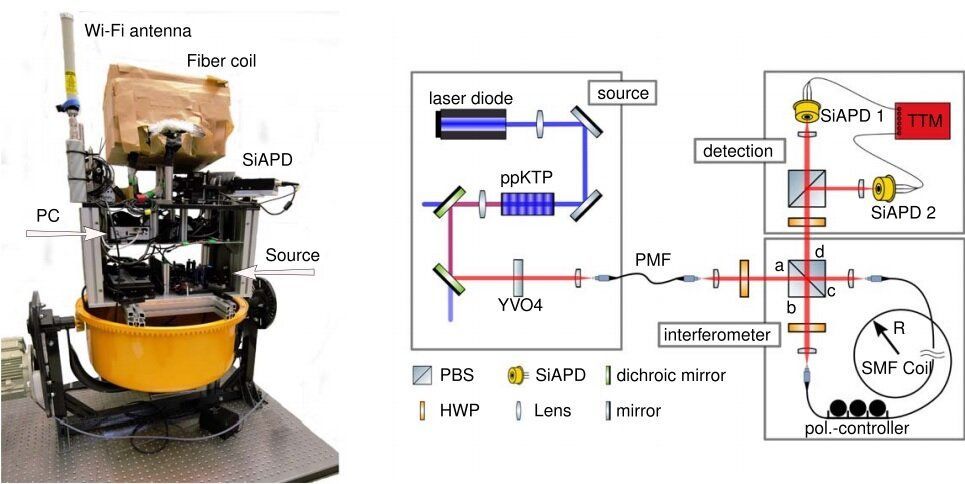
Beijing: China is set to launch the world’s first quantum communication satellite which boasts of hack-proof ultra high security features to prevent wiretapping and intercepts.
If the satellite works well, it will pave the way to a hack-proof communication system, state-run Xinhua news agency reported on Sunday.
It will launch the satellite in a matter of days.
Hmmm.
Testimonials from prominent physics researchers from institutions such as Cambridge University, Princeton University, and the Max Planck Institute for Physics in Munich claim that quantum mechanics predicts some version of “life after death.”
They assert that a person may possess a body-soul duality that is an extension of the wave-particle duality of subatomic particles.
Wave-particle duality, a fundamental concept of quantum mechanics, proposes that elementary particles, such as photons and electrons, possess the properties of both particles and waves. These physicists claim that they can possibly extend this theory to the soul-body dichotomy. If there is a quantum code for all things, living and dead, then there is an existence after death (speaking in purely physical terms). Dr. Hans-Peter Dürr, former head of the Max Planck Institute for Physics in Munich, posits that, just as a particle “writes” all of its information on its wave function, the brain is the tangible “floppy disk” on which we save our data, and this data is then “uploaded” into the spiritual quantum field. Continuing with this analogy, when we die the body, or the physical disk, is gone, but our consciousness, or the data on the computer, lives on.
If you think quantum computing sounds like something out of science fiction, you’re not alone. It’s still more theory than practice, but it might be able to answer questions that are unsolvable by current computers. Earlier this year, IBM made a small quantum computer available via the cloud.
Quantum Mechanics and the Weirdness of Particles
To understand quantum computers, you must first know a little bit about quantum mechanics. In the briefest possible description, quantum mechanics is the branch of physics that models how particles behave at the smallest scales.
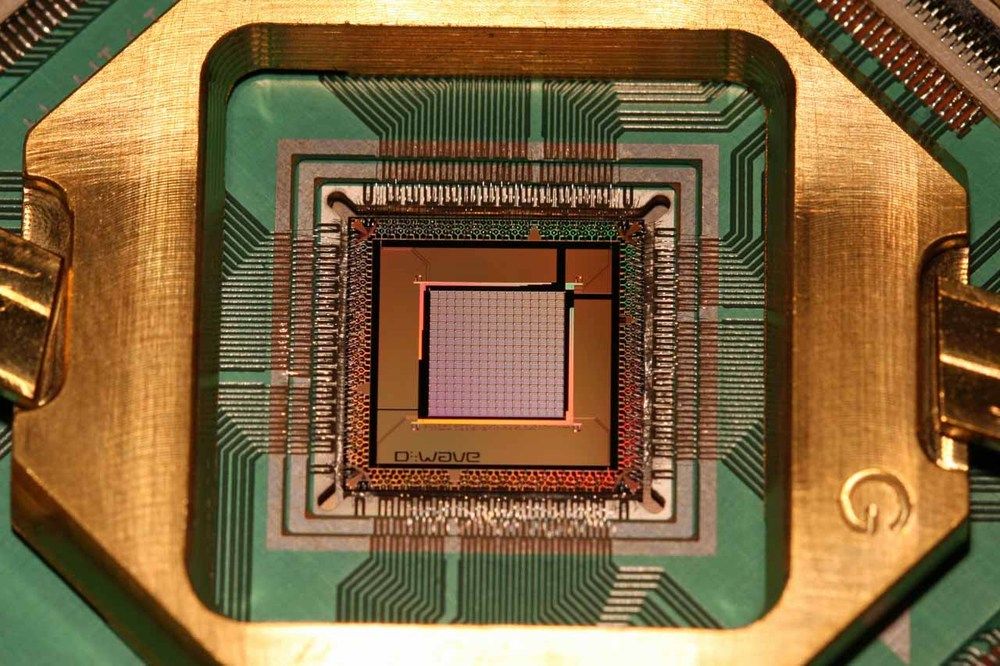
China has made a breakthrough in the research of quantum computing. The quantum laboratory of the University of Science and Technology of China recently announced its success in developing a semiconductor quantum chip.
According to a CNTV report on Aug. 11, the quantum chip is equivalent to the “brain” of future quantum computers; it enables quantum operations and information processing. Besides computing, technologies for quantum storage and control are also essential to the future of this technology. The “sandwich-type” solid-state quantum memory can be operational at a low temperature with magnetic auxiliary equipment.
Zhou Zongquan, a researcher at the Key Laboratory of Quantum Information under the Chinese Academy of Sciences (CAS), said that the direction of future development is to prolong the life of quantum memory.
ACQUIRE researchers will confront major challenges in a four-year quest to engineer a quantum communication system on a chip. The chip will need to operate at room temperature with low energy in a fiber optic network with entangled photons.
Currently, such a communication system may be demonstrated in laboratories, but only at cryogenic (very low) temperatures, and with bulky, energy-intensive equipment. However, a fundamental understanding of quantum physics and optical materials, as well as recent progress in nanoscale photonic integration, have brought communication systems scaled to the quantum level within reach.
If successful, the ACQUIRE teams’ results will begin to realize the hardware needed for secure and efficient quantum communication. The findings from the ACQUIRE projects will also advance quantum sensing and computing.
Believe me there are more things coming in this diamond space.
Doped, carefully point-flawed diamonds are crucial to this quantum communications architecture.
I never get tired of talking about the many uses for Q-dot technology. One area that has me even more intrigued is how it is used in crystallized formations. I expect to see more and more experimenting on crystalized formations on many fronts including complex circuitry for performance and storage.
And, with synthetic technology today plus 3D printing along with Q-dots we could (as I have eluded to many times over several months) truly begin to see some amazing technology be developed on the wearable tech front.
Wearables could include synthetic circuitry stones in various accessories to not only store information, but also serve as another form of unique id because in synthetic stones we have been able (like in nature) create complex crystalized formations that are each unique/ 1 of a kind like a unique finger print, or iris of an eye. I expect to see some very interesting things coming in this space.
Unique optical features of quantum dots make them an attractive tool for many applications, from cutting-edge displays to medical imaging. Physical, chemical or biological properties of quantum dots must, however, be adapted to the desired needs.
Unfortunately, up to now quantum dots prepared by chemical methods could only be functionalized using copper-based click reactions with retention of their luminescence. This obstacle can be ascribed to the fact that copper ions destroy the ability of quantum dots to emit light. Scientists from the Institute of Physical Chemistry of the Polish Academy of Sciences (IPC PAS) in Warsaw and the Faculty of Chemistry of the Warsaw University of Technology (FC WUT) have shown, however, that zinc oxide (ZnO) quantum dots prepared by an original method developed by them, after modification by the click reaction with the participation of copper ions, fully retain their ability to emit light.
“Click reactions catalyzed by copper cations have long attracted the attention of chemists dealing with quantum dots. The experimental results, however, were disappointing: after modification, the luminescence was so poor that they were just not fit for use. We were the first to demonstrate that it is possible to produce quantum dots from organometallic precursors in a way they do not lose their valuable optical properties after being subjected to copper-catalysed click reactions,” says Prof. Janusz Lewinski (IPC PAS, FC WUT).