Scientists seek a single description of reality. But modern physics allows for many different descriptions, many equivalent to one another, connected through a vast landscape of mathematical possibility.
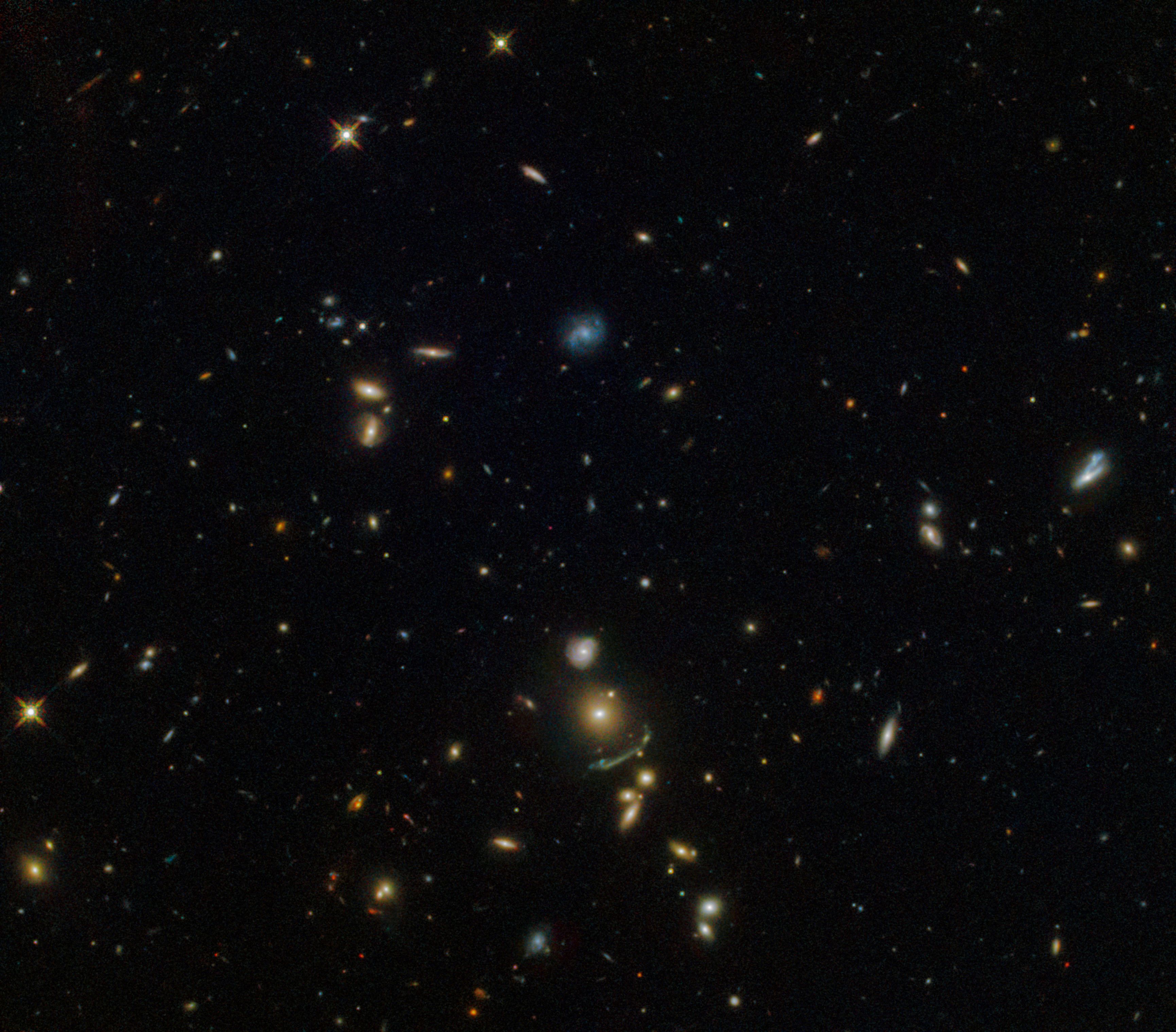
This NASA/ESA Hubble Space Telescope image shows a cluster of hundreds of galaxies located about 7.5 billion light-years from Earth. The brightest galaxy within this cluster, named SDSS J1156+1911, is visible in the lower middle of the frame. It was discovered by the Sloan Giant Arcs Survey, which studied data maps covering huge parts of the sky from the Sloan Digital Sky Survey. The survey found more than 70 galaxies that look to be significantly affected by a cosmic phenomenon known as gravitational lensing.
Gravitational lensing is one of the predictions of Albert Einstein’s General Theory of Relativity. The mass contained within a galaxy is so immense that it can actually warp and bend the very fabric of its surroundings (known as space-time), forcing light to travel along curved paths. As a result, the image of a more distant galaxy appears distorted and amplified to an observer, as the light from it has been bent around the intervening galaxy. This effect can be very useful in astronomy, allowing astronomers to see galaxies that are either obscured or too distant to be otherwise detected by our current instruments.
Galaxy clusters are giant structures containing hundreds to thousands of galaxies, some with masses over one million billion times the mass of the Sun! SDSS J1156+1911 is only roughly 600 billion times the mass of the Sun, making it less massive than the average galaxy. However, it is massive enough to produce the fuzzy, greenish streak seen just below the brightest galaxy — the lensed image of a more distant galaxy.
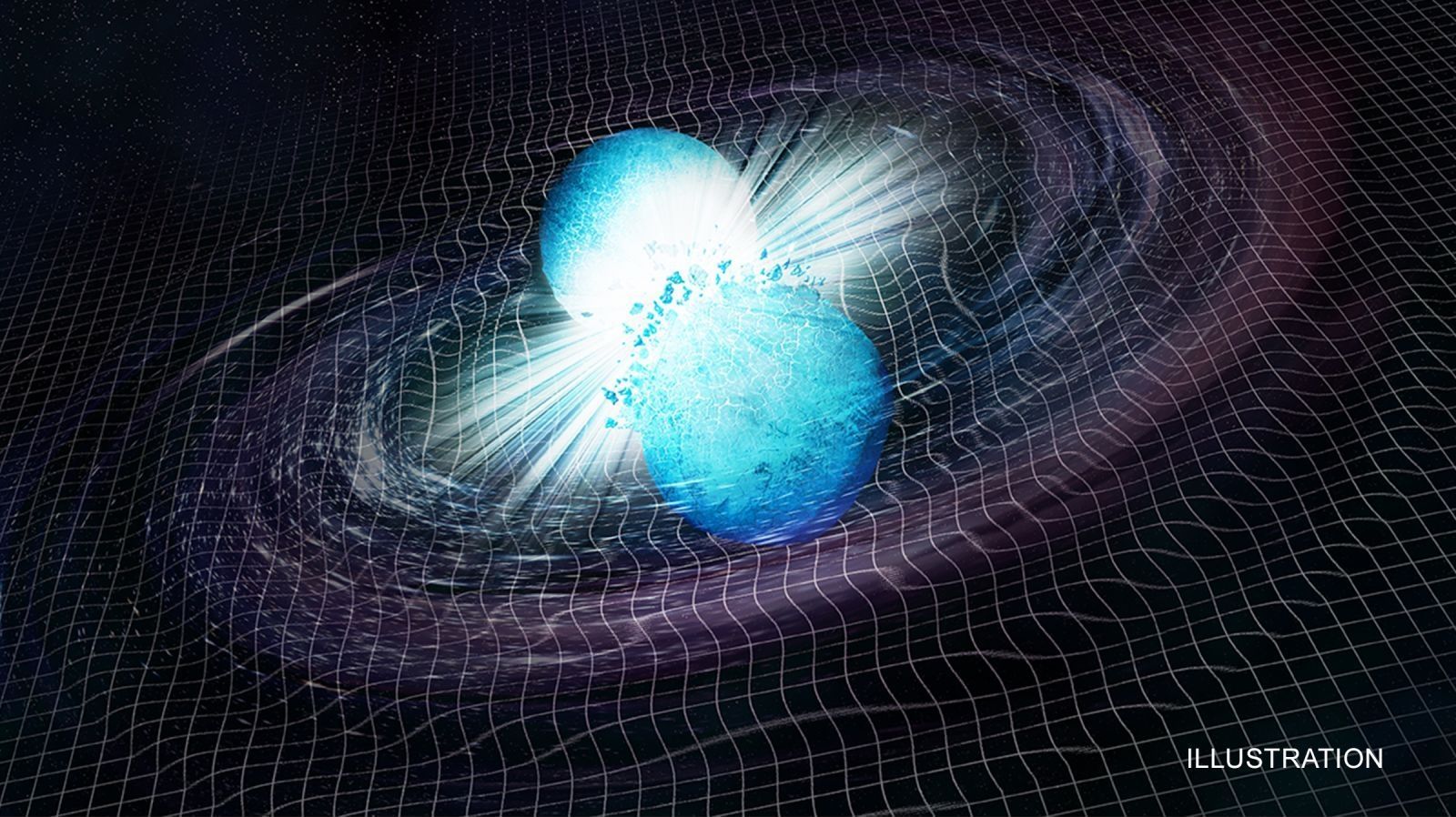
On August 17, 2017, astronomers witnessed an extraordinary celestial event: a collision between two ultra-dense neutron stars. Scientists had never seen anything quite like it, leading to much speculation as to what happened in the wake of the monumental encounter. New research now suggests the collision produced a black hole—but if true, it would be the lightest black hole known to science.
The thought of two neutron stars smashing into each other is nothing short of astounding. Neutron stars are stellar corpses—the remnants supernovae—and they cram a huge amount of mass into a ludicrously small sphere. Typical neutron stars are only as wide as a large city, but they’re about a half million times more massive than Earth, or about two solar masses.
A collision of two neutron stars may seem unlikely, but it happened. Data from the Laser Interferometer Gravitational Wave Observatory (LIGO) and the Virgo interferometer showed that shit got completely wild in the moments leading up to the colossal smash up. For a period of about two minutes, the binary pair spiraled around each other with unimaginable speed, spewing gravitational waves into the cosmic void. Each orbit brought the pair closer together, culminating in a collision that produced a giant shockwave.

Using a pioneering method, researchers from the Astronomy and Astrophysics Group of the UPC and the Canary Islands Institute of Astrophysics (IAC) have found a neutron star of about 2.3 solar masses—one of the most massive ever detected. The study was published on the 23rd of May in the Astrophysical Journal and opens a new path of knowledge in many fields of astrophysics and nuclear physics.
Neutron stars (often called pulsars) are stellar remnants that have reached the end of their evolutionary life: they result from the death of a star of between 10 and 30 solar masses. Despite their small size (about 20 kilometres in diameter), neutron stars have more mass than the sun, so they are extremely dense.
Researchers from the Universitat Politècnica de Catalunya (UPC) and the Canary Islands Institute of Astrophysics (IAC) used an innovative method to measure the mass of one of the heaviest neutron stars known to date. Discovered in 2011 and called PSR J2215+5135, with about 2.3 solar masses it is one of the most massive of the more than 2,000 neutron stars known to date. Although a study published in 2011 reported evidence of a neutron star with 2.4 solar masses, the most massive neutron stars that had previously achieved a consensus among scientists, reported in 2010 and 2013, have 2 solar masses.

A lot can happen in a second; you could meet a stranger, snap your fingers, fall in love, fall asleep, sneeze. But what is a second, really — and is it as precise as we think it is?
Right now, the most-precise clocks used to tell global time have an error of about 1 second every 300 million years — so a clock that started ticking in the time of the dinosaurs wouldn’t be off by even a second today. But scientists think we can do better. [The 18 Biggest Unsolved Mysteries in Physics]
So, they are looking to lutetium, a neglected rare-earth element that has been gathering dust at the bottom of the periodic table, according to a new study published April 25 in the journal Nature Communications.
The Standard Model. What dull name for the most accurate scientific theory known to human beings.
More than a quarter of the Nobel Prizes in physics of the last century are direct inputs to or direct results of the Standard Model. Yet its name suggests that if you can afford a few extra dollars a month you should buy the upgrade. As a theoretical physicist, I’d prefer The Absolutely Amazing Theory of Almost Everything. That’s what the Standard Model really is.
Many recall the excitement among scientists and media over the 2012 discovery of the Higgs boson. But that much-ballyhooed event didn’t come out of the blue – it capped a five-decade undefeated streak for the Standard Model. Every fundamental force but gravity is included in it. Every attempt to overturn it to demonstrate in the laboratory that it must be substantially reworked – and there have been many over the past 50 years – has failed.
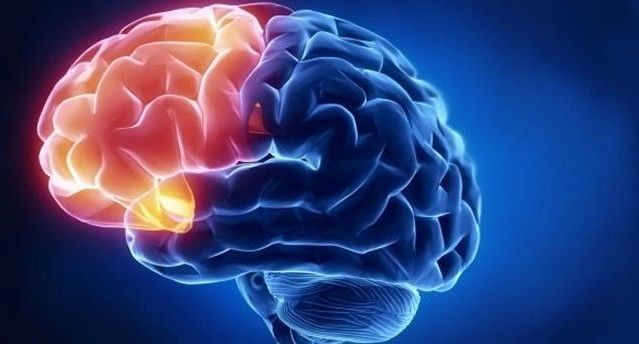
Q) Why Algorithmic leaps can be better than Hardware leaps?
Ans) Hardware constraints create bottlenecks that are hard to tackle as uncertainty of physics at small scale (nano-meters and less) come into play (electrons start jumping around).
At this point, ideas (algorithms) can be used to unleash full potential of the feasible hardware.
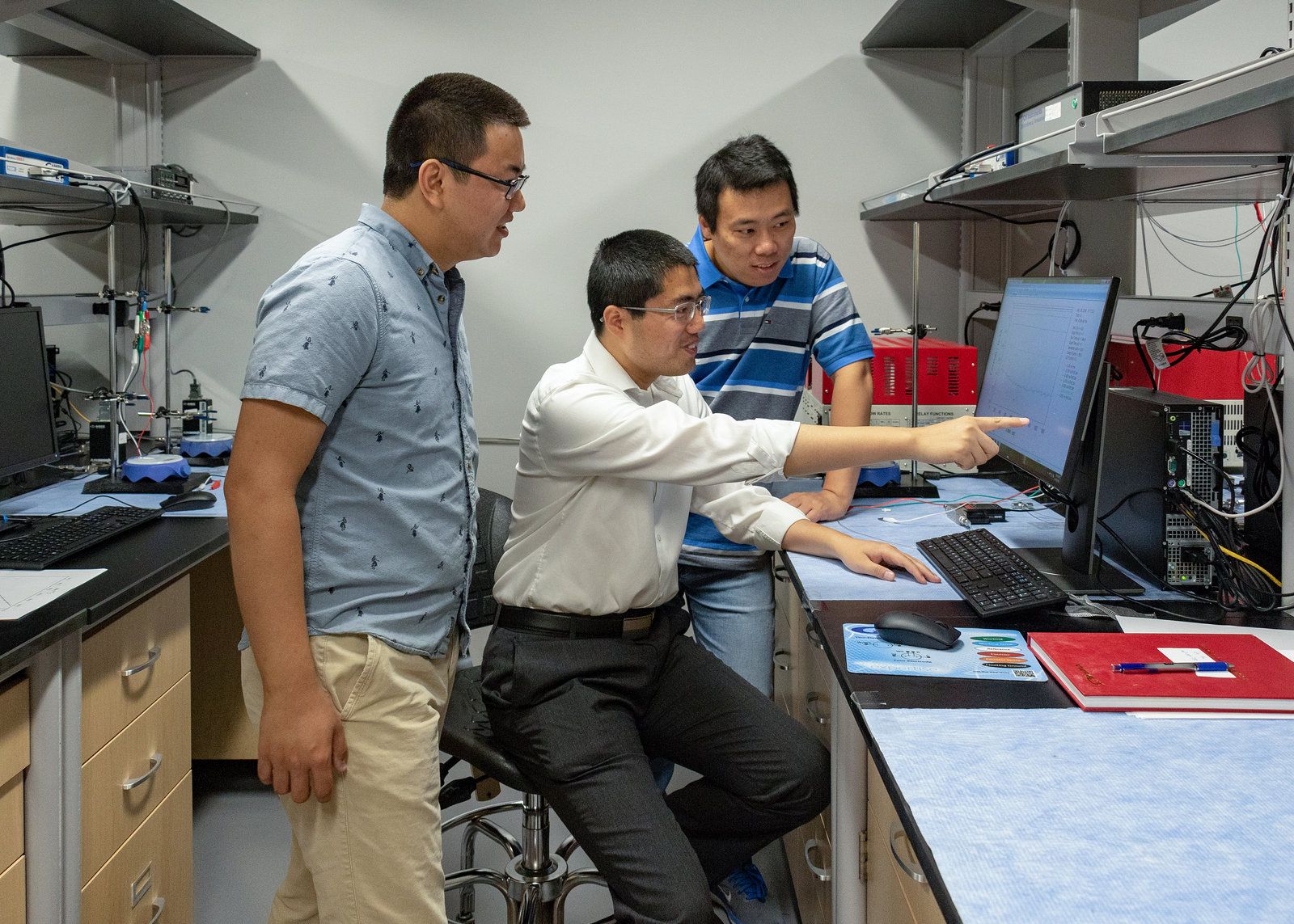
A UCF research team with collaborators at Virginia Tech have developed a new “green” approach to making ammonia that may help make feeding the rising world population more sustainable.
“This new approach can facilitate ammonia production using renewable energy, such as electricity generated from solar or wind,” said physics Assistant Professor Xiaofeng Feng. “Basically, this new approach can help advance a sustainable development of our human society.”
Ammonia, a compound of nitrogen and hydrogen, is essential to all life on the planet and is a vital ingredient in most fertilizers used for food production. Since World War I, the ammonia in fertilizer has been primarily produced using the Haber-Bosch method, which is energy and fossil-fuel intensive. There have been substantial obstacles to improving the process, until now.

Not everyone is convinced. Critics point out that one of the points of exponential growth is that it cannot carry on forever. After a 50-year run, Moore’s Law is stuttering. Singularitarians retort that the laws of physics define a limit to how much computation you can cram into a given amount of matter, and that humans are nowhere near that limit. Even if Moore’s Law slows, that merely postpones the great day rather than preventing it. Others say the Singularity is just reli…gion in new clothes, reheated millenarianism with transistors and Wi-Fi instead of beards and thunderbolts. (One early proponent of Singularitarian and transhumanist ideas was Nikolai Federov, a Russian philosopher born in 1829 who was interested in resurrecting the dead through scientific means rather than divine ones.) And those virtual-reality utopias do look an awful lot like heaven. Perhaps the best way to summarise the Singularity comes from the title of a book published in 2012: the Rapture of the Nerds.
And will it lead to the extermination of all humans?
by T.C.