The three-body problem has vexed mathematicians and physicists for 300 years, but AI can find solutions far faster than any other method anyone has come up with.
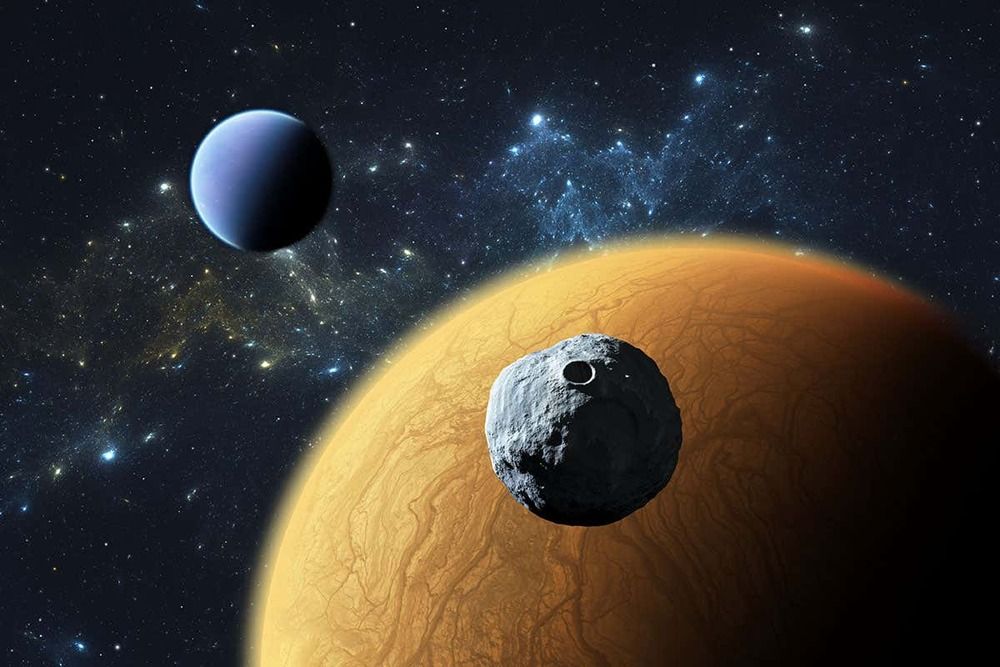
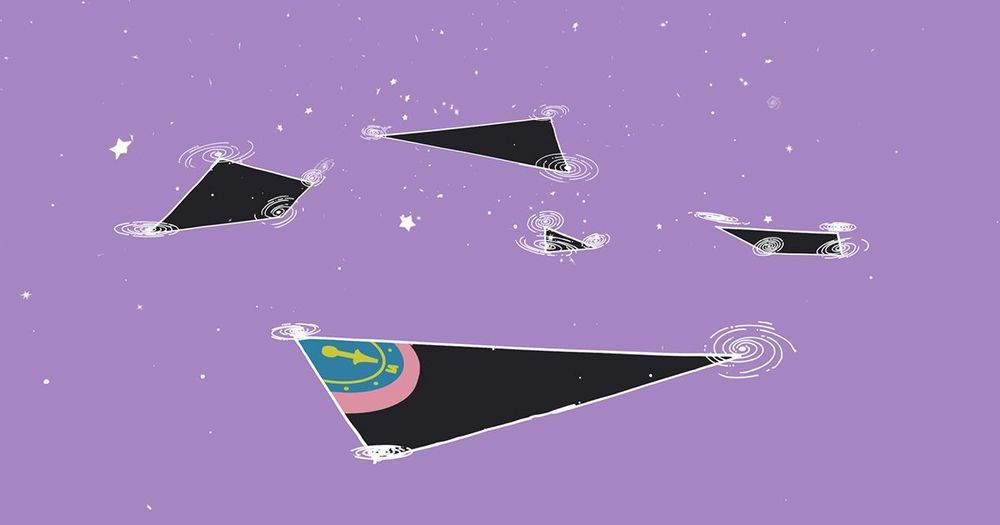
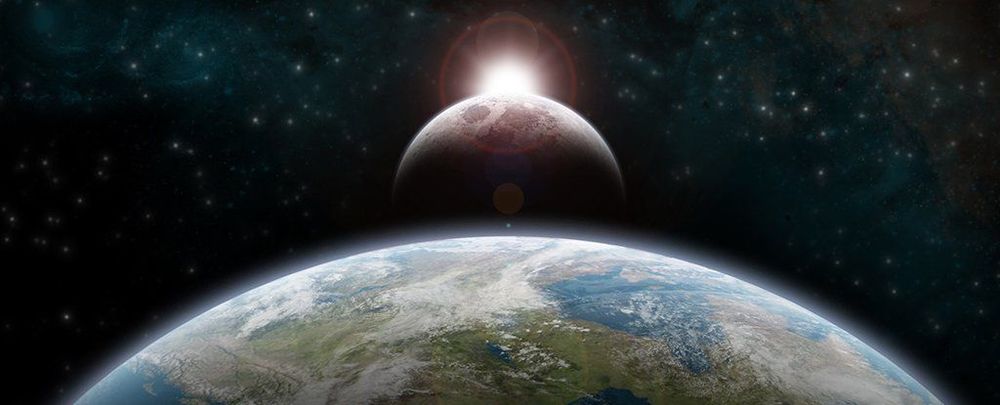
The three-body problem, one of the most notoriously complex calculations in physics, may have met its match in artificial intelligence: a new neural network promises to find solutions up to 100 million times faster than existing techniques.
First formulated by Sir Isaac Newton, the three-body problem involves calculating the movement of three gravitationally interacting bodies – such as the Earth, the Moon, and the Sun, for example – given their initial positions and velocities.
It might sound simple at first, but the ensuing chaotic movement has stumped mathematicians and physicists for hundreds of years, to the extent that all but the most dedicated humans have tried to avoid thinking about it as much as possible.

Wormholes, passageways that connect one universe or time to another, are still only theoretical — but that doesn’t mean physicists aren’t looking for them. In a new study, researchers describe how to find wormholes in the folds of our galaxy.
These hypothetical passageways, created by folding a region of space like a piece of paper, are predicted by Einstein’s theory of general relativity. But they require extreme gravitational conditions, such as those around supermassive black holes.
In the new study, two researchers came up with a method to search for wormholes close to home, around the Milky Way’s central, supermassive black hole, called Sagittarius A*. If a wormhole were to exist around Sagittarius A*, the stars on one side of the passage would be influenced by the gravity of stars on the other side, the researchers said.
Our universe may be riddled with defects in space-time known as cosmic strings. Though we don’t have any evidence yet that they exist, they may still be out there, and I promise that you really don’t want to encounter one.
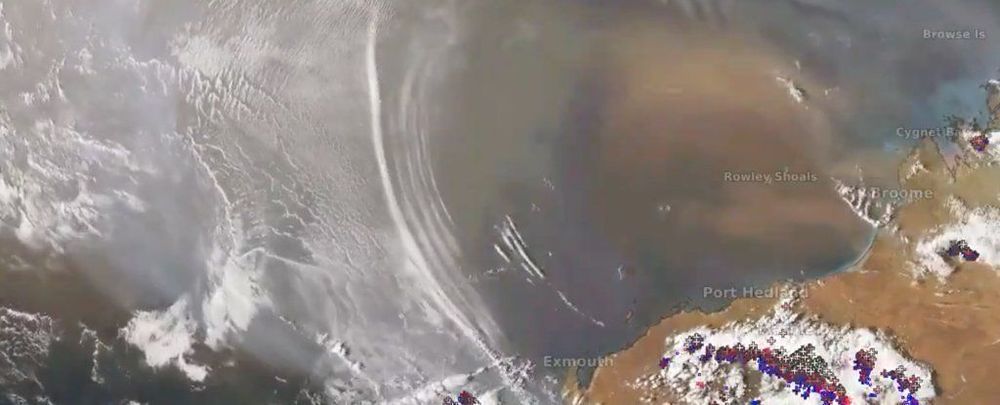
The atmosphere is fluid. This means it’s subject to fluid dynamics, such as circulation, currents, and, yes, gravity waves. The atmosphere is always in motion, so these phenomena happen all the time; but actually seeing them is another matter.
Well, thanks to weather satellites, now you can take a mighty gawk at atmospheric gravity waves that rippled out over Western Australia last week.
Not to be confused with gravitational waves, which are disturbances in the curvature of spacetime created by massive acceleration, gravity waves, also known as buoyancy waves, are a physical phenomenon where waves are generated in any fluid medium, such as waves at the beach, or ripples in a glass of water.
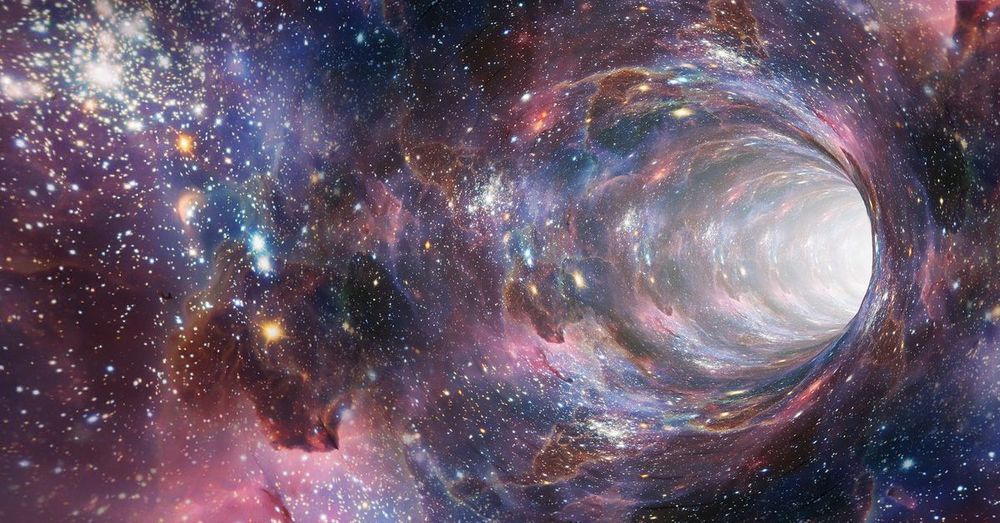
Science fiction writers love wormholes because they make the impossible possible, linking otherwise unreachable places together. Enter one, and it’ll spit you back out in another locale—typically one that’s convenient for the plot. And no matter how unlikely these exotic black hole relatives are to exist in reality, they tend to fascinate physicists for exactly the same reason. Recently, some of those physicists took the time to ponder what such a cosmic shortcut might look like in real life, and even make a case that there could be one at the center of our galaxy.
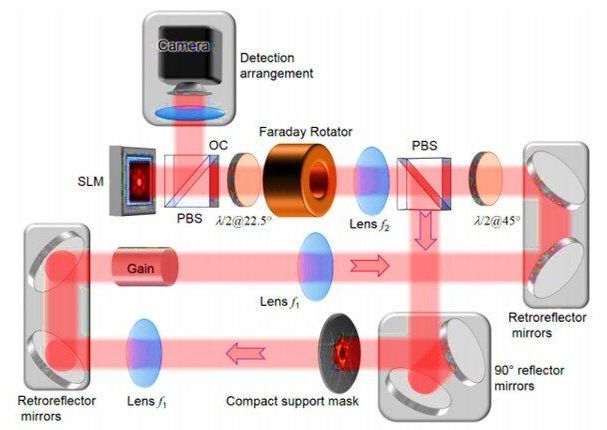
Physicists can explore tailored physical systems to rapidly solve challenging computational tasks by developing spin simulators, combinatorial optimization and focusing light through scattering media. In a new report on Science Advances, C. Tradonsky and a group of researchers in the Departments of Physics in Israel and India addressed the phase retrieval problem by reconstructing an object from its scattered intensity distribution. The experimental process addressed an existing problem in disciplines ranging from X-ray imaging to astrophysics that lack techniques to reconstruct an object of interest, where scientists typically use indirect iterative algorithms that are inherently slow.
In the new optical approach, Tradonsky et al conversely used a digital degenerate cavity laser (DDCL) mode to rapidly and efficiently reconstruct the object of interest. The experimental results suggested that the gain competition between the many lasing modes acted as a highly parallel computer to rapidly dissolve the phase retrieval problem. The approach applies to two-dimensional (2-D) objects with known compact support and complex-valued objects, to generalize imaging through scattering media, while accomplishing other challenging computational tasks.
To calculate the intensity distribution of light scattered far from an unknown object relatively easily, researchers can compute the source of the absolute value of an object’s Fourier transform. The reconstruction of an object from its scattered intensity distribution is, however, ill-posed, since phase information can be lost and diverse phase distributions in the work can result in different reconstructions. Scientists must therefore obtain prior information about an object’s shape, positivity, spatial symmetry or sparsity for more precise object reconstructions. Such examples are found in astronomy, short-pulse characterization studies, X-ray diffraction, radar detection, speech recognition and when imaging across turbid media. During the reconstruction of objects with a finite extent (compact support), researchers offer a unique solution to the phase retrieval problem, as long as they model the same scattered intensity at a sufficiently higher resolution.
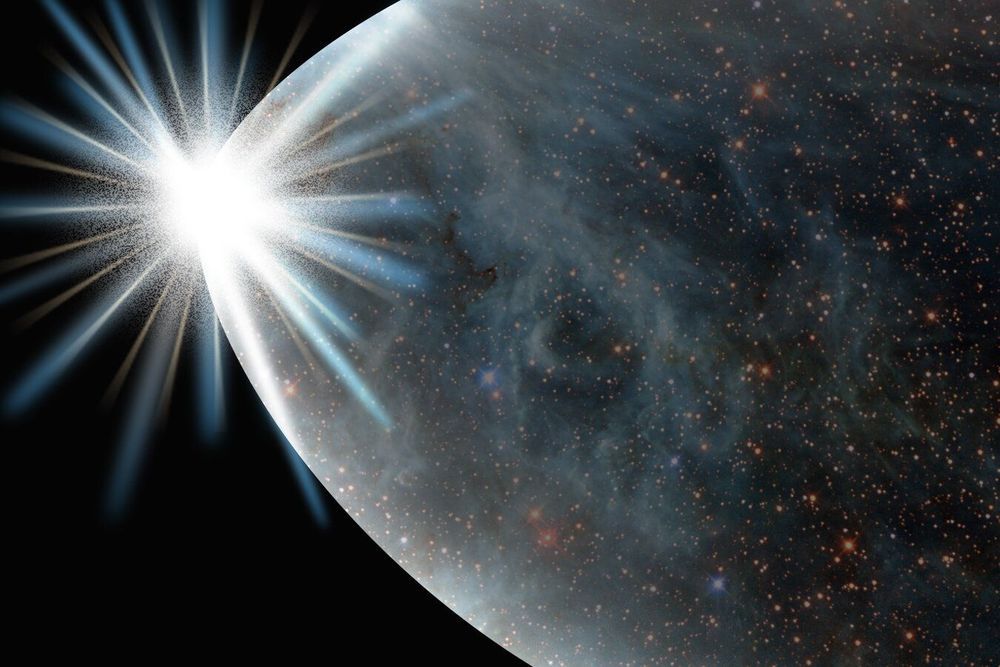
As the Big Bang theory goes, somewhere around 13.8 billion years ago the universe exploded into being, as an infinitely small, compact fireball of matter that cooled as it expanded, triggering reactions that cooked up the first stars and galaxies, and all the forms of matter that we see (and are) today.
Just before the Big Bang launched the universe onto its ever-expanding course, physicists believe, there was another, more explosive phase of the early universe at play: cosmic inflation, which lasted less than a trillionth of a second. During this period, matter—a cold, homogeneous goop—inflated exponentially quickly before processes of the Big Bang took over to more slowly expand and diversify the infant universe.
Recent observations have independently supported theories for both the Big Bang and cosmic inflation. But the two processes are so radically different from each other that scientists have struggled to conceive of how one followed the other.