In 1900, so the story goes, prominent physicist Lord Kelvin addressed the British Association for the Advancement of Science with these words: “There is nothing new to be discovered in physics now.”
How wrong he was. The following century completely turned physics on its head. A huge number of theoretical and experimental discoveries have transformed our understanding of the universe, and our place within it.
Don’t expect the next century to be any different. The universe has many mysteries that still remain to be uncovered – and new technologies will help us to solve them over the next 50 years.
Scientists at the Faculty of Physics and Engineering, working with the Tomsk company Scientific and Production Center Chemical Technologies, have created and tested an improved model of a hybrid rocket engine. The team synthesized new fuel components that increased its calorie content, and therefore its efficiency.
The development emerged from a project to improve the design of a solid–fuel hybrid rocket engine and the fuel used in such engines. The scientists mathematically modeled an optimized engine and made fuel compositions based on aluminum diboride and dodecaboride. This is one of the most promising areas increasing fuel efficiency.
Rocket fuel with the addition of the components proposed by TSU specialists is distinguished by the highest calorific value, which characterizes fuel efficiency. Alexander Zhukov, professor at the Department of Mathematical Physics says that boron is the highest-energy solid component known today, but directly introducing it into the fuel is inefficient because a dense oxide film forms, leading to a high degree of burning out. But in combination with aluminum, boron burns well and increases energy.
It’s no secret that the average smart phone today packs an abundance of gadgets fitting in your pocket, which could have easily filled a car trunk a few decades ago. We like to think about video cameras, music playing equipment, and maybe even telephones here, but let’s not ignore the amount of measurement equipment we also carry around in form of tiny sensors nowadays. How to use those sensors for educational purposes to teach physics is presented in [Sebastian Staacks]’ talk at 36C3 about the phyphox mobile lab app.
While accessing a mobile device’s sensor data is usually quite straightforwardly done through some API calls, the phyphox app is not only a shortcut to nicely graph all the available sensor data on the screen, it also exports the data for additional visualization and processing later on. An accompanying experiment editor allows to define custom experiments from data capture to analysis that are stored in an XML-based file format and possible to share through QR codes.
Aside from demonstrating the app itself, if you ever wondered how sensors like the accelerometer, magnetometer, or barometric pressure sensor inside your phone actually work, and which one of them you can use to detect toilet flushing on an airplane and measure elevator velocity, and how to verify your HDD spins correctly, you will enjoy the talk. If you just want a good base for playing around with sensor data yourself, it’s all open source and available on GitHub for both Android and iOS.
We all feel the passing of time, but nothing in physics suggests it is a fundamental property of the universe. So where does our sense of time’s flow come from?
Planets beyond our galaxy could be discovered using gravitational waves. Such worlds would be like Magrathea in ‘The Hitchhiker’s Guide to the Galaxy.’
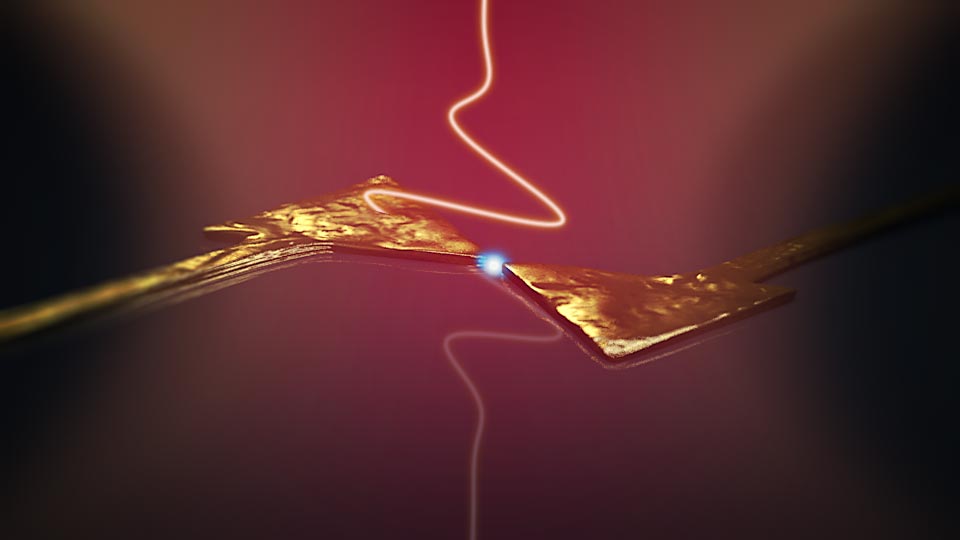
A European team of researchers including physicists from the University of Konstanz has found a way of transporting electrons at times below the femtosecond range by manipulating them with light. This could have major implications for the future of data processing and computing.
Contemporary electronic components, which are traditionally based on silicon semiconductor technology, can be switched on or off within picoseconds (i.e. 10-12 seconds). Standard mobile phones and computers work at maximum frequencies of several gigahertz (1 GHz = 109 Hz) while individual transistors can approach one terahertz (1 THz = 1012 Hz). Further increasing the speed at which electronic switching devices can be opened or closed using the standard technology has since proven a challenge. A recent series of experiments – conducted at the University of Konstanz and reported in a recent publication in Nature Physics – demonstrates that electrons can be induced to move at sub-femtosecond speeds, i.e. faster than 10-15 seconds, by manipulating them with tailored light waves.
“This may well be the distant future of electronics,” says Alfred Leitenstorfer, Professor of Ultrafast Phenomena and Photonics at the University of Konstanz (Germany) and co-author of the study. “Our experiments with single-cycle light pulses have taken us well into the attosecond range of electron transport”. Light oscillates at frequencies at least a thousand times higher than those achieved by purely electronic circuits: One femtosecond corresponds to 10-15 seconds, which is the millionth part of a billionth of a second. Leitenstorfer and his team from the Department of Physics and the Center for Applied Photonics (CAP) at the University of Konstanz believe that the future of electronics lies in integrated plasmonic and optoelectronic devices that operate in the single-electron regime at optical – rather than microwave – frequencies. “However, this is very basic research we are talking about here and may take decades to implement,” he cautions.
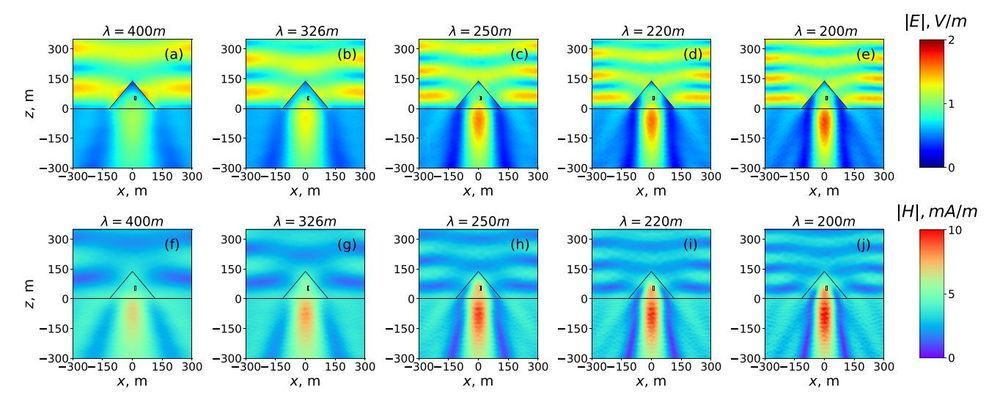
An international research group has applied methods of theoretical physics to investigate the electromagnetic response of the Great Pyramid to radio waves. Scientists predicted that under resonance conditions, the pyramid can concentrate electromagnetic energy in its internal chambers and under the base. The research group plans to use these theoretical results to design nanoparticles capable of reproducing similar effects in the optical range. Such nanoparticles may be used, for example, to develop sensors and highly efficient solar cells. The study was published in the Journal of Applied Physics.
While Egyptian pyramids are surrounded by many myths and legends, researchers have little scientifically reliable information about their physical properties. Physicists recently took an interest in how the Great Pyramid would interact with electromagnetic waves of a resonant length. Calculations showed that in the resonant state, the pyramid can concentrate electromagnetic energy in the its internal chambers as well as under its base, where the third unfinished chamber is located.
These conclusions were derived on the basis of numerical modeling and analytical methods of physics. The researchers first estimated that resonances in the pyramid can be induced by radio waves with a length ranging from 200 to 600 meters. Then they made a model of the electromagnetic response of the pyramid and calculated the extinction cross section. This value helps to estimate which part of the incident wave energy can be scattered or absorbed by the pyramid under resonant conditions. Finally, for the same conditions, the scientists obtained the electromagnetic field distribution inside the pyramid.
The discovery of an exceptionally strong “forbidden” beta-decay involving fluorine and neon could change our understanding of the fate of intermediate-mass stars.
Every year roughly 100 billion stars are born and just as many die. To understand the life cycle of a star, nuclear physicists and astrophysicists collaborate to unravel the physical processes that take place in the star’s interior. Their aim is to determine how the star responds to these processes and from that response predict the star’s final fate. Intermediate-mass stars, whose masses lie somewhere between 7 and 11 times that of our Sun, are thought to die via one of two very different routes: thermonuclear explosion or gravitational collapse. Which one happens depends on the conditions within the star when oxygen nuclei begin to fuse, triggering the star’s demise. Researchers have now, for the first time, measured a rare nuclear decay of fluorine to neon that is key to understanding the fate of these “in between” stars [1, 2]. Their calculations indicate that thermonuclear explosion and not gravitational collapse is the more likely expiration route.
The evolution and fate of a star strongly depend on its mass at birth. Low-mass stars—such as the Sun—transition first into red giants and then into white dwarfs made of carbon and oxygen as they shed their outer layers. Massive stars—those whose mass is at least 11 times greater than the Sun’s—also transition to red giants, but in the cores of these giants, nuclear fusion continues until the core has turned completely to iron. Once that happens, the star stops generating energy and starts collapsing under the force of gravity. The star’s core then compresses into a neutron star, while its outer layers are ejected in a supernova explosion. The evolution of intermediate-mass stars is less clear. Predictions indicate that they can explode both via the gravitational collapse mechanism of massive stars and by a thermonuclear process [3– 6]. The key to finding out which happens lies in the properties of an isotope of neon and its ability to capture electrons.