Toggle light / dark theme

Mind the gap: State-of-the-art technologies and applications for EEG-based brain–computer interfaces

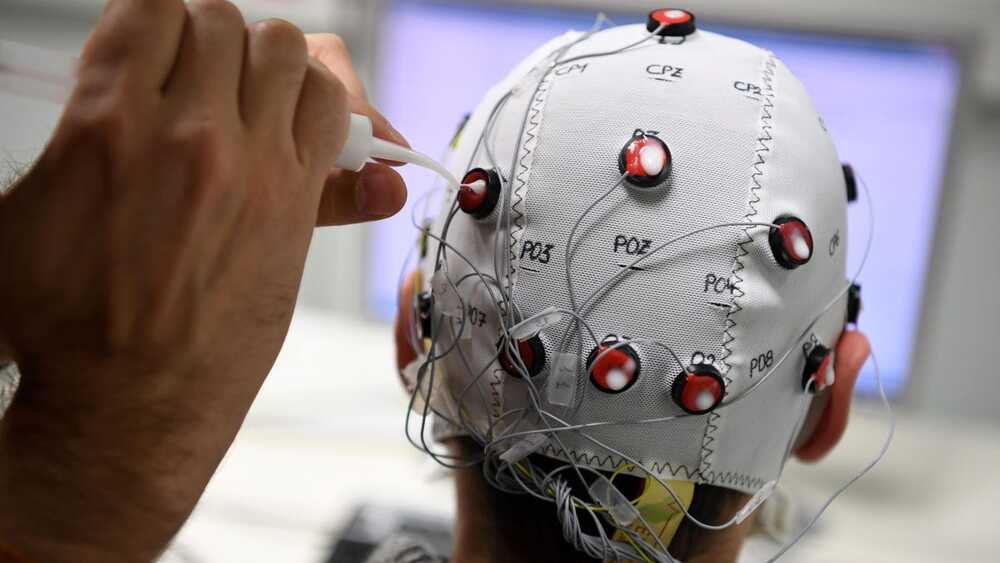
Brain–computer interfaces (BCIs) provide bidirectional communication between the brain and output devices that translate user intent into function. Among the different brain imaging techniques used to operate BCIs, electroencephalography (EEG) constitutes the preferred method of choice, owing to its relative low cost, ease of use, high temporal resolution, and noninvasiveness. In recent years, significant progress in wearable technologies and computational intelligence has greatly enhanced the performance and capabilities of EEG-based BCIs (eBCIs) and propelled their migration out of the laboratory and into real-world environments. This rapid translation constitutes a paradigm shift in human–machine interaction that will deeply transform different industries in the near future, including healthcare and wellbeing, entertainment, security, education, and marketing. In this contribution, the state-of-the-art in wearable biosensing is reviewed, focusing on the development of novel electrode interfaces for long term and noninvasive EEG monitoring. Commercially available EEG platforms are surveyed, and a comparative analysis is presented based on the benefits and limitations they provide for eBCI development. Emerging applications in neuroscientific research and future trends related to the widespread implementation of eBCIs for medical and nonmedical uses are discussed. Finally, a commentary on the ethical, social, and legal concerns associated with this increasingly ubiquitous technology is provided, as well as general recommendations to address key issues related to mainstream consumer adoption.

When Will Neuralink Be Available To Everyone?

When will Neuralink be available to healthy individuals? It’s difficult to find a coherent train of thought pertaining to this question specifically.

Recently, I’ve started thinking more in terms of regulatory approval rather than rough timeline estimates. This sent me down a fascinating path learning more about how medical devices in general make it through “the system.”

This video essay hopefully ties together that research in an accessible way that addresses the topic more directly.

Cheers.

Andrew.

Brain Cells Snap Open Their DNA To Make Memories – Extent of DNA Double-Strand Breaks Is “Surprising and Concerning”

To quickly express learning and memory genes, brain cells snap both strands of DNA in many more places and cell types than previously realized, a new study shows.

The urgency to remember a dangerous experience requires the brain to make a series of potentially dangerous moves: Neurons and other brain cells snap open their DNA in numerous locations — more than previously realized, according to a new study — to provide quick access to genetic instructions for the mechanisms of memory storage.

The extent of these DNA double-strand breaks (DSBs) in multiple key brain regions is surprising and concerning, says study senior author Li-Huei Tsai, Picower Professor of Neuroscience at MIT and director of The Picower Institute for Learning and Memory, because while the breaks are routinely repaired, that process may become more flawed and fragile with age. Tsai’s lab has shown that lingering DSBs are associated with neurodegeneration and cognitive decline and that repair mechanisms can falter.

Brain ‘Noise’ Keeps Nerve Connections Young

The findings, published in Nature Communications, could have important implications for human health: minis have been found at every type of synapse studied so far, and defects in miniature neurotransmission have been linked to range of neurodevelopmental disorders in children. Figuring out how a reduction in miniature neurotransmission changes the structure of synapses, and how that in turn affects behavior, could help to better understand neurodegenerative disorders and other brain conditions.


Summary: Study reveals how miniature release events help to keep neurons intact and preserve motor neuron function in aging insects.

Source: EPFL

Neurons communicate through rapid electrical signals that regulate the release of neurotransmitters, the brain’s chemical messengers. Once transmitted across a neuron, electrical signals cause the juncture with another neuron, known as a synapse, to release droplets filled with neurotransmitters that pass the information on to the next neuron. This type of neuron-to-neuron communication is known as evoked neurotransmission.

However, some neurotransmitter-packed droplets are released at the synapse even in the absence of electrical impulses. These miniature release events — or minis — have long been regarded as ‘background noise’, says Brian McCabe, Director of the Laboratory of Neural Genetics and Disease and a Professor in the EPFL Brain Mind Institute.

Scientists Warn of “Bleak Cyborg Future” From Brain-Computer Interfaces

Researchers warn of the potential social, ethical, and legal consequences of technologies interacting heavily with human brains.

Surpassing the biological limitations of the brain and using one’s mind to interact with and control external electronic devices may sound like the distant cyborg future, but it could come sooner than we think.

Researchers from Imperial College London conducted a review of modern commercial brain-computer interface (BCI) devices, and they discuss the primary technological limitations and humanitarian concerns of these devices in APL Bioengineering, from AIP Publishing.

Dr. Jean M. Hebert, Ph.D. — Replacing Aging — Albert Einstein College of Medicine

Replacing Aging — Dr. Jean M. Hebert, Ph.D. Albert Einstein College of Medicine.


Dr. Jean M. Hebert, Ph.D. (https://einsteinmed.org/faculty/9069/jean-hebert/) is Professor in the Department of Genetics and in the Dominick P. Purpura Department of Neuroscience, at Albert Einstein College of Medicine.

He’s also the author of the book Replacing Aging, which describes how regenerative medicine will beat aging.

With a Ph.D. in Genetics from the University of California, San Francisco, Dr. Hebert’s current lab’s projects fall into two groups.

First, they focus on using the mouse neocortex as a platform for testing the ability of multi-cell type grafts (increasingly resembling normal neocortex) to integrate with host tissue.

Solid State Batteries — Autumn 2021 mass production in Japan. Is it FINALLY happening?

Solid state batteries are the long-promised Holy Grail of battery technology. They’re smaller and better than existing Lithium Ion batteries. They charge more quickly and last much longer. What’s not to like? Trouble is, no-one’s managed to mass produce one at any useful scale yet. Turns out it’s quite tricky to make them reliable! Now though, two major Japanese companies are finally firing up their full production lines. So will 2021 be the year?

Video Transcripts available at our website.
http://www.justhaveathink.com.

Help support this channels independence at http://www.patreon.com/justhaveathink.

Or with a donation via Paypal by clicking here.
https://www.paypal.com/cgi-bin/webscr?cmd=_s-xclick&hosted_b…source=url.

You can also help keep my brain ticking over during the long hours of research and editing via the nice folks at BuyMeACoffee.com.
https://www.buymeacoffee.com/justhaveathink.

Download the Just Have a Think App from the AppStore or Google Play.

Chemists Found an Effective Remedy for “Aged” Brain Diseases

Summary: Newly synthesized compounds can halt the degradation of neurons in a range of neurodegenerative diseases, including Alzheimer’s and Parkinson’s disease, researchers say.

Source: Ural Federal University

Russian scientists have synthesized chemical compounds that can stop the degeneration of neurons in Alzheimer’s, Parkinson’s, and other severe brain pathologies. These substances can provide a breakthrough in the treatment of neurodegenerative pathologies.

New molecules of pyrrolyl-and indolylazine classes activate intracellular mechanisms to combat one of the main causes of “aged” brain diseases – an excess of so-called amyloid structures that accumulate in the human brain with age.

Non-Neuronal Cells Drive Sex Differences in Early Brain Development

“In this study, for the first time, we see evidence that events which were always assumed to be occurring in the same manner, regardless of sex, may actually be completely different in males compared to females. The fact that these differences involve astrocytes, which have traditionally been ignored in neuroscience but have recently become a hot topic for study, makes them all the more intriguing.”


Summary: Thrombospondin-2, a protein with cell adhesion properties usually secreted by astrocytes, prompted a strong increase in synapses in male-derived neurons but showed no effect in females.

Source: Marshall University

During development, brain cells may find different ways to connect with each other based on sex, according to researchers at the Marshall University Joan C. Edwards School of Medicine.

The study, recently published in eNeuro, showed a significantly more robust synaptogenic response in male-derived cells compared to female-derived cells when exposed to factors secreted from astrocytes, which are non-neuronal cells found throughout the central nervous system.

/* */