Aspirin is a blood thinner & can help head off heart attacks and strokes by preventing clots from forming in the blood vessels that lead to the heart or brain.
The U.S. Preventive Services Task Force’s proposed changes to recommendations for using low-dose aspirin to prevent a first heart attack or stroke closely align with guidelines from the American College of Cardiology and the American Heart Association.
Endocrine disrupting chemicals cause adverse effects in animals. But limited scientific information exists on potential health problems in humans. Because people are typically exposed to multiple at the same time, assessing public health effects is difficult.
Many chemicals, both natural and man-made, may mimic or interfere with the body’s hormones, known as the endocrine system. Called endocrine disruptors, these chemicals are linked with developmental, reproductive, brain, immune, and other problems.
Endocrine disruptors are found in many everyday products, including some plastic bottles and containers, liners of metal food cans, detergents, flame retardants, food, toys, cosmetics, and pesticides.
Some endocrine-disrupting chemicals are slow to break-down in the environment. That characteristic makes them potentially hazardous over time.
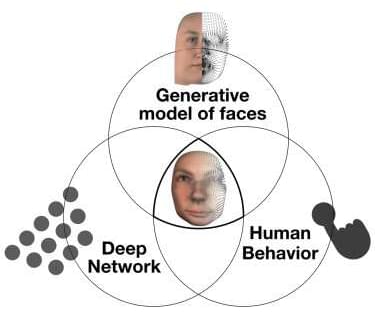
New research, published in the journal Patterns and led by the University of Glasgow’s School of Psychology and Neuroscience, uses 3D modeling to analyze the way Deep Neural Networks—part of the broader family of machine learning—process information, to visualize how their information processing matches that of humans.
It is hoped this new work will pave the way for the creation of more dependable AI technology that will process information like humans and make errors that we can understand and predict.
One of the challenges still facing AI development is how to better understand the process of machine thinking, and whether it matches how humans process information, in order to ensure accuracy. Deep Neural Networks are often presented as the current best model of human decision-making behavior, achieving or even exceeding human performance in some tasks. However, even deceptively simple visual discrimination tasks can reveal clear inconsistencies and errors from the AI models, when compared to humans.
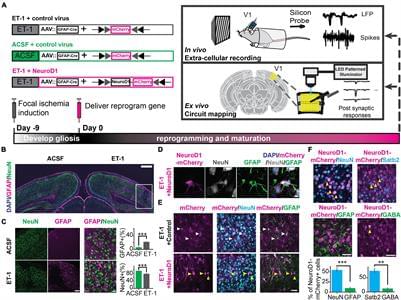
Neural circuits underlying brain functions are vulnerable to damage, including ischemic injury, leading to neuronal loss and gliosis. Recent technology of direct conversion of endogenous astrocytes into neurons in situ can simultaneously replenish the neuronal population and reverse the glial scar. However, whether these newly reprogrammed neurons undergo normal development, integrate into the existing neuronal circuit, and acquire functional properties specific for this circuit is not known. We investigated the effect of NeuroD1-mediated in vivo direct reprogramming on visual cortical circuit integration and functional recovery in a mouse model of ischemic injury. After performing electrophysiological extracellular recordings and two-photon calcium imaging of reprogrammed cells in vivo and mapping the synaptic connections formed onto these cells ex vivo, we discovered that NeuroD1 reprogrammed neurons were integrated into the cortical microcircuit and acquired direct visual responses. Furthermore, following visual experience, the reprogrammed neurons demonstrated maturation of orientation selectivity and functional connectivity. Our results show that NeuroD1-reprogrammed neurons can successfully develop and integrate into the visual cortical circuit leading to vision recovery after ischemic injury.
Functional circuit impairment associated with neuronal loss is commonly seen in patients with brain injuries, such as ischemia. Though neural stem cells (NSCs) exist in the subventricular zone (SVZ) in the adult brain, they are found to differentiate mainly into astrocytes when they migrate to injured cortex (Benner et al., 2013; Faiz et al., 2015), and their neurogenesis capacity is too limited to compensate for the neuronal loss. Currently, it still remains a challenge to generate neurons in adults and functionally incorporate them into the local circuits. Several strategies have shown the capability to induce neurogenesis and lead to some behavioral recovery. One promising approach is to transplant stem cell-derived neurons or neural progenitor cells (Tornero et al., 2013; Michelsen et al., 2015; Falkner et al., 2016; Somaa et al., 2017). Yet, there are concerns about graft rejection and tumorigenicity of the transplanted cells (Erdo et al., 2003; Marei et al., 2018).
Live human brain tissue — generously donated by brain surgery patients with epilepsy or tumors — is yielding incredible #neuroscience insights. A study on cells… See More.
As part of an international effort to map cell types in the brain, scientists identified increased diversity of neurons in regions of the human brain that expanded during our evolution.
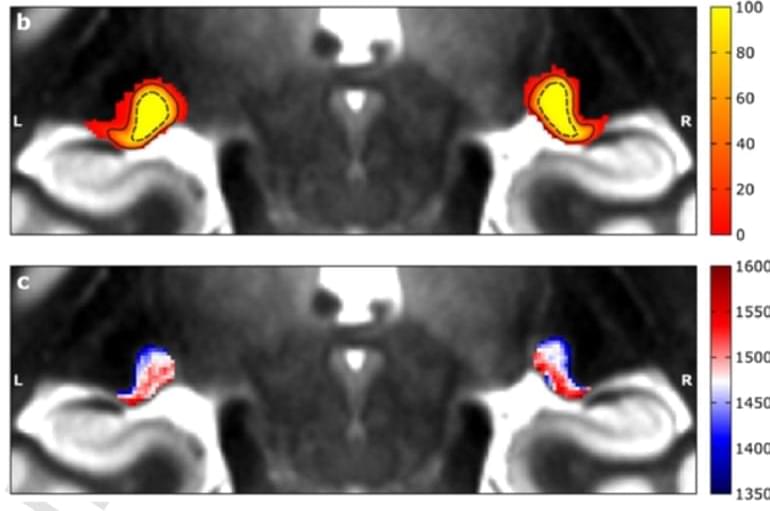
Summary: A new, non-invasive neuroimaging technique allowed researchers to investigate the visual sensory thalamus, a brain area associated with visual difficulties in dyslexia and other disorders.
Source: TU Dresden
The visual sensory thalamus is a key region that connects the eyes with the cerebral cortex. It contains two major compartments. Symptoms of many diseases are associated with alterations in this region. So far, it has been very difficult to assess these two compartments in living humans, because they are tiny and located very deep inside the brain.
This difficulty of investigating the visual sensory thalamus in detail has hampered the understanding of the function of visual sensory processing tremendously in the past. By coincidence, Christa Müller-Axt, Ph.D. student in the lab of neuroscientist Prof. Katharina von Kriegstein at TU Dresden, discovered structures that she thought might resemble the two visual sensory thalamus compartments in neuroimaging data.
“The use of organophosphate esters in everything from TVs to car seats has proliferated under the false assumption that they’re safe,” said Heather Patisaul, lead author and neuroendocrinologist at North Carolina State University. “Unfortunately, these chemicals appear to be just as harmful as the chemicals they’re intended to replace but act by a different mechanism.”
Summary: Exposure to even low levels of common chemicals called organophosphate esters can harm IQ, memory, learning, and brain development overall in young children.
Source: Green Science Policy Institute
Chemicals increasingly used as flame retardants and plasticizers pose a larger risk to children’s brain development than previously thought, according to a commentary published today in Environmental Health Perspectives.
The research team reviewed dozens of human, animal, and cell-based studies and concluded that exposure to even low levels of the chemicals—called organophosphate esters—may harm IQ, attention, and memory in children in ways not yet looked at by regulators.
Intel has introduced Loihi 2 its second-generation neuromorphic research chip, featuring eight times the computational neurons compared to the earlier Loihi 1.