Toggle light / dark theme

Fast track control accelerates switching of quantum bits

From laptops to cellphones, technology advances through the ever-increasing speed at which electric charges are directed through circuits. Similarly, speeding up control over quantum states in atomic and nanoscale systems could lead to leaps for the emerging field of quantum technology.

An international collaboration between physicists at the University of Chicago, Argonne National Laboratory, McGill University, and the University of Konstanz recently demonstrated a new framework for faster control of a quantum bit. First published online Nov. 28, 2016, in Nature Physics, their experiments on a single electron in a diamond chip could create quantum devices that are less prone to errors when operated at high speeds.

Scientists are Creating a New Diamond Predicted to be Harder Than a Jeweler’s Diamond

For all my Lab friends who utilize Spectrometers, drill bit fans as well as many of us QC fans. A new stronger syn. diamond being developed.


But you won’t find this diamond on any engagement rings — it will help cut through ultra-solid materials on mining sites.

Step aside, girls. Diamonds may now be a miner’s best friend, thanks to scientists from Australian National University (ANU).

Led by ANU professor Jodie Bradby, an international team is creating a hexagonal diamond, called Lonsdaleite, that’s predicted to be harder than a jeweler’s diamond. The researchers made nano-sized Lonsdaleite at 400 degrees Celsius (752 degrees Fahrenheit), effectively halving the temperature in which it can be formed in a lab. They’ve published their work in Scientific Reports.

Nano-Nouvelle Trial Delivers Nanotech Breakthrough

A successful production trial by Australian battery technology innovator Nano-Nouvelle has proved its pioneering nanotechnology ­­­supports industrial-scale manufacture, with output rates 100 times faster.

The Sunshine Coast-based company is developing world-leading nanotechnology that can boost the energy storage capacity of lithium ion batteries by as much as 50 per cent. Lithium ion batteries are used in devices ranging from mobile phones and notebooks to and electric vehicles and home energy storage systems.

As well as proving its technology, Nano-Nouvelle has worked with companies worldwide to ensure its battery-boosting breakthrough is usable with today’s production lines.

Two electrons go on a quantum walk and end up in a qudit: Russian scientists find a way to reliably connect quantum elements

This is a BIG DEAL in QC, and Russian Scientists solved it.


Abstract: Scientists from the Institute of Physics and Technology of the Russian Academy of Sciences and MIPT have let two electrons loose in a system of quantum dots to create a quantum computer memory cell of a higher dimension than a qubit (a quantum bit). In their study published in Scientific Reports, the researchers demonstrate for the first time how quantum walks of several electrons can help to implement quantum computation.

“By studying the system with two electrons, we solved the problems faced in the general case of two identical interacting particles. This paves the way toward compact high-level quantum structures,” comments Leonid Fedichkin, Expert at the Russian Academy of Sciences, Vice-Director for Science at NIX (a Russian computer company), and Associate Professor at MIPT’s Department of Theoretical Physics.

In a matter of hours, a quantum computer would be able to hack through the most popular cryptosystem used even in your web browser. As far as more benevolent applications are concerned, a quantum computer would be capable of molecular modeling that takes into account all interactions between the particles involved. This in turn would enable the development of highly efficient solar cells and new drugs. To have practical applications, a quantum computer needs to incorporate hundreds or even thousands of qubits. And that is where it gets tricky.

A virus-sized computing device

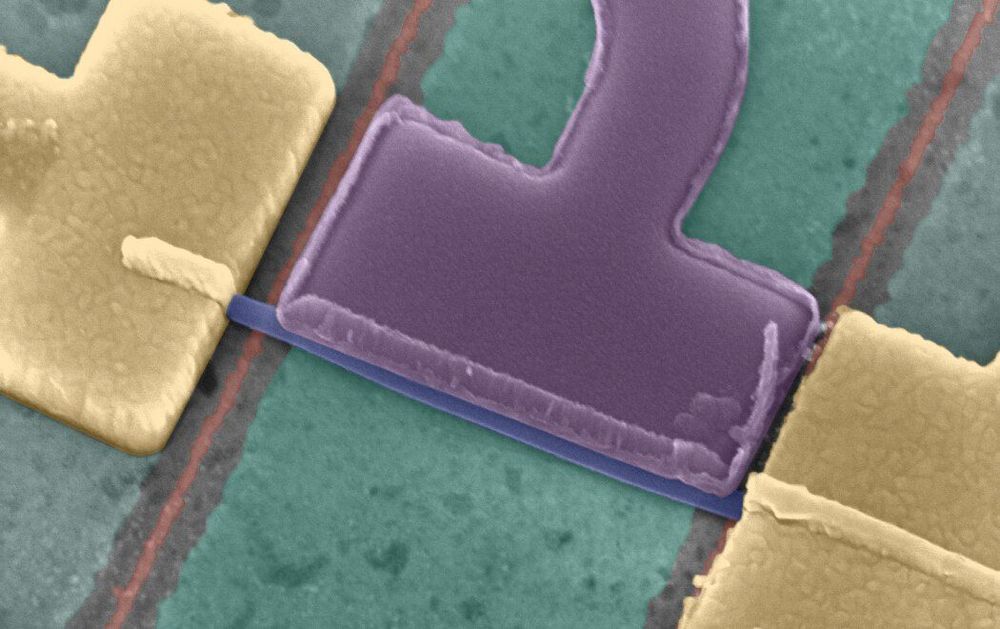
Researchers at University of California, Santa Barbara, have designed a functional nanoscale computing element that could be packed into a space no bigger than 50 nanometres on any side.

red blood cell nanotechnology nanotech future timeline

In 1959, renowned physicist Richard Feynman, in his talk “Plenty of Room at the Bottom” spoke of a future in which tiny machines could perform huge feats. Like many forward-looking concepts, his molecule and atom-sized world remained for years in the realm of science fiction. And then, scientists and other creative thinkers began to realise Feynman’s nanotechnological visions.

Exercise Improves Arterial Resilience to Age-Related Increases in Oxidative Stress

Excercise is the best low cost activity you can do as part of your personal longevity strategy. Here we see data showing it can improve resistance to oxidative stress.


Researchers digging deeper into the mechanisms by which exercise produces benefits have found that it improves the resistance of blood vessels to oxidative stress. With age the presence of oxidizing molecules and oxidative modification of proteins, preventing correct function, increases for reasons that include damage to mitochondria, the power plants of the cell. Oxidative damage to molecular machinery is somewhere in the middle of the chain of cause and effect that starts with fundamental forms of damage to cells and tissues and spirals down into age-related diseases. Near all of this oxidation is repaired very quickly, the damaged molecules dismantled and recycled, but in most contexts more of it over the long term is worse than less of it.

Quote:

NASA’s Working on a Nano-Starship That Travels at 1/5 the Speed of Light

In April, a team of scientists including Stephen Hawking announced a mind-boggling new project to explore interstellar space, using lasers to propel a nano-spacecraft the size of a postage stamp to our nearest star system, Alpha Centauri.

If they could get their little ‘StarChip’ spacecraft to travel at 20 percent the speed of light, it could arrive in just 20 years. But how would the electronics on such a tiny, vulnerable spacecraft survive for 20 years in the hostility of space?

The problem for Hawking’s Breakthrough Starshot project, say researchers at NASA and the Korea Institute of Science and Technology, is radiation.

/* */