Human urine is an promising material in the future where an enormous amount of urine is produced by rapidly growing population.
Category: materials – Page 349
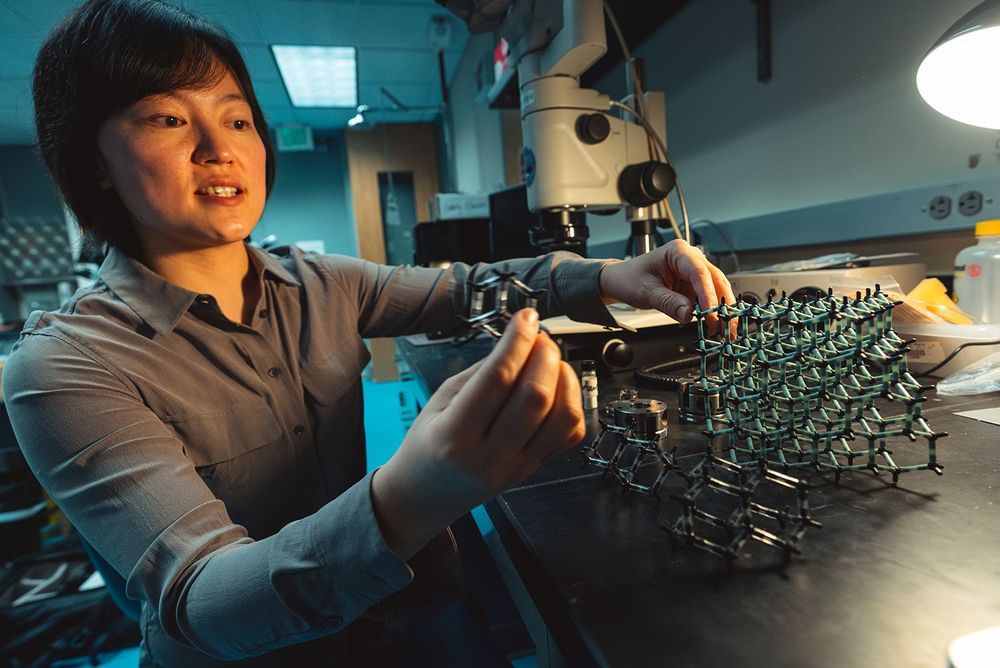
Stanford scientists turn fossil fuel molecule into pure diamond
Research that investigates the mechanisms behind diamond formation, and uncovers new ways to produce synthetic forms of the unique stone, could mean big things, and not just for the coffers of jewelers around the world. A new type of artificial diamond developed by scientists at Stanford University sheds yet more light on this high-pressure production process, with a molecule found in crude oil and natural gas serving as their starting point.
Conventional diamonds take shape hundreds of miles beneath the Earth’s surface, under extreme heat and pressure that causes carbon to crystalize into the valuable stones. The ones we see above ground were shot upwards towards the surface through volcanic eruptions millions of years ago.
Scientists have spent decades tinkering with different ways to turn various materials into synthetic versions, with diamond giant De Beers even getting in on the act. These methods, however, have generally involved massive amounts of energy and require catalysts to trigger the transformation. The researchers at Stanford’s School of Earth, Energy & Environmental Sciences set out to find a simpler way of doing things.

Patents Secured for Revolutionary Nuclear Fusion Technology
Scientists in Australia are making some astonishing claims about a new nuclear reactor technology. Startup HB11, which spun out of the University of New South Wales, has applied for and received patents in the U.S., Japan, and China so far. The company’s technology uses lasers to trigger a nuclear fusion reaction in hydrogen and boron—purportedly with no radioactive fuel required. The secret is a cutting-edge laser and, well, an element of luck.
The laser doesn’t heat the materials. Instead, it speeds up the hydrogen to the point where it (hopefully) collides with the boron to begin a reaction.
Higgs Boson in Superconductors
Superfluid helium, describable by a two-component order parameter, exhibits only the Bogolubov mode with energy $\to 0$ at long wavelengths, while a Lorentz-invariant theory with a two-component order parameter exhibits a finite energy mode at long wavelengths (the Higgs Boson), besides the above mass-less mode. The mass-less mode moves to high energies if it couples to electromagnetic fields (the Anderson-Higgs mechanism). Superconductors, on the other hand have been theoretically and experimentally shown to exhibit both modes. This occurs because the excitations in superconductors have an (approximate) particle-hole symmetry and therefore show a similarity to Lorentz-invariant theories.

EP0050523A2 — Electromagnetic transmission using a curl-free magnetic vector potential field
A system for transmission of information using a curl-free magnetic vector potential radiation field. The system includes current-carrying apparatus for generating a predominantly curl-free magnetic vector potential field coupled to apparatus for modulating the current applied to the field generating apparatus. Receiving apparatus includes a detector with observable properties that vary with the application of an applied curl-free magnetic vector potential field. Analyzing apparatus for determining the information content of modulation imposed on the curl-free vector potential field is coupled to the detector. The magnetic vector potential field can be established in materials that are not capable of transmitting more common electromagnetic radiation.
The receiver may detect changes of phase of the sine function which determines the Josephson junction current. The distance of the transmitter can be determined from the strength of the received signal. By generating a field of predetermined orientation and using a detector responsive to orientation, the direction of the transmitter may be determined. A rotating field may be used for this.

Happy to announce Dr. Christian Schafmeister as a speaker for our 2020 Undoing Aging Conference
Christian Schafmeister, Ph.D., Professor at Temple University in Philadelphia says: “We are developing “therapeutic catalysts” — small, robust, non-immunogentic catalysts that will permeate the tight spaces within tissues and fix things. Our specific targets include reversing the unwanted cross-links that develop in the extracellular matrix with aging.”
Enzymes, while possessing exquisite substrate-specificity, are limited by their molecular size in their ability to gain access to their substrate when it is embedded within dense material. We have always known that this may be a problem for our approach to restoring the elasticity of aged tissues. Christian’s fascinating work offers the potential to solve this issue with molecules that have the same catalytic function as enzymes but are much smaller and can therefore reach these embedded substrates.

Pembient: For millennia, civilizations have recognized animal horn as a resilient, eco-friendly material capable of being crafted into a wide range of useful and beautiful objects
Its timeless appeal is evident globally, from jewelry in Asia to tools in the Middle East to containers in Europe, and beyond. Only in the last century have moldable, petroleum-based plastics overshadowed it. Our mission is to use biotechnology to grow horns larger than animals can produce, thereby unlocking the medium’s full potential…and eliminating the demand for animal ivory.
Biofabricated Horn.

From ‘living’ cement to medicine-delivering biofilms, biologists remake the material world
Engineered living materials (ELM) are designed to blur boundaries. They use cells, mostly microbes, to build inert structural materials such as hardened cement or woodlike replacements for everything from construction materials to furniture. Some, like Srubar’s bricks, even incorporate living cells into the final mix. The result is materials with striking new capabilities, as the innovations on view last week at the Living Materials 2020 conference in Saarbrüken, Germany, showed: airport runways that build themselves and living bandages that grow within the body. “Cells are amazing fabrication plants,” says Neel Joshi, an ELM expert at Northeastern University. “We’re trying to use them to construct things we want.”
Engineered microbes shift from making molecules to materials.

Graphene forms under microscope’s eye
You don’t need a big laser to make laser-induced graphene (LIG). Scientists at Rice University, the University of Tennessee, Knoxville (UT Knoxville) and Oak Ridge National Laboratory (ORNL) are using a very small visible beam to burn the foamy form of carbon into microscopic patterns.
Scientists record the formation of foamy laser-induced graphene made with a small laser mounted to a scanning electron microscope. The reduced size of the conductive material may make it more useful for flexible electronics.