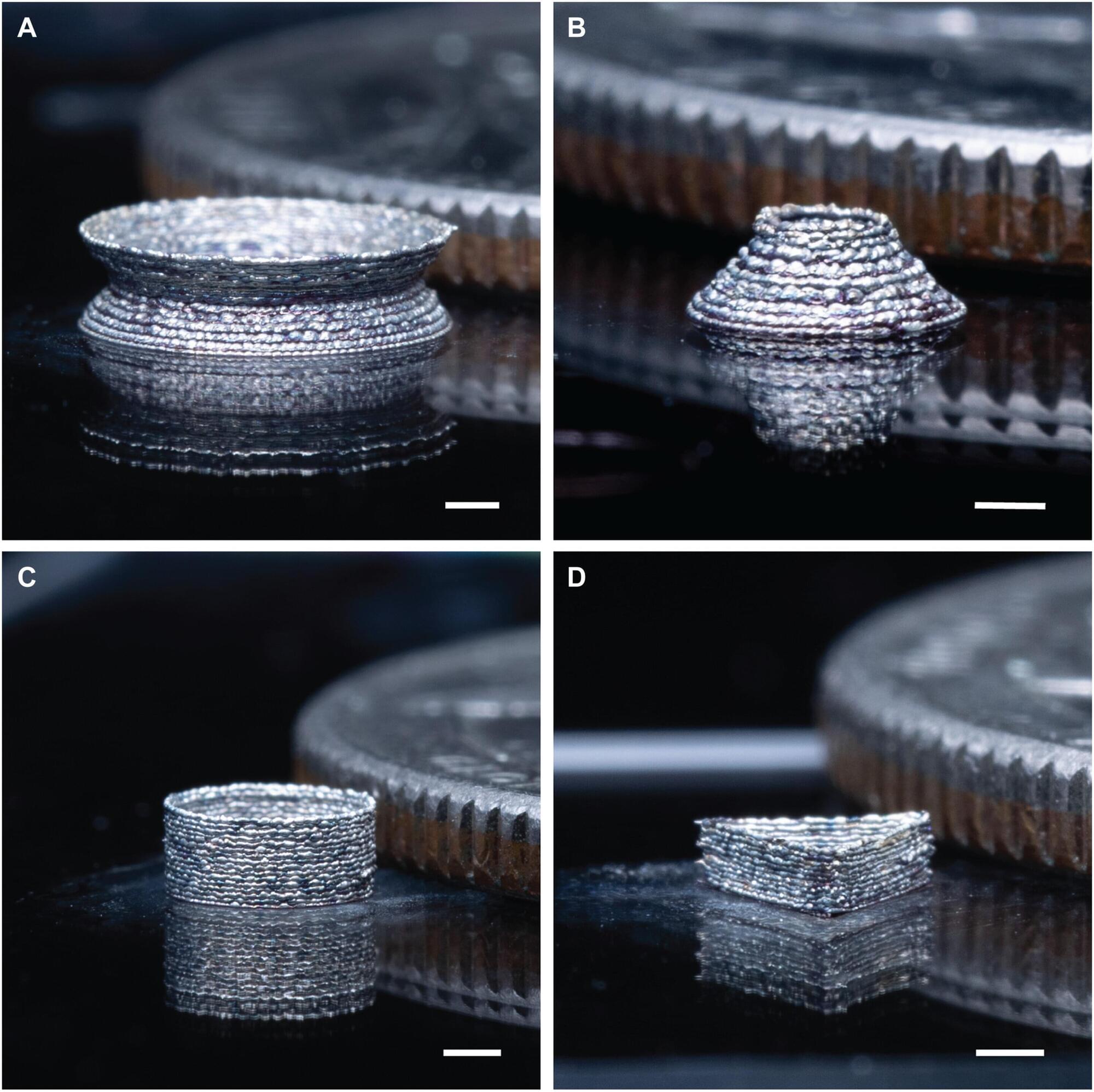
With shape memory polymers, hydrogels, and alloys, 4D printing is turning prototypes into programmable, industry-ready components.
Category: materials – Page 27
AI system learns from many types of scientific information and runs experiments to discover new materials
Materials science experiments can also face reproducibility challenges. To address the problem, CRESt monitors its experiments with cameras, looking for potential problems and suggesting solutions via text and voice to human researchers.
The researchers used CRESt to develop an electrode material for an advanced type of high-density fuel cell known as a direct formate fuel cell. After exploring more than 900 chemistries over three months, CRESt discovered a catalyst material made from eight elements that achieved a 9.3-fold improvement in power density per dollar over pure palladium, an expensive precious metal. In further tests, CRESTs material was used to deliver a record power density to a working direct formate fuel cell even though the cell contained just one-fourth of the precious metals of previous devices.
The results show the potential for CRESt to find solutions to real-world energy problems that have plagued the materials science and engineering community for decades.
Broadband photodetector material senses visible light to long-wave infrared, simplifying device design
A research team in South Korea has developed a next-generation sensor material capable of integrating the detection of multiple light wavelengths.
A joint research team led by Dr. Wooseok Song at the Korea Research Institute of Chemical Technology (KRICT) and Professor Dae Ho Yoon at Sungkyunkwan University successfully developed a new broadband photodetector material that can sense a wider range of wavelengths compared to existing commercial materials, and achieved cost-effective synthesis on a 6-inch wafer-scale substrate.
This research is published in ACS Nano.
Doping triggers tunable charge density wave in 2D antiferromagnetic semiconductor
Researchers at the National University of Singapore (NUS) have observed a doping-tunable charge density wave (CDW) in a single-layer semiconductor, Chromium(III) selenide (Cr2Se3), extending the CDW phenomenon from metals to doped semiconductors.
CDWs are intriguing electronic patterns widely observed in metallic two-dimensional (2D) transition metal chalcogenides (TMCs). The study of CDW provides insights into emergent orders in quantum materials, where electron correlations play a non-negligible role. However, most reported TMCs exhibiting CDW are intrinsic metals, and tuning their carrier density is predominantly accomplished through intercalation or atomic substitution. These approaches may introduce impurities or defects that complicate the understanding of the underlying mechanisms.
A research team led by Professor Chen Wei from the Department of Physics and the Department of Chemistry at NUS, synthesized single-layer semiconducting Cr2Se3 and demonstrated the CDW phenomenon using scanning tunneling microscopy (STM).
Engineers develop a magnetic transistor for more energy-efficient electronics
Transistors, the building blocks of modern electronics, are typically made of silicon. Because it’s a semiconductor, this material can control the flow of electricity in a circuit. But silicon has fundamental physical limits that restrict how compact and energy-efficient a transistor can be.
MIT researchers have now replaced silicon with a magnetic semiconductor, creating a magnetic transistor that could enable smaller, faster, and more energy-efficient circuits. The material’s magnetism strongly influences its electronic behavior, leading to more efficient control of the flow of electricity.
The team used a novel magnetic material and an optimization process that reduces the material’s defects, which boosts the transistor’s performance.
MIT engineers develop a magnetic transistor for more energy-efficient electronics
Transistors, the building blocks of modern electronics, are typically made of silicon. Because it’s a semiconductor, this material can control the flow of electricity in a circuit. But silicon has fundamental physical limits that restrict how compact and energy-efficient a transistor can be.
MIT researchers have now replaced silicon with a magnetic semiconductor, creating a magnetic transistor that could enable smaller, faster, and more energy-efficient circuits. The material’s magnetism strongly influences its electronic behavior, leading to more efficient control of the flow of electricity.
The team used a novel magnetic material and an optimization process that reduces the material’s defects, which boosts the transistor’s performance.
Rare-earth tritellurides reveal a hidden ferroaxial order of electronic origin
The discovery of “hidden orders,” organization patterns in materials that cannot be detected using conventional measurement tools, can yield valuable insight, which can in turn support the design of new materials with advantageous properties and characteristics. The hidden orders that condensed matter physicists hope to uncover lie within so-called charge density waves (CDWs).
CDWs are periodic wave-like modulations of the electronic charge inside a crystal. CDWs in rare-earth tellurides, compounds containing tellurium and other rare-earth elements, have been found to sometimes give rise to unusual physical phenomena that are not observed in the absence of these wave-like states of matter.
Researchers at Boston College, Cornell University and other institutes recently observed a ferroaxial order in rare-earth tellurides that appears to originate from a combination of coupled orbital and charge patterns.
Rice researchers create novel metamaterial that can potentially revolutionize implantable, ingestible devices
Researchers led by Rice’s Yong Lin Kong have developed a soft but strong metamaterial that can be controlled remotely to rapidly transform its size and shape.
Researchers develop colorized X-ray imaging for clearer material and tissue analysis
When German physicist Wilhelm Röntgen discovered X-rays in the late 1800s while experimenting with cathode ray tubes, it was a breakthrough that transformed science and medicine. So much so that the basic concept remains in use today. But a team of researchers at Sandia National Laboratories believes they’ve found a better way, harnessing different metals and the colors of light they emit.
“It’s called colorized hyperspectral X-ray imaging with multi-metal targets, or CHXI MMT for short,” said project lead Edward Jimenez, an optical engineer. Jimenez has been working with materials scientist Noelle Collins and electronics engineer Courtney Sovinec to create X-rays of the future.
“With this new technology, we are essentially going from the old way, which is black and white, to a whole new colored world where we can better identify materials and defects of interest,” Collins said.